Saint Eliphius (Élophe in French, sometimes spelled Éloffe or Éliphe) is a martyr of Lorraine whom tradition says was beheaded on the banks of the Vair, near present-day Soulosse in the Vosges, under the emperor Julian, around 362. Regarded as the first martyr of Lorraine, he is nicknamed the "Saint Denis of Lorraine". A large part of his relics was taken to Cologne in the 10th century. His feast day is October 16.
Who was Saint Eliphius?
Eliphius is a very ancient saint whose real history almost entirely escapes us. His cult has long been attested in the south of the former diocese of Toul, around Soulosse and Neufchâteau. Yet he appears clearly in the documents only in the 10th century, when the bishop of Toul offered his relics to the archbishop of Cologne. His passion, that is, the account of his martyrdom, was written later still, in the 11th century, then expanded by Rupert of Deutz around 1130. Historians see it above all as an account meant to edify. The Roman Martyrology mentions him on October 16, presenting him as a victim of Julian.

The account of his passion
According to the anonymous 11th-century author, the emperor Julian, who had returned to the worship of the gods, came to Gaul to restore the idols. In the land of the Leuci, he learned of a well-known Christian family: Eliphius, his elder brother Eucharius and their sisters. Julian had thirty-three Christians arrested, among them Eliphius, and they were miraculously set free. Eliphius then went to Toul to be with his dying mother, converted many people there, and returned to preach at Grand, the ancient Grannum, a great pagan sanctuary of the region.
Denounced, he was arrested on the banks of the Vair and ordered to sacrifice to the idols. He refused and was condemned to be beheaded. The legend adds that he picked up his head, washed it at a spring and carried it to the top of the hill that now bears his name, where he was buried. This feature, called cephalophory, is found with other saints of the region, such as Saint Libaria, and with Saint Denis of Paris.
What can be said of it
Historians remain cautious. Julian's visit to the Vosges is very probably legendary, and the persecutions hardly touched the Christian communities of this region. If Eliphius did die a violent death at an early date, he may have been a victim of the unrest and invasions that struck northern Gaul. The Benedictines of Paris, in their Lives of the Saints, honestly conclude that we will never know the truth. The account also gathered into a single family several saints honored around Neufchâteau: Eucharius at Liverdun, Libaria at Grand, Menna at Poussay. No one knows how this cycle of legends took shape. What remains is the memory of a witness to Christ, venerated without interruption on his hill for more than a thousand years.
Devotion and art
Around 964, Saint Gerard of Toul entrusted the greater part of the relics of Eliphius to Saint Bruno of Cologne. They were placed in the church of Saint Martin in that city, where a cult grew up; this is probably the origin of the Martyrology's statement that places his martyrdom in Cologne. Scholars disagree about how the relics were divided: for some, almost the whole body went to the Rhineland, for others, only the head was taken there.
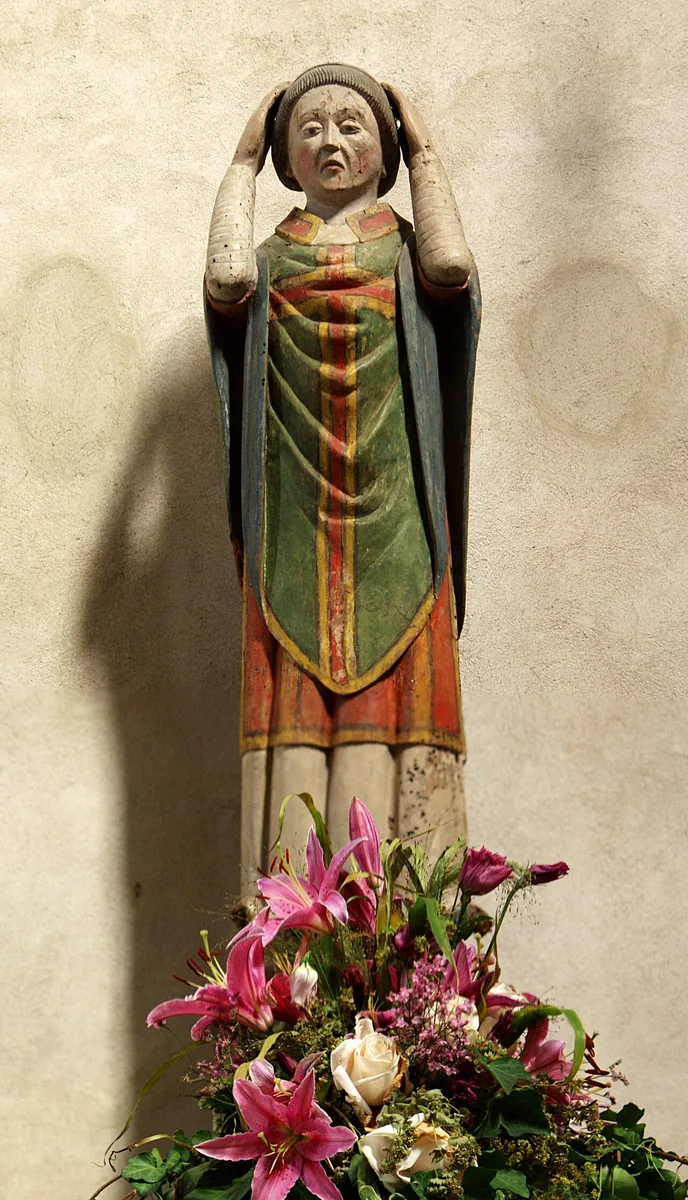
In the village of Saint-Élophe, the pilgrimage was still very popular in the 19th century. People came to ask for healing from fever, gout and kidney stones. Several churches are dedicated to him in the former dioceses of Toul and Trier, but also further away: at Rampillon, in Seine-et-Marne, the 13th-century church shows him as a young deacon on the central pillar of the doorway; in Eure-et-Loir, the village of Saint-Éliph bears his name. He is shown as a deacon, often carrying his head in his hands.

What can we learn from Saint Eliphius?
Even if his story is wrapped in legend, Saint Eliphius reminds us that the faith came to Lorraine carried by witnesses ready to give everything. His figure as a deacon is that of a servant of the Word, who proclaims Christ to the end. The head carried in his hands says, in the language of medieval images, that death did not have the last word. You can pray to him for faithfulness in trials, for the sick and for the Church in Lorraine.
Where to pray to Saint Eliphius
- Church of Saint-Élophe, at Soulosse-sous-Saint-Élophe (Vosges): on the hill where tradition places his burial, with an ancient sarcophagus held to be his tomb.
- Church of Saint Martin in Cologne (Germany): the church where his relics were placed in the 10th century.
- Church of Saint-Éliphe at Rampillon (Seine-et-Marne): a 13th-century church dedicated to him.
- Saint-Éliph (Eure-et-Loir): the village that bears his name, with a statue of the saint.
Discover also
- Saint Gerard of Toul, the bishop who entrusted his relics to Cologne.
- Saint Mansuetus of Toul, first bishop of Toul, another great figure of the Christian beginnings of Lorraine.
- Saint Memmius, first bishop of Châlons, linked by legend to his sister Susanna.