Saint Memmius, called Memmie or Menge in French, is honored as the first bishop of Châlons and the first evangelizer of the Châlons area of Champagne, in the 3rd century. He died around 300 and rests in the church of the town that bears his name, Saint-Memmie, on the edge of Châlons-en-Champagne. His feast day is August 5.
Who was Saint Memmius?
Like many founders of Churches in Gaul, Memmius is known to us mainly through tradition, handed down and embellished over the centuries. He is venerated as the one who brought the Gospel to Châlons and organized the first Christian community of the city. Two traditions disagree about his time: one, legendary, makes him a Roman citizen sent to Gaul by Saint Peter himself; the other, reported in the 10th century by the historian Flodoard, says he was a contemporary of Saint Sixtus, first bishop of Reims, which places him in the 3rd century. Historians accept this second dating. The details of his life, however, remain very uncertain.
The first bishop of Châlons
Châlons, the ancient Durocatalaunum, was then a town of Roman Gaul, on the Marne. According to tradition, Memmius arrived there as a missionary and preached Christ to a population that was still pagan. He gathered the first Christians, baptized them and formed them. He thus became the first shepherd, the "episkopos," of the community, and the Church of Châlons places him at the head of its list of bishops.
The legend linking him directly to Saint Peter belongs to a widespread medieval trend: many Churches in Gaul wanted to trace their foundation back to the apostles, to stress their faithfulness to Rome. Flodoard's testimony, which makes him a contemporary of Saint Sixtus of Reims, is more likely. It places Memmius within the movement that evangelized the towns of northern Gaul in the 3rd century.
The wonderworker of the Nau
Tradition credits Memmius with miracles that struck the people. The most famous tells that the son of the Roman governor of the region drowned in the Nau, a small river of Châlons. Memmius is said to have prayed for him and given him back alive to his parents. This account, which cannot be verified, expresses the conviction of the faithful: with the Gospel, the bishop brought the life-giving power of the risen Christ, stronger than death.
His sister, Poma, is also venerated as a saint. Her relics are kept in the same church as the tomb of Memmius.
Devotion and art
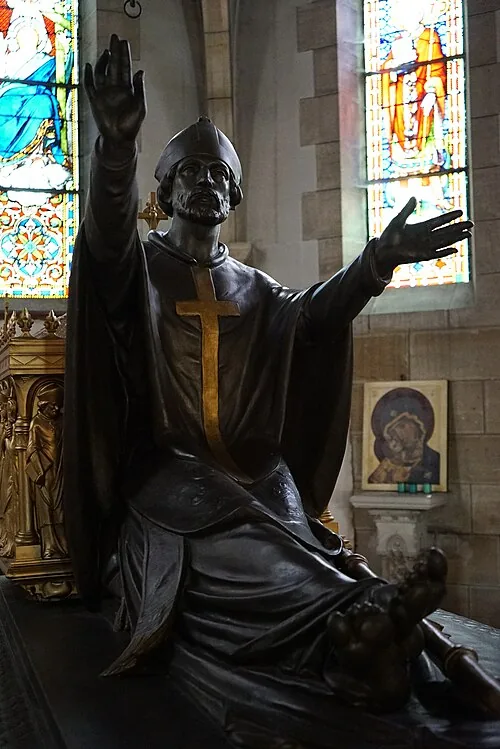
Memmius died around 300. He is celebrated on August 5 and honored as patron of the diocese of Châlons. His tomb is in the church of Saint-Memmie, in the town of the same name, on the edge of Châlons-en-Champagne. There you can see a 12th-century tombstone depicting him, topped by a recumbent effigy, as well as reliquaries of Saint Poma and of two of his successors, Donatian and Domitian.
His cult spread well beyond Châlons: many churches are dedicated to him in the Marne (Baconnes, Bergères-lès-Vertus, Corfélix, Courtisols, Villeneuve), but also in the Aube, the Meuse, the Vosges, where a village is called Saint-Menge, and the Yonne. He is shown as a bishop, with mitre and crozier, as in a stained-glass window of the church of Sarry.

What can we learn from Saint Memmius?
Memmius is a founder. What we know of him is little, but the essential remains: a man brought the Gospel to a town that did not know it, and a Church was born from his word. Sixteen centuries later, the diocese of Châlons remembers him as its father in faith. You can pray to him for the diocese of Châlons and for Champagne, for families mourning a child, and for those who proclaim Christ where he is still unknown.
To pray with him, see the prayer to Saint Memmius and the novena to Saint Memmius.
Where to pray to Saint Memmius
- Church of Saint-Memmie, Saint-Memmie (Marne): his tomb, with the recumbent effigy and the 12th-century tombstone.
- The churches of Saint-Memmie in the Marne: Baconnes, Bergères-lès-Vertus, Corfélix, Courtisols, Villeneuve.
- Saint-Menge (Vosges) and Merry-Sec (Yonne): places that bear his name or are dedicated to him.
Discover also
- Saint Sixtus of Reims, first bishop of Reims, whose contemporary Flodoard says he was.
- Saint Alpinus of Châlons, another great bishop of Châlons, in the 5th century.
- Saint Peter, the apostle who, according to legend, sent him to Gaul.