Saint Efflam (Efflamm in Old Breton) is a Breton saint of the early Middle Ages who, according to tradition, came from Ireland and lived as a hermit on the coast of the Trégor, near Plestin-les-Grèves, in the Côtes-d'Armor. An Irish prince married to Saint Enora, he is said to have chosen with her to consecrate his life to God. His Life, written several centuries after him, is largely legendary. His feast day is November 6.
Who was Saint Efflam?
Efflam belongs to the great family of the founding saints of Brittany, the monks and hermits who came from Britain or Ireland between the 5th and 7th centuries. Historians describe him as semi-legendary. Even the dates differ: depending on the author, he is placed in the 5th, 6th or 7th century. His Latin Life was written at the end of the 11th or the beginning of the 12th century, among the clergy of Tréguier, who also wished to highlight the origins of their Church. It therefore mixes the memory of a real hermit, whose cult has been rooted in Plestin for centuries, with wondrous tales, such as his meeting with King Arthur.

The prince who chose God
According to the Life, Efflam was the son of a king of Ireland. He was married very young to Enora, daughter of another ruler. But the young man had already promised his life to God. With his wife's consent, he made a vow of chastity and, supported by an angel, fled so as not to give in to the pressure of those around him. Like many monks of his time, he took to the sea and reached Armorica.
He is said to have landed on the long beach called the Lieue de Grève, between Plestin and Saint-Michel-en-Grève, facing a great rock. Another tradition has him landing with Enora at the port of Le Yaudet, near Lannion, in a boat of hides stretched over wooden laths. He is said to have first lived for a while with Saint Gestin, then built a hermitage in the forest that then lined the coast. Popular tradition gives him several companions, Kirio, Tuder, Kemo, Haran or Nerin, whose names are found in the place names of the area; it was a hymn composed in 1897 by the parish priest of Plestin that fixed this list.
Efflam, Arthur and the dragon
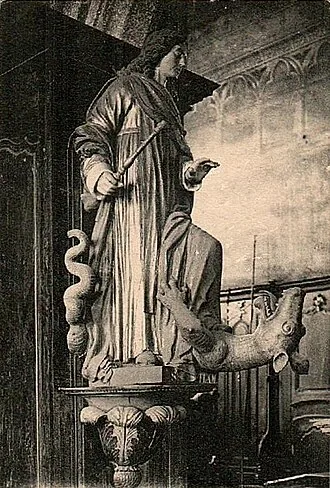
The most famous story in his Life brings him together with King Arthur. Arthur was pursuing a dragon that terrorized the country. Exhausted by thirst, he met Efflam, who made a spring gush out for him, the one still shown at Saint-Efflam. Then the hermit prayed before the monster's cave, and the dragon went and threw itself into the sea. Albert Le Grand, in the 17th century, adds that the dragon demanded a human victim every year.
This story is not historical. It expresses, in the language of images, the victory of Christ over the forces of evil and over paganism. Some have also seen in it the memory of frequent drownings in the bay, where the tide comes in very fast: until the 19th century, crossing the beach on a rising tide was dangerous.
Enora, the consecrated wife
Enora could not resign herself to living far from her husband. She joined him in Armorica, but not to resume married life: Efflam had an oratory built for her some distance from his own, and each lived in prayer. The legend adds that they died at the same moment. This story, rare in Breton hagiography, makes Efflam and Enora a couple united by the same consecration to God.
Devotion and art
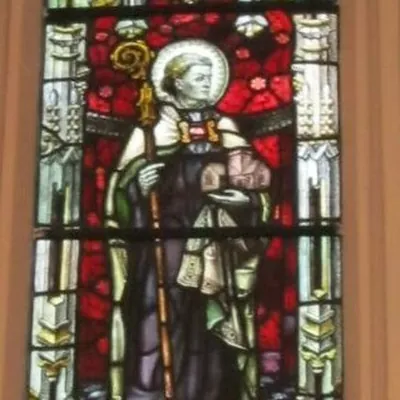
Saint Efflam is the patron of Plestin-les-Grèves. The parish church dedicated to him keeps a 15th or 16th-century tomb on which he is shown lying. It was there that bones recognized as his relics were found in 1819. By the beach, the hamlet of Saint-Efflam has a chapel and a spring that bear his name. He is also honored at Kervignac, Pédernec, Morlaix and Langoëlan, where an oratory was blessed in 2016, and by many statues in the Trégor, one of which, at Trébeurden, shows him in rich costume.
Popular devotion calls on him for the healing of burns, inflammations, abscesses and boils, and of dislocated limbs. At Kervignac, people leave nails at the foot of his statue; at Langoëlan, he is invoked against fire, lightning and sudden death.
What can we learn from Saint Efflam?
Behind the wonders, tradition keeps the portrait of a man who left everything, rank, country and human plans, to follow Christ. His story with Enora reminds us that human love and God's call are not opposed: they can meet in the same gift of self. You can pray to him for married couples, for those discerning their vocation and for those who suffer from burns or inflammations.
To pray with him, see the prayer to Saint Efflam and the novena to Saint Efflam.
Where to pray to Saint Efflam
- Plestin-les-Grèves (Côtes-d'Armor): the church of Saint-Efflam, with his tomb, and, by the beach, the chapel and spring of Saint-Efflam.
- Kervignac (Morbihan): the chapel of Saint-Efflam, where nails are left at the foot of his statue.
- Pédernec (Côtes-d'Armor) and Morlaix (Finistère): old chapels dedicated to him.
- Langoëlan (Morbihan): the oratory blessed in 2016 on the site of his former chapel.
Discover also
- Saint Tugdual, founder of Tréguier, whose Church set down the Life of Efflam in writing.
- Saint Winwaloe, another great saint of early Brittany.
- Saint Samson of Dol, a monk from across the Channel who founded in Armorica.
- Saint Patrick, the apostle of Ireland, Efflam's homeland according to tradition.