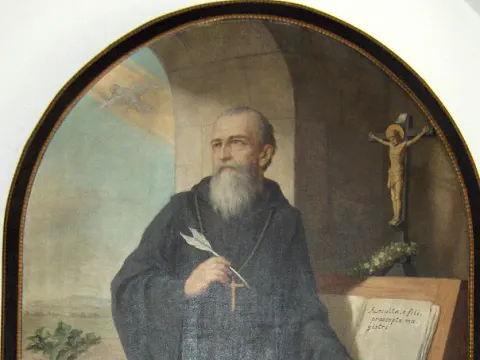
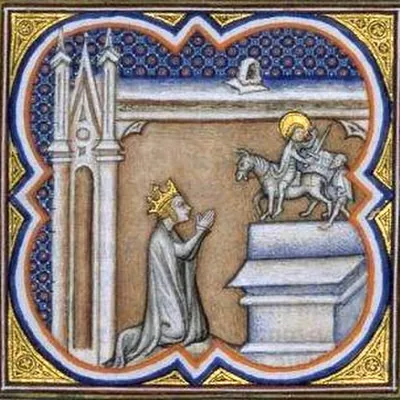
Saint Iestyn (Gestin in French, Jestin or Istan in Breton) was a Welsh saint of the 6th century, honored in Brittany and in Wales. Breton tradition makes him a companion of Saint Efflam and the founder of a hermitage on the coast of Trégor, at the place that now bears his name: Plestin-les-Grèves, "the parish of Iestyn." His life belongs almost entirely to legend, but his local cult is old and still alive. His feast day is April 19.
Who was Saint Iestyn?
The name Iestyn comes from the Latin Justinus, Justin. It is found in several forms: Yestin, Iestyn in Wales, Jestin or Istan in Brittany. Like many Breton saints of the early period, Iestyn is known through late traditions, handed down in parishes and collected in the 19th century. They connect the saints to great families and distant journeys, following the habits of medieval hagiography. We must therefore distinguish what is really known, that is, the existence of an old cult attested by place names, churches and statues, from what legend tells.
A Breton historian, François Gourvil, thought it more likely that only the cult of this Welsh saint crossed the Channel, carried by the emigrants who came from Britain in the 6th and 7th centuries, rather than the saint himself.
The legend of Iestyn and Efflam
Tradition presents Iestyn as a Welsh prince, son of a King Geraint and descendant of Emperor Constantine, according to a genealogy meant above all to emphasize the saint's nobility. Having come to Armorica with Saint Efflam and Saint Enora, he is said to have settled by the sea, at the place called Les Grèves. There he built an oratory and a cell.
A popular account, recorded in the 19th century, tells the rest. Iestyn had to leave his hermitage for a journey to Rome. On his return, he found his cell occupied by Saint Efflam, who wanted to give it back to him. Iestyn refused, and the two hermits decided to live together. This little story, which is not historical, says something beautiful: two men of God preferred brotherhood to ownership. It is also found in the tradition of Efflam, who is said to have first lived for a time with Iestyn before building his own hermitage.
The cult at Plestin and elsewhere
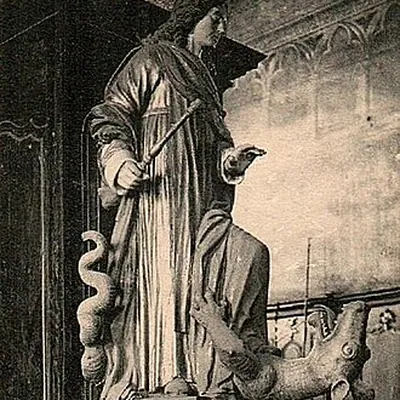
The very name of Plestin-les-Grèves, in Côtes-d'Armor, comes from Plou-Iestin, "the parish of Iestyn." Iestyn is the patron of the parish, while Saint Efflam is the titular saint of the church. A statue there shows him as a priest, wearing liturgical vestments. A pardon (a traditional Breton religious festival) is held every year on the fourth Sunday after Easter. Near the church, a fountain placed under his name was believed to cure fevers.
In the hamlet of Pen ar Ven, a chapel of Saint-Gestin, rebuilt in 1673, stood near a fountain; the whole, now in ruins, lies in an enclosure that, according to tradition, was his first hermitage. In Finistère, the church of Saint-Justin at Guiler-sur-Goyen, formerly called Saint-Gestin, houses a statue of "Saint Jestin." Finally, in Wales, his cult is attached to the old parish of Llaniestyn, where he is shown as a pilgrim carrying a walking staff.

What can we learn from Saint Iestyn?
We know few certain things about Saint Iestyn. But a parish has borne his name for centuries, and generations of Bretons have prayed to him. The legend that shows him sharing his hermitage with Efflam remains a simple lesson: to welcome the other rather than defend one's territory. You can pray to him for families who welcome others, for those who must share their space, for Brittany and Wales, and for the sick suffering from fever.
Where to pray to Saint Iestyn
- Plestin-les-Grèves (Côtes-d'Armor): the parish church, with his statue, and the fountain of Saint-Gestin; the pardon is held on the fourth Sunday after Easter.
- Pen ar Ven, at Plestin: the ruins of the chapel of Saint-Gestin and its fountain.
- Guiler-sur-Goyen (Finistère): the church of Saint-Justin, formerly Saint-Gestin.
- Llaniestyn (Wales): the parish that bears his name.
Discover also
- Saint Efflam, his companion according to tradition, patron of the church of Plestin.
- Saint Winwaloe, another great saint of the Breton beginnings.
- Saint Budoc, a master of monastic life in Brittany.