Saint Crescentinus, in Italian San Crescentino, was a martyr of the early fourth century, honored in Umbria and the Marche. According to his Passion, he was a Christian Roman soldier who left the army during the persecution of Diocletian, preached the Gospel in the upper Tiber valley and was beheaded at Tifernum, today's Città di Castello, around 303. Legend credits him with slaying a dragon. His feast day is June 1.
Who was Saint Crescentinus?
Crescentinus is first of all a name: that of a martyr whose cult has long been attested around Città di Castello. We know his life through a Passio written around the seventh century, partly legendary. It says he was born in Rome around 276, the son of a converted Roman nobleman named Eutimius, and that he served in the emperor's guard under the command of Saint Sebastian.
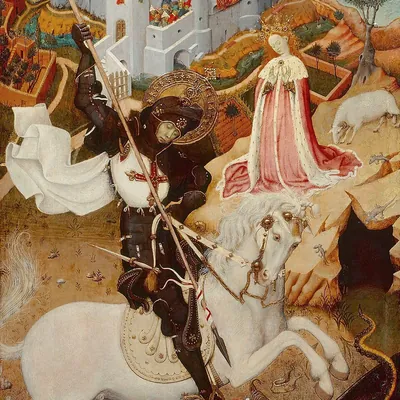
These details are hard to verify. What is certain is that the Church honors Crescentinus as a martyr who died for Christ in the upper Tiber valley, and that his cult spread as far as Urbino, which took him as its patron. Like Saint George, he is shown as a Christian soldier who defeats the dragon.

A Christian soldier facing persecution
At the end of the third century, the emperor Diocletian wanted to purge the army of Christians. Many soldiers had to choose between their faith and their career, and some, like Saint Maurice and his companions, paid with their lives. According to his Passion, Crescentinus chose to leave Rome. After his parents died, he gave his goods to the poor and set out on horseback with a few companions toward the Tiber valley.
When he reached Tifernum Tiberinum, a town that was still pagan, he began to preach the Gospel. The account credits him with many conversions and miracles. Hearing of his influence, the emperor ordered Flaccus, the prefect of Etruria, to bring him back to the army and to the gods of Rome, on pain of death. Crescentinus refused and went on with his mission.
The legend of the dragon
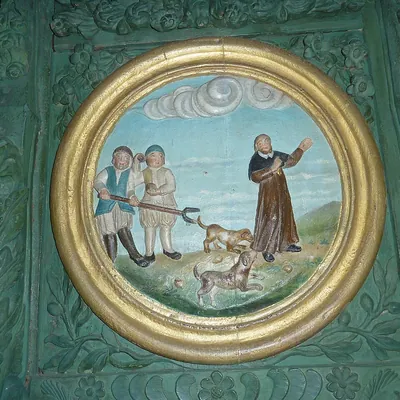
Popular tradition tells that a dragon lived near a sulfur spring at Pieve de' Saddi, in what is now the town of Pietralunga. Its foul breath brought disease and laid waste to the countryside. Crescentinus fought it and killed it, and the people welcomed him as their liberator and were converted. A rib said to be "the dragon's" is still shown in the diocesan museum of Città di Castello.
As with Saint George or Saint Michael, the dragon is first of all an image: the image of evil, fear and idolatry, which retreat before the Gospel. Crescentinus's fight tells, in the language of legend, what his mission was: to set a people free through faith in Christ.
His martyrdom
According to the Passion, Flaccus had Crescentinus taken to a temple of Jupiter and ordered him to worship the gods. He refused. Condemned to be burned, he came out of the fire unharmed, singing God's praises in the middle of the flames. The soldiers then dragged him through the streets, bound, with a rope around his neck, and cut off his head. Tradition places his death on June 1, 303.
Devotion and art
Crescentinus is honored by the Catholic Church with an immemorial cult, and he appears in the Roman Martyrology on June 1. In 1068, Bishop Mainard of Urbino had his relics moved to the cathedral of his city. Urbino still celebrates him every year: his statue is carried in procession, and an old custom has the faithful bring their heads close to the relics to be relieved of headaches. He is the patron saint of Urbino, of Città di Castello and of Crescentino, in Piedmont.
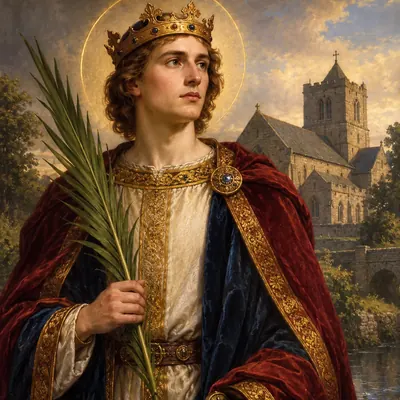
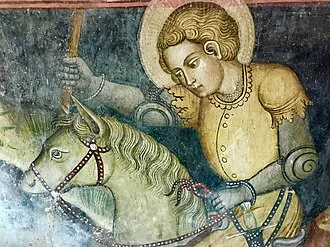
He is shown as a young soldier or a knight, often on horseback, piercing a dragon with his lance, with the palm of martyrdom or a banner.

What can we learn from Saint Crescentinus?
Behind the legend, Crescentinus is a witness to Christ who put his faith before his career, and then his faith before his life. He left his security behind, shared his goods and proclaimed the Gospel to a people who did not know it. You can pray to him for courage in times of trial, for Christians in the military, for those struggling against a fear or a temptation and, following the tradition of Urbino, for the sick who suffer from headaches.
Where to pray to Saint Crescentinus
- Urbino (Marche, Italy): the cathedral, which has kept his relics since 1068.
- Città di Castello (Umbria): the town of his martyrdom, of which he is patron, with its diocesan museum.
- Pieve de' Saddi (Pietralunga, Umbria): the church built on the site of his fight with the dragon.
- Morra (Città di Castello): the oratory of San Crescentino, dedicated in 1420.
To pray with him at home, you can use the prayer to Saint Crescentinus or the novena to Saint Crescentinus.
Discover also
- Saint Sebastian, the martyred officer under whom he is said to have served.
- Saint Maurice of Agaunum, another soldier martyred in the persecution of Diocletian.
- Saint Michael the Archangel, who defeats the dragon in the Book of Revelation.
- Saint Ubald of Gubbio, another great patron saint of Umbria.