Saint Wigstan, also known as Wystan or Wistan, was an Anglo-Saxon prince of Mercia and grandson of King Wiglaf, murdered in 849 for opposing a marriage he judged contrary to the law of the Church. Buried in the royal crypt at Repton, in Derbyshire, he was venerated as a martyr, and his relics were later moved to Evesham Abbey. His feast day is June 1.
Who was Saint Wigstan?
Wigstan belonged to the royal family of Mercia, the great kingdom of central England. His father, Wigmund, was the son of King Wiglaf; his mother, Ælfflæd, was the daughter of another Mercian king, Ceolwulf I. He may have reigned briefly, or been called to reign, after the death of his grandfather.
The historical sources about him are very slim: a mention in chronicles and a few lines in the annals of Evesham. The story of his life and death, the Passion of Saint Wigstan, was written at Evesham in the twelfth century, long after the events. We must therefore distinguish the historical core, a young prince killed in 849 and venerated at Repton, from the details handed down by tradition.

A prince who refused a marriage
According to the Evesham tradition, Wigstan, still young, left the government of the kingdom to others in order to give himself more fully to God. King Beorhtwulf came to the throne. His son, Beorhtfrith, wanted to marry Ælfflæd, Wigstan's widowed mother. The marriage would have strengthened Beorhtfrith's claim to the crown.
But Wigstan opposed it. According to his Passion, Beorhtfrith was bound to the family by a spiritual or blood relationship that made the union contrary to the rules of the Church. Wigstan put the law of God before political advantage, even though the marriage would have settled the question of the succession.
Murder at a meeting of peace
Beorhtfrith then asked for a meeting, on the pretext of making peace. During the encounter, he struck Wigstan on the head and killed him, together with those who were with him. According to tradition, this happened on June 1, 849.
Whether the motive was first religious or political, and it was surely both, Wigstan's death was seen as that of an innocent man killed for defending the law of God, and he was honored as a martyr.
The hair of the martyr
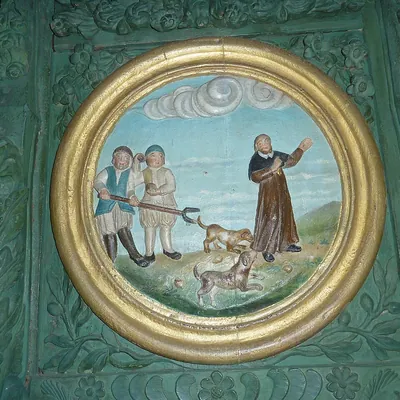
A striking legend grew up around the place of the murder, traditionally identified as Wistow, in Leicestershire, whose name is said to mean "Wigstan's place." People told how a column of light rose there for thirty days, and how every year, on the anniversary of his death, "hair" of the martyr sprang up from the ground where he fell. This story, handed down by the monks of Evesham, shows how alive his memory was in the region.
Repton and Evesham
Wigstan was buried at Repton, in Derbyshire, in the crypt that served as a mausoleum for the kings of Mercia, where his grandfather Wiglaf already lay. This crypt, one of the best-preserved Anglo-Saxon monuments in England, with its spiral columns, can still be visited beneath the parish church that bears his name. Pilgrims came to pray at his tomb.
In the eleventh century, under King Cnut, his relics were moved to the Benedictine abbey of Evesham, in Worcestershire, one of the great monasteries of medieval England. They were venerated there until Henry VIII's dissolution of the monasteries in the sixteenth century, which led to their loss. Of Evesham Abbey only a few remains survive today, including a fine bell tower from the early sixteenth century.
Why is Saint Wigstan honored as a martyr?
Wigstan did not die for refusing to deny Christ before a pagan judge. He died for refusing to approve a marriage he believed God's law forbade. The Church of his time recognized in this a true witness: a man who chose faithfulness to God over power and family advantage, and who paid for it with his life. He has no formal patronage, but his story makes him a fitting intercessor for young people facing hard choices, for the respect of marriage and family, and for victims of violence linked to power.
Symbols and how to recognize Saint Wigstan in art
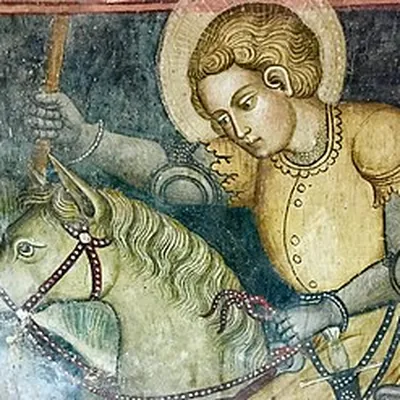
No well-established iconography of Saint Wigstan is known. His memory is carried above all by places: the Anglo-Saxon crypt of Repton, the church of Saint Wystan that stands above it, and the church of Saint Wistan at Wistow.
What can we learn from Saint Wigstan?
We know little about Wigstan, but the heart of his memory is clear: a powerful young man who preferred faithfulness to God's law over political arrangements, and who paid for it with his life. He joins the long line of Anglo-Saxon saints of royal blood who died violent deaths and were honored as martyrs, such as Saint Edmund or Saint Kenelm. We can pray to him for young people who must make difficult choices, for respect for marriage and the family, and for those who suffer violence linked to power.
To pray with him, see the prayer to Saint Wigstan and the novena to Saint Wigstan, from May 24 to his feast on June 1.
Where to pray to Saint Wigstan
- Repton (Derbyshire, England): Saint Wystan's Church and its Anglo-Saxon crypt, the place of his first burial.
- Wistow (Leicestershire, England): the church of Saint Wistan, on the site tradition links to his martyrdom.
- Evesham (Worcestershire, England): the remains of the abbey where his relics were venerated.
Discover also
- Saint Kenelm, another young prince of Mercia honored as a martyr.
- Saint Edmund the Martyr, king of East Anglia killed by the Vikings.
- Saint Ethelbert of East Anglia, a king murdered at the Mercian court.
- Saint Æthelred of Mercia, a king of Mercia who became a monk.