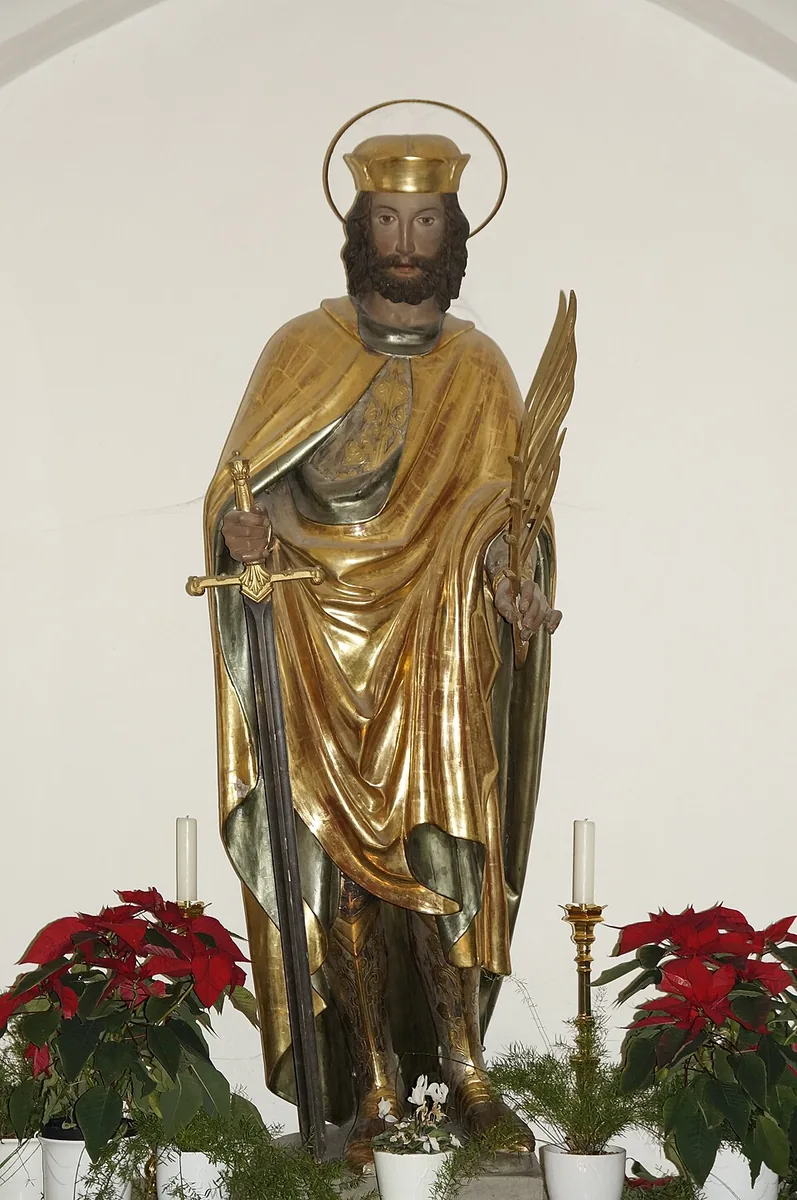
Saint Castulus (Kastulus in German) was a Roman martyr of the late third century, under the Emperor Diocletian. According to tradition, this officer of the imperial palace, husband of Saint Irene, hid persecuted Christians and led them to baptism before being buried alive. His relics, brought to Bavaria in the eighth century, made him a much-loved saint there, the patron of farmers and shepherds. His feast day is March 26.
Who was Saint Castulus?
The story of Castulus comes to us from the Passion of Saint Sebastian, an ancient but largely legendary text that brings together a whole group of Roman Christians around the famous martyr. His story must therefore be read with caution. What is certain is that his cult is old: a cemetery bearing his name existed on the Via Labicana in Rome, and his name appears in the Roman Martyrology.
According to this tradition, Castulus was an officer of the imperial household, perhaps a chamberlain or treasurer in the palace of Diocletian. His wife, Irene, is also honored as a saint: according to the same account, she is the one who nursed Saint Sebastian back to health after his first ordeal, when he had been shot with arrows and left for dead.
A protector of persecuted Christians
According to the Passion, Castulus was linked to Saint Sebastian, an officer like himself, whom he introduced at court. Having become a Christian, he used his position in the palace to help the faithful. He hid believers in his house, visited prisoners, in particular the martyrs Mark and Marcellian, and organized prayer meetings. With another Christian, Tiburtius, he led many men and women to the faith and presented them to Pope Caius for baptism.
The picture is that of a man who lived at the very heart of imperial power, in the household of the emperor who would launch the last great persecution, and who quietly turned that position into a shelter for those in danger.
The martyrdom
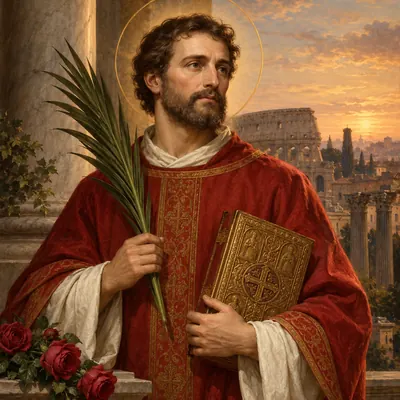
The group was betrayed by a false brother, Torquatus, who denounced the Christians to the prefect of the city. Castulus was arrested and tortured. According to tradition, he was thrown into a pit, which was then filled with sand and earth: he died buried alive. This is why he is often shown with a spade, alongside the palm of martyrdom.
A Bavarian saint
In the second half of the eighth century, probably between 764 and 772, two monks, Albin and Rhenobot, brought his relics from Rome to the Benedictine abbey of Moosburg, on the Isar River in Bavaria. They left a lasting mark on the history of the town and its monastery. In the early sixteenth century, the sculptor Hans Leinberger made for the collegiate church of Moosburg a great altarpiece with scenes from his life, one of the largest preserved in Bavaria. In 1598 the chapter was moved to Landshut, and the relics were placed in the Basilica of Saint Martin, where they still are.
Other relics have been venerated elsewhere: in Reichertshofen in Bavaria, in the Church of Saint Castulus (Saint Haštal) in Prague, and even in France, at Cassaniouze in the Cantal. Bavarians affectionately call him Sankt Kastl.
Why is Saint Castulus the patron saint of farmers and shepherds?
His patronages grew out of the popular devotion of rural Bavaria rather than from the details of his life in Rome. Once his relics arrived in Moosburg, in the heart of a farming region, the people of the countryside adopted him as their protector. For centuries they have invoked him as patron of farmers and shepherds, and as a protector against lightning, livestock diseases and horse thieves: all the dangers that threatened a farm and its animals.
His life also speaks to other situations. He can be invoked by Christians who hold responsibilities in hostile environments, and by those who hide or welcome people under threat.
Symbols and how to recognize Saint Castulus in art
Saint Castulus is often shown with a spade, recalling the pit in which he was buried alive, together with the palm of martyrdom. In Landshut, his statue stands beside that of Saint Martin, the patron of the basilica, on either side of the chapter's coat of arms. The engraver Jacques Callot depicted his martyrdom, showing him being thrown into the pit.
What can we learn from Saint Castulus?
Even though his life has reached us through legend, Castulus embodies a quiet courage: that of someone who, from inside the halls of power, protects those who are persecuted. You can pray to him for Christians with responsibilities in hostile settings, for farmers and herders, and for those who shelter people in danger.
His story also shows how the memory of a martyr can live on. Little is known for certain about his life, yet the prayer of generations, from the Via Labicana in Rome to the farms of Bavaria, has kept his name alive for more than seventeen centuries.
To pray with him, see the prayer to Saint Castulus and the novena to Saint Castulus.
Where to pray to Saint Castulus
- Landshut (Bavaria, Germany): the Basilica of Saint Martin, which keeps his relics.
- Moosburg an der Isar: the collegiate church of Saint Castulus and its great altarpiece by Hans Leinberger.
- Prague: the Church of Saint Haštal (Castulus), in the Old Town.
Discover also
- Saint Sebastian, his companion according to tradition.
- Saint Caius, the pope who baptized the converts.
- Saint Marcellinus, pope in the time of Diocletian.
- Saint Martin of Tours, patron of the basilica in Landshut.
- Saint Isidore the Farmer, another patron of farmers.