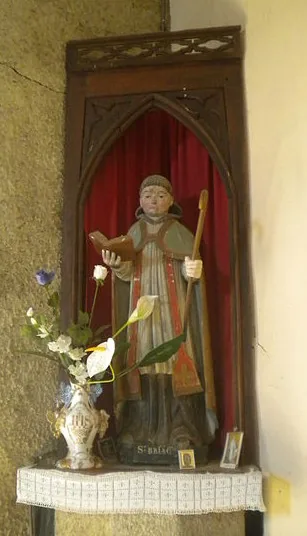
Saint Briac (Briag in Breton) is a monk honored in Brittany as one of the companions of Saint Tugdual. According to tradition, he came from Ireland, founded the monastery from which the town of Bourbriac, in the Côtes-d'Armor, grew, and died there around 627. His tomb is venerated in the church of Bourbriac, and the town of Saint-Briac-sur-Mer bears his name. His feast day is December 17.
Who was Saint Briac?
Briac is one of those Breton saints whose name has marked the landscape and the parishes far more than the archives. His whole story rests on an account published in 1636 by the Dominican Albert Le Grand in his Lives of the Saints of Armorican Brittany, who claimed to rely on older manuscripts now lost. No early text allows us to check this Life, and present-day historians question it: his cult is not attested before the 11th century, and his name seems Breton rather than Irish. Some scholars think he may have been a monk from eastern Brittany sent to the west in the 10th century, after the Viking raids. His story must therefore be read with caution. What remains is a saint deeply rooted in Breton piety, invoked for centuries.

A companion of Saint Tugdual
According to the traditional account, Briac was born in Ireland into a noble family. After his studies, he left his country to join the monastery led by Tugdual in Wales, whom the Bretons also call Pabu, meaning "the father." When Tugdual decided to cross the sea to proclaim the Gospel in Armorica, Briac went with him along with many monks; tradition speaks of about seventy companions. They landed in the Léon region and first settled in the monastery founded by Tugdual, before spreading out along the north coast of Brittany.
The founder of Bourbriac
Briac in turn founded a monastery, inland, in the Guingamp area. The very name of Bourbriac is said to keep his memory. Tradition also credits him with an oratory built on the coast, at the place that would become the parish of Saint-Briac, near Dinard. The accounts describe him as a man drawn to contemplation: he liked to withdraw into solitude, before returning, old and ill, to end his days among his monks.
He is credited with a spring whose water was believed to heal, and he has long been invoked for the healing of mental illness, like other Breton saints. These traditions show the trust the faithful placed in him.
Devotion and art
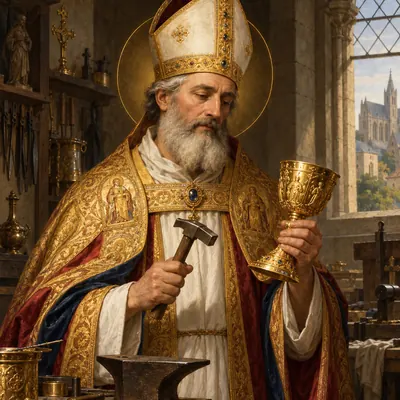
Saint Briac is celebrated on December 17. His tomb is in the church of Bourbriac, which is dedicated to him: a recumbent effigy represents him, and the whole is protected as a historic monument. The present parish is named Bourbriac and Saint-Briac. Statues and stained-glass windows recall his life in several churches of the Côtes-d'Armor, as at Lanleff. He is shown as a monk or abbot, sometimes with a crozier.

What can we learn from Saint Briac?
Even though his story remains little known, Briac recalls the work of the monks who gave birth to the Breton parishes: men who left everything to follow a master, who prayed, cleared the land and welcomed others. You can pray to him for those who suffer in mind, for religious communities, for Brittany and for all who faithfully follow a spiritual guide.
To pray with him, see the prayer to Saint Briac and the novena to Saint Briac.
Where to pray to Saint Briac
- Bourbriac (Côtes-d'Armor): the church that houses his tomb and effigy.
- Saint-Briac-sur-Mer (Ille-et-Vilaine): the town that bears his name, where tradition places his oratory.
- Lanleff (Côtes-d'Armor): the church where a statue of the saint is found.
Discover also
- Saint Tugdual, the abbot he followed from Wales to Brittany according to tradition.
- Saint Brioc, another founding monk from across the Channel.
- Saint Patrick, the apostle of Ireland, the homeland tradition gives him.