Saint Brioc, known in French as Saint Brieuc, was a monk who came from Britain in the fifth or sixth century. He is honored as the founder of the Breton town that bears his name, Saint-Brieuc, and as its first bishop. He is one of the seven founding saints of Brittany, whose cathedrals mark out the Tro Breizh pilgrimage. His life is known through a late account, written around the eleventh century, in which legend plays a large part. His feast day is May 1.
Who was Saint Brioc?
Brioc belongs to the great movement of British monks, from Wales and Cornwall, who evangelized Armorica (today's Brittany) between the fifth and seventh centuries. His Celtic name is thought to come from Briomaglos, "prince of strength." He left his mark on many places on both sides of the Channel: Saint-Brieuc, Briec, Saint-Brieuc-des-Iffs and Saint-Brieuc-de-Mauron in Brittany; St Breock in Cornwall; Llandyfriog in Wales.
History and legend must be distinguished, however. The Life of Saint Brioc (Vita Briocii) was written around 1050, probably at the abbey of Saint-Serge in Angers, where his relics had been taken in the ninth century. Most historians give it little historical value: it mixes real memories with borrowings from the Bible, from other saints' lives and from literary motifs. What can be held with caution is the existence of a monk from Britain who founded a monastery on the north coast of Brittany, around which a town grew.
A monk from Britain
According to the Vita, Brioc was born to pagan parents, Cerpus and Eldruda. An angel is said to have announced his birth to his mother and asked her to convert. Entrusted very young to monks, the boy was then sent to Gaul to Saint Germanus. The story tells of his first miracle: sent to fetch water, he gave his pitcher to lepers; scolded on his return, he received from God a bronze vessel to replace the one he had given away. Historians point out that the author probably confused Germanus of Auxerre with Germanus of Paris, who died at the end of the sixth century.
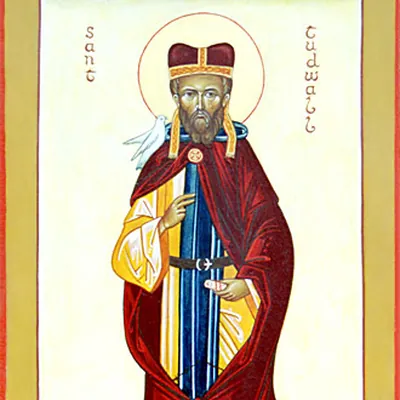
Once a priest, Brioc evangelized Cornwall, where his memory is kept at St Breock. Then he crossed the sea with his disciples. He first founded a monastery in the Trégor, which, according to the Vita, he entrusted to his nephew Saint Tugdual. This detail mainly serves to assert Brioc's precedence over Tugdual, at a time when neighboring monasteries and dioceses were rivals.
The founding of Saint-Brieuc
The story then shows him landing at the mouth of the Gouët. He converted his kinsman Riwal, the Breton chief of the region, who gave him land. Brioc set up a monastery there, at the place called the Champ-du-Rouvre, around which the town would grow. Modern research suggests that the historical foundation may be later, in the course of the sixth century. Saint-Brieuc only became the seat of a diocese in the ninth century, under the Breton king Nominoë; the title of first bishop given to Brioc therefore belongs to tradition more than to history.
According to legend, at his death his monks saw his soul rise to heaven in the form of a turtledove.

Relics and devotion
In the ninth century, at the time of the Norman raids, Brioc's relics were carried to the abbey of Saint-Serge in Angers. A solemn translation took place there in 1166. Part of the relics was later returned to Saint-Brieuc, at the beginning of the thirteenth century according to local tradition, and they are honored in Saint-Étienne Cathedral.
Why is Saint Brioc the patron saint of purse makers?
Saint Brioc was invoked against public calamities. He was also the patron of makers of purses and alms bags, perhaps because this trade flourished in his town, and because his Vita stresses his charity. Today he is above all the patron of the Diocese of Saint-Brieuc and Tréguier.
With Saint Paul Aurelian, Saint Tugdual, Saint Malo, Saint Samson, Saint Patern and Saint Corentin, Brioc is one of the seven founding saints of Brittany. Since the Middle Ages, the Tro Breizh, the "tour of Brittany," has linked the seven episcopal towns that keep their memory. Pilgrims still walk these roads today, and Saint-Brieuc is one of the stages.
Even though his biography remains uncertain, Saint Brioc bears witness to the monks from across the Channel who shaped Christian Brittany, and he is a link between Wales, Cornwall and Brittany. His legend highlights charity, peace and the courage to set out. Catholics pray to him for Brittany, for those who travel by sea, for the pilgrims of the Tro Breizh, and to learn to give, like the boy who offered his pitcher to the lepers. To pray with him, see the prayer to Saint Brioc and the novena to Saint Brioc.
Symbols and how to recognize Saint Brioc in art
He is shown as a bishop, with miter and crozier, sometimes with three purses at his belt, recalling his patronage of purse makers and his charity. He may also appear with wolves: the legend tells that a threatening pack dispersed peacefully when he raised his hand.

Where to pray to Saint Brioc
- Saint-Brieuc (Côtes-d'Armor, France): Saint-Étienne Cathedral, where his relics are kept.
- Saint-Brieuc: the Saint-Brieuc fountain, near the chapel of Notre-Dame-de-la-Fontaine, associated by tradition with his arrival.
- Erdeven (Morbihan): the chapel of the Seven Saints, which has a statue of Saint Brioc.
- Saint-Brieuc-des-Iffs (Ille-et-Vilaine): the church dedicated to him.
- St Breock (Cornwall, England): the parish church that keeps his name.
Discover also
- Saint Tugdual of Tréguier, presented by tradition as his nephew.
- Saint Samson of Dol, another founding saint of Brittany.
- Saint Corentin of Quimper, founder of the Church of Cornouaille.
- Saint Germanus of Auxerre, his teacher according to the Vita.
- Saint Ivo of Kermartin, great saint of the same Diocese of Saint-Brieuc and Tréguier.