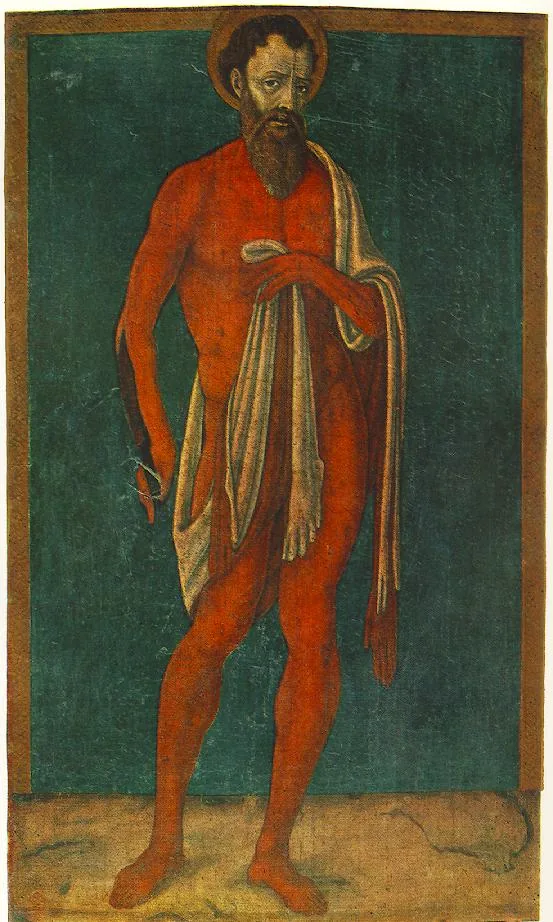
Saint Bartholomew is one of the twelve apostles chosen by Jesus. The Gospels say almost nothing about him, but an ancient tradition identifies him with Nathanael, the disciple from Cana whom Jesus greeted as "a true Israelite, in whom there is no guile." According to tradition, he preached the Gospel as far as India and Armenia, where he died a martyr, flayed alive. The Latin Church celebrates his feast on August 24.
Who was Saint Bartholomew?
The name Bartholomew appears in all four lists of the Twelve, in the Gospels of Matthew, Mark and Luke and in the Acts of the Apostles. It is an Aramaic family name, Bar-Talmai, meaning "son of Talmai." In the first three Gospels, he is always named right after Philip.
The Gospel of John, for its part, never mentions Bartholomew, but tells the story of the call of Nathanael, who was brought to Jesus precisely by Philip. Since the Middle Ages, many writers have concluded that they are the same person, Nathanael being his given name and Bartholomew the name of his father. This identification is not certain, but it is widely accepted in the liturgy and in preaching.
Nathanael under the fig tree
The first chapter of the Gospel of John tells a vivid scene. Philip, who has just met Jesus, runs to find his friend Nathanael: "We have found the one about whom Moses wrote in the Law, and also the prophets: Jesus, son of Joseph, from Nazareth." Nathanael answers with skepticism: "Can anything good come from Nazareth?" Philip does not argue; he simply says: "Come and see."
When Jesus sees him coming, he says of him: "Here is truly an Israelite in whom there is no guile." Surprised, Nathanael asks how he knows him. Jesus answers that he saw him under the fig tree, even before Philip called him. Deeply moved, Nathanael makes one of the first professions of faith in the Gospel: "Rabbi, you are the Son of God, you are the King of Israel." Jesus promises him that he will see "heaven opened."
At the end of the Gospel, Nathanael is named again among the disciples to whom the risen Lord appears by the Sea of Tiberias.

A mission to the far East
After Pentecost, the New Testament says nothing more about Bartholomew, and ancient traditions take over. In the 4th century, the historian Eusebius of Caesarea reports that the Christian philosopher Pantaenus, who traveled to India at the end of the 2nd century, found Christians there who had the Gospel of Matthew in Hebrew, left with them by the apostle Bartholomew. Other accounts have him preaching in Mesopotamia, Persia and above all Armenia.
The Armenian Apostolic Church venerates him, together with Saint Thaddeus, as one of its two founding apostles. The "Acts" and "Passions" devoted to Bartholomew, written several centuries after his death, belong more to legend than to history: they tell of royal conversions, battles against idols and miracles. Above all, they bear witness to the veneration that surrounded him throughout the Christian East.
The martyrdom of the apostle
According to the most widespread tradition, Bartholomew died in Armenia, at Albanopolis, on the orders of a king angered by the conversion of his brother. He is said to have been flayed alive and then beheaded; other accounts speak of a crucifixion.
That is why art most often shows him with a large knife, sometimes carrying his own skin over his arm. Michelangelo painted him this way in the Last Judgment of the Sistine Chapel, and a striking statue of the flayed apostle by Marco d'Agrate stands in Milan Cathedral.

The journey of the relics
Tradition says that the apostle's body was carried far from Armenia and reached the island of Lipari, north of Sicily, in the 6th century; its cathedral is dedicated to him. In 838, under the threat of Saracen raids, his relics were moved to Benevento. Around 983, Emperor Otto III had part of them brought to Rome, to the church he founded on the Tiber Island, today the Basilica of San Bartolomeo all'Isola.
Benevento and Rome both claim the main relics. A fragment of the skull is venerated in Frankfurt Cathedral, which bears his name.
Why is Saint Bartholomew the patron saint of tanners and butchers?
Because of the manner of his martyrdom, flayed alive, Bartholomew became the patron saint of tanners, butchers, bookbinders and all who work with leather and hides.
But his deepest legacy is spiritual. Saint Bartholomew is the apostle of honesty. Jesus praised in him the absence of guile: a man who says what he thinks, who doubts openly, yet agrees to go and see. His faith was born of an encounter, not of an argument. He is prayed to for a simple and sincere heart, for those who hesitate to believe, and for all craftsmen who work with leather.
To pray with him, read the prayer to Saint Bartholomew, which includes the Gospel account of his call, or follow the novena to Saint Bartholomew, from August 15 to 23, ending on the eve of his feast.
Symbols and how to recognize Saint Bartholomew in art
- The knife: his most common attribute, the instrument of his martyrdom.
- His own skin: draped over his arm or shoulders, as in Michelangelo's Last Judgment and Marco d'Agrate's statue in Milan.
- The book: like the other apostles, he often holds the Gospel he preached.
- The fig tree: in scenes of the call of Nathanael, he is shown sitting beneath it.
Where to pray to Saint Bartholomew
- Rome: the Basilica of San Bartolomeo all'Isola, on the Tiber Island, which keeps his relics.
- Benevento (Italy): the Basilica of San Bartolomeo, which also claims his body.
- Lipari (Aeolian Islands): the Cathedral of Saint Bartholomew, the first stop of his relics in the West according to tradition.
- Frankfurt am Main (Germany): the Cathedral of Saint Bartholomew, where a fragment of his skull is venerated.
Discover also
- Saint Philip, the friend who brought him to Jesus.
- Saint Andrew, the first called among the apostles.
- Saint John the Apostle, the evangelist who tells the story of Nathanael's call.
- Saint Thomas, another apostle of honest doubt, missionary to India according to tradition.
- Saint Jude Thaddeus, the apostle often identified with the Thaddeus whom Armenia venerates alongside Bartholomew.