Saint Alexius, called "the Man of God," is a saint who was very popular in the Middle Ages, whose life tradition places in Rome and Edessa at the beginning of the 5th century. According to his legend, this son of a Roman senator gave up marriage and his wealth to live as a beggar, then came back to die, unknown to all, under the staircase of his parents' house. His story is largely legendary, but it nourished the piety of all Christendom. His feast day is July 17.
Who was Saint Alexius?
Two things must be distinguished: the account of Alexius's life, and the devotion it inspired. Historians have shown that the Life of Saint Alexius, written in Greek, was born from the merging of two older stories. The first, in Syriac, tells of a "Man of God" of Edessa, who died a beggar in front of the city's church after revealing to the doorkeeper that he came from a noble family of Rome. The second is the life of a saint of Constantinople, John Calybites. Around the 8th century, these two stories were combined and transposed to Rome. The result was a "story useful to the soul," which met with immense success. It is therefore impossible to reconstruct a historical biography of Alexius; but the message of his story, a love of God that goes as far as total self-stripping, has touched generations of Christians.
The story of the legend
According to the legend, Alexius was the only son of Euphemian, a very devout Roman senator, and of his wife Aglaës. His parents betrothed him to a virtuous young woman. On the wedding night, Alexius persuaded her to give up marriage in order to give herself to God, and then he fled. He sailed for Syria and reached Edessa, in Mesopotamia. There he gave all his goods to the poor and became a beggar under the porch of the church of the Mother of God. He lived there seventeen years in prayer and privation. But the doorkeeper, enlightened by the Virgin Mary, discovered his holiness, and crowds came running.
To escape this glory, Alexius set sail again, intending to reach Tarsus, the homeland of Saint Paul. A storm drove his ship to Rome. Unrecognizable after so many years of privation, he asked for hospitality from his own father, who did not recognize him and had him lodged under the staircase of his palace. For seventeen more years, Alexius lived there in poverty, fed on his father's orders and insulted by the servants. Feeling death approach, he wrote the account of his life on a piece of parchment. A heavenly voice then announced in Rome the death of "the Man of God." He was found dead, his parchment clutched in his hand. Only on reading this text did his parents and his bride discover who he was.
A cult that came from the East
The name of Alexius is absent from all martyrologies and calendars before the year 1000. His legend took shape in the East around the 8th century, and his cult developed first in the Byzantine world. Around 980, it reached Rome. In 977, Pope Benedict VII had settled on the Aventine, in the church of Saint Boniface, an exiled Syrian metropolitan, Sergius of Damascus, with a community of Greek monks. It was probably through them that devotion to Alexius took root in the city: in 986 the church received a second dedication, to Saint Alexius. From Rome his cult spread rapidly throughout Europe.
His Life was translated into Latin and then into many languages. In France, the Life of Saint Alexis, composed in the 11th century, is one of the first great texts of French literature. Over the centuries, his figure inspired poems, plays, an opera by Stefano Landi (1632) and a cantata by Rimsky-Korsakov.
Devotion today and art
In 1969, during the reform of the liturgical calendar that followed the Second Vatican Council, the feast of Saint Alexius on July 17 was removed from the General Roman Calendar. The official document lists him among the "saints who present serious historical difficulties." Since then his feast is no longer celebrated throughout the Church, but his memory remains, especially in Rome and in the communities that took him as patron. The Orthodox Churches honor him on March 17. His head is venerated at the monastery of Agia Lavra, near Kalavryta, in Greece.
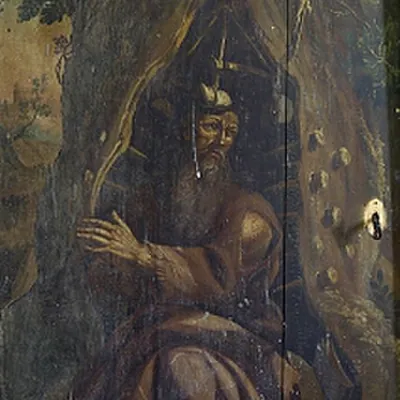
He is shown as a pilgrim or a beggar, often lying under a staircase, holding a parchment. He is invoked as patron of beggars, pilgrims and travelers, as well as of nurses and belt makers.

What can we learn from Saint Alexius?
Even if his story is legendary, Saint Alexius passes on a profound insight of the Gospel: one can leave everything for Christ, even one's name and reputation, and live hidden among one's own. His figure reminds us that the poor we pass every day, on the doorstep of our homes, may be "men of God" whom we do not recognize. We can pray to him for the homeless, for beggars and pilgrims, and to learn humility.
Where to pray to Saint Alexius
- Basilica of Saints Boniface and Alexius (Aventine, Rome): the church dedicated to him since 986, where steps of the staircase under which, according to tradition, he died are shown.
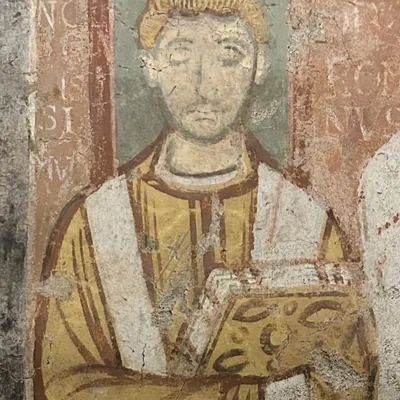
- Basilica of San Clemente (Rome): the lower basilica keeps an 11th-century fresco telling his life.
- Monastery of Agia Lavra (Kalavryta, Greece): an Orthodox monastery where his head is venerated.
Discover also
- Saint Benedict Joseph Labre, a beggar pilgrim who died in Rome, often compared to Saint Alexius.
- Saint Roch, another pilgrim saint, who according to tradition returned unrecognized to his hometown.
- Saint Alexis Falconieri, one of the seven founders of the Servites, who bears his name.
- Saint Jerome Emiliani, founder of the Somascans, who serve the Aventine basilica today.