Saint Roch (also known as Saint Rocco) was a pilgrim from Montpellier, in southern France, who lived in the 14th century. According to tradition, he devoted his life to caring for plague victims along the roads of Italy, caught the disease himself and was fed by a dog, before dying unknown in a prison cell. Invoked for centuries against epidemics, he is one of the most popular saints in Europe. His feast day is August 16.
Who was Saint Roch?
Very little is known for certain about Saint Roch. The first accounts of his life, such as the one by the Venetian Francesco Diedo, published in 1478, or a short anonymous Latin Life, were written more than a century after his death, when his cult had already spread across northern Italy. They do not always agree on places and dates.
Old tradition places his birth around 1295; many historians today prefer to place his life in the second half of the 14th century, in the time of the great waves of plague that followed the Black Death of 1348. Yet the portrait that emerges from these accounts is consistent: a layman who gave up everything to become a pilgrim and a servant of the sick.
A pilgrim at the service of plague victims
According to the accounts, Roch was the only son of a prominent family in Montpellier. He is said to have been born with a red, cross-shaped mark on his chest, a sign that would later make it possible to identify him. Having lost his parents young, he sold his possessions, gave the money to the poor and set out for Rome dressed as a pilgrim, with staff, satchel and hat.
In Italy, he found cities ravaged by the plague. At Acquapendente, north of Rome, instead of fleeing like so many others, he put himself at the service of the sick in the hospital. Tradition says he healed many of them with the sign of the cross. He continued on his way, caring for the sick in Cesena, in Rome and then in other towns of northern Italy. This devotion, in the midst of general fear, is the heart of his holiness.

Saint Roch's dog
At Piacenza, Roch in turn caught the plague. So as not to infect others, he withdrew into a forest, near a spring. According to the legend, the dog of a local nobleman, named Gothard in the accounts, brought him every day a loaf of bread taken from his master's table. Intrigued, the nobleman followed the animal, found the sick man and cared for him; moved by the encounter, he was converted and became a hermit himself.
This episode gave rise to the familiar image of Saint Roch: a pilgrim lifting his tunic to show the plague sore on his thigh, accompanied by a dog with a loaf of bread in its mouth. Sculptors and painters have shown him this way thousands of times, from village churches to the canvases of Rubens.
Death in obscurity
Once healed, Roch set out again. Arrested in a town at war, he was taken for a spy. He refused to reveal who he was and remained in prison for several years, where he died. The accounts differ on the place: Montpellier in some early versions, Angera or Voghera in Lombardy in others; most historians today favor Voghera. After his death, according to tradition, the red cross on his chest made it possible to identify him.

A cult born of epidemics
Devotion to Roch first developed in northern Italy in the 15th century. An early account reports that in 1414, when an epidemic threatened the Council of Constance, processions in his honor were followed by the end of the outbreak. In 1485, his relics were taken to Venice, a city especially exposed to epidemics because of its sea trade, and placed in the church of San Rocco. A powerful confraternity, the Scuola Grande di San Rocco, was founded in his name.
All over Europe, confraternities, chapels and churches were dedicated to him, often after an epidemic. In France, the church of Saint-Roch in Paris, on the rue Saint-Honoré, and the one in Montpellier, his hometown, are the best known. Italian immigrants carried his cult to the Americas, and in the United States the Saint Roch Chapel in New Orleans remains a well-known place of prayer for the sick. Pilgrims on the Camino de Santiago also like to invoke him because of his pilgrim's garb.
Why is Saint Roch the patron saint of dogs and the sick?
Saint Roch is the saint of those who stay when others flee. He founded no order and wrote no book: he cared for the sick, then accepted being cared for, and died without seeking recognition. His humility and courage speak to all who look after the sick.
Because he served plague victims and suffered the plague himself, he is invoked in times of epidemic and for people with contagious diseases. Because of his pilgrimage, he is a patron of pilgrims and travelers. And because of the faithful dog that fed him, he is the patron of dogs and their owners; in many villages of France and Italy, his feast is the day for blessing animals.
To pray with him, read the prayer to Saint Roch or follow the novena to Saint Roch, from August 7 to 15, ending on the eve of his feast.
Symbols and how to recognize Saint Roch in art
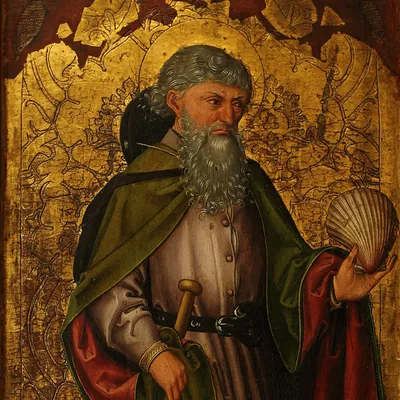
- The pilgrim's dress: staff, satchel, cloak and broad hat, often with the scallop shell of pilgrims.
- The plague sore: he lifts his tunic to show a wound on his thigh.
- The dog: at his feet, holding a loaf of bread in its mouth.
- The angel: sometimes tending his wound, or holding a tablet announcing that he will be the protector against the plague, as in Rubens's painting.
Where to pray to Saint Roch
- Venice: the church of San Rocco, which keeps his relics, and the neighboring Scuola Grande.
- Montpellier: the church of Saint-Roch in his hometown, which keeps a relic of the saint.
- Paris: the church of Saint-Roch on the rue Saint-Honoré, a great 17th-century Baroque church.
- Voghera (Lombardy): the place of his death according to many historians, where his memory is honored.
- New Orleans (Louisiana): the Saint Roch Chapel and its cemetery, a long-standing place of prayer for healing.
Discover also
- Saint Sebastian, another great protector invoked against the plague.
- Saint Charles Borromeo, the Archbishop of Milan who served plague victims in 1576.
- Saint James the Greater, patron of the pilgrims of Compostela.
- Saint Francis of Assisi, another layman who gave up his goods to follow the poor Christ.
- Saint Vincent de Paul, apostle of charity to the poor and the sick.