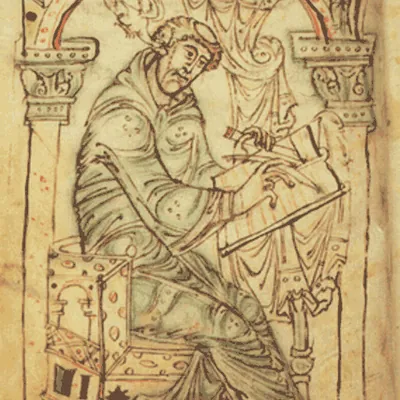
Saint Aldhelm was an Anglo-Saxon monk of the seventh century, abbot of Malmesbury and then the first Bishop of Sherborne, in the kingdom of Wessex. A student of the school of Canterbury and a Latin poet and prose writer of astonishing skill, he is considered by historians to be "the first English man of letters." Tradition also makes him a musician who sang to draw crowds to the Gospel. He died in 709 or 710, and his feast day is May 25.
Who was Saint Aldhelm?
Aldhelm was born around 640 in Wessex, the kingdom of the West Saxons. His life is known mainly from two biographies written after the Norman Conquest, by Abbot Faritius of Abingdon and by the chronicler William of Malmesbury, who relied in part on a lost text by King Alfred the Great. According to these authors, he belonged to the royal family of Wessex, and his father may have been King Centwine. He may have received part of his education at the abbey of Iona, one of the great centers of Irish Christianity.
Wessex was then a young Christian kingdom: its king Cynegils had been baptized only a few years before Aldhelm's birth. Aldhelm belonged to the first generations of West Saxons raised in the faith, and he would spend his life deepening it among his people.
In the early 670s he went to Canterbury to study under Archbishop Theodore of Tarsus and Abbot Hadrian. There he discovered the close study of the Bible, Latin meter, the reckoning of the calendar and probably some Greek. This training made him one of the most learned minds of his century.

Abbot of Malmesbury
The founding of Malmesbury is traditionally dated to 675, but the charter that gives this date is a twelfth-century forgery. Aldhelm probably became abbot only after 680. Under his leadership the monastery became a center of study and prayer.
William of Malmesbury tells a story that became famous. Seeing that the country people left church as soon as Mass was over, Aldhelm stood on a bridge dressed as a minstrel and sang poems in English. Once a crowd had gathered, he slipped words of Scripture into his songs. This story, handed down by tradition, explains why he is depicted as a monk with a harp and invoked by musicians.
First Bishop of Sherborne
In 705 or 706 the large diocese of the West Saxons was divided in two, Winchester and Sherborne, and Aldhelm became the first Bishop of Sherborne. Saint Bede the Venerable, who mentions him in his Ecclesiastical History, describes his time as bishop as energetic.
It was brief, however: in four years Aldhelm founded several churches, at Sherborne and perhaps at Bradford-on-Avon and Wareham. He died in 709 or 710 at Doulting, in Somerset. According to William of Malmesbury, his body was carried to Malmesbury, and crosses were set up along the way at each place where the funeral procession stopped.

An exceptional Latin writer
Aldhelm left only works in Latin, in a very recognizable style: long sentences, alliteration, rare and learned vocabulary. His treatise On Virginity, written first in prose and then in verse, is addressed to Abbess Hildelith and the nuns of Barking.
His long letter to King Aldfrith of Northumbria contains treatises on the number seven, on meter and on scansion, together with a collection of one hundred Riddles in verse, short puzzles in which an animal, a plant, a star or an everyday object describes itself and invites the reader to guess its name. Through these small poems he taught his students to look at creation with wonder and to see in it the work of the Creator. He also wrote poems meant to be inscribed in churches, and a verse account of a journey through Cornwall and Devon.
His influence was considerable. It can be traced in many Anglo-Saxon writers, from Saint Boniface, the apostle of Germany, to Alcuin, master of Charlemagne's palace school.
Why is Saint Aldhelm the patron saint of musicians?
Aldhelm is invoked as patron of musicians and composers because of the story of the bridge at Malmesbury: a monk who sang the people's own songs in their own language to bring them back to the Word of God. For him, study, poetry and song were paths to God.
As abbot and pastor, he sought to reach people where they were, even on a bridge, with their language and their love of music. He can be prayed to for musicians, poets, teachers and all who look for new words to speak the Gospel. To pray with him, see the prayer to Saint Aldhelm and the novena to Saint Aldhelm.
Symbols and how to recognize Saint Aldhelm in art
Saint Aldhelm appears either as a monk or as a bishop with miter and crosier. Because of the Malmesbury story, he is often shown with a harp, as a monk-musician. A book recalls the scholar and the Latin poet. A stained glass window in St Aldhelm's Catholic Church in Malmesbury shows him as a bishop. In Dorset, a headland on the Purbeck coast bears his name, St Aldhelm's Head, crowned by a small medieval chapel.

Where to pray to Saint Aldhelm
- Malmesbury, Wiltshire: the abbey he led and where he was buried, and the Catholic church of St Aldhelm.
- Sherborne, Dorset: the abbey, heir to his episcopal see.
- Doulting, Somerset: the village where he died.
Discover also
- Saint Theodore of Tarsus, his teacher at Canterbury.
- Saint Bede the Venerable, another great Anglo-Saxon scholar, who mentions him.
- Saint Boniface, missionary from Wessex shaped by his style.
- Saint Dunstan, another saint of Wessex, also a musician according to tradition.
- Saint Aidan, a monk from Iona, a monastery linked to Aldhelm's early education.