Saint Dunstan was an Anglo-Saxon monk and prelate of the tenth century, abbot of Glastonbury and then Archbishop of Canterbury from 959 until his death on May 19, 988. Counselor to several kings, he was one of the architects of the great English monastic reform, which brought new life to abbeys ruined by the Viking invasions. A musician, scribe and goldsmith according to his biographers, he became the hero of a popular legend in which he shoes the devil's hooves. His feast day is May 19.
Who was Saint Dunstan?
Dunstan was born around 909 at Baltonsborough, near Glastonbury in Somerset, into a noble family related to the royal house of Wessex. He received his first lessons from Irish monks living at Glastonbury, then was sent as a page to the court of King Æthelstan. Torn between marriage and religious life, he fell seriously ill with a skin disease he believed was leprosy. He saw his recovery as a sign and chose to consecrate himself to God.
Ordained a priest around 939, he returned to Glastonbury and first lived there as a hermit, in a small cell built against the church. His biographers describe days divided between prayer, study, manual work, painting and music. These craftsman's skills, especially in metalwork, are the origin of his traditional patronage of goldsmiths and blacksmiths.

The reformer of Glastonbury
In 943 King Edmund made Dunstan abbot of Glastonbury and gave him the means to restore the abbey. The young abbot did more than rebuild: he reestablished a true monastic life according to the Rule of Saint Benedict and made Glastonbury a renowned center of learning. As counselor to King Eadred, he did not hesitate to rebuke the aristocracy of Wessex for their loose morals.
This frankness cost him dearly. On the very day of his coronation, around 956, the young King Eadwig left the banquet, and Dunstan went to fetch him back to his duties. Disgraced and stripped of his property, he had to go into exile. He found refuge in Flanders, at Ghent, where he discovered the monastic reform of the Continent, inspired by Gerard of Brogne and by the movement that came from Cluny.
Archbishop of Canterbury
Recalled by Edgar, he became bishop of Worcester and then of London. When Edgar came to rule all of England in 959, he named him Archbishop of Canterbury; the pope later made him his legate. A close collaboration between king and archbishop followed. With two other Benedictine bishops, Æthelwold of Winchester and Oswald of Worcester, Dunstan restored or founded many monasteries, replaced clergy judged unworthy with monks and promoted learning. Around 970 the Regularis Concordia set out common customs for the monasteries of the kingdom.
His biographers report that he imposed a long penance on the king himself for his conduct. In 973, at Bath, he presided over the solemn coronation of Edgar. After Edgar's death he supported his son Edward, whose murder in 978 affected him deeply. He spent his last ten years at Canterbury in prayer and teaching, and died on May 19, 988, shortly after the feast of the Ascension.
Why is Saint Dunstan the patron saint of goldsmiths and blacksmiths?
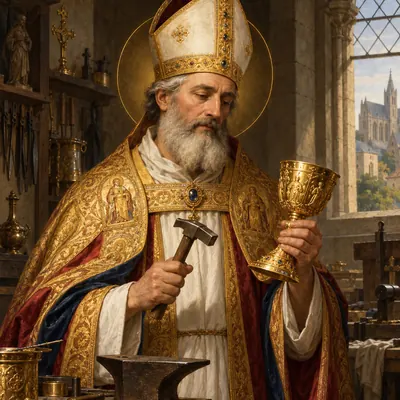
His early biographers describe Dunstan as a skilled craftsman who worked with metal, as well as a painter, scribe and musician. This is why goldsmiths, blacksmiths and metalworkers have long taken him as their patron.
English popular tradition went further and made Dunstan a blacksmith and farrier. According to the legend, the devil once came and asked him to shoe his cloven hooves. Dunstan recognized him, chained him to the wall and nailed on the shoes so painfully that the devil begged for mercy. He was released only after swearing never to enter a house with a horseshoe over the door. This story, which has no historical basis, partly explains the custom of hanging a horseshoe above the door, and it added to the saint's popularity among metalworkers.
Dunstan joined the contemplative life with public responsibility. A monk at heart, he agreed to advise kings and govern the Church without giving up telling the truth to the powerful, even at the price of exile. His main work remains the renewal of Benedictine life in England, whose legacy shaped the following centuries. People pray to him for craftsmen and goldsmiths, for musicians, and for those who must balance prayer and responsibility.
Symbols and how to recognize Saint Dunstan in art
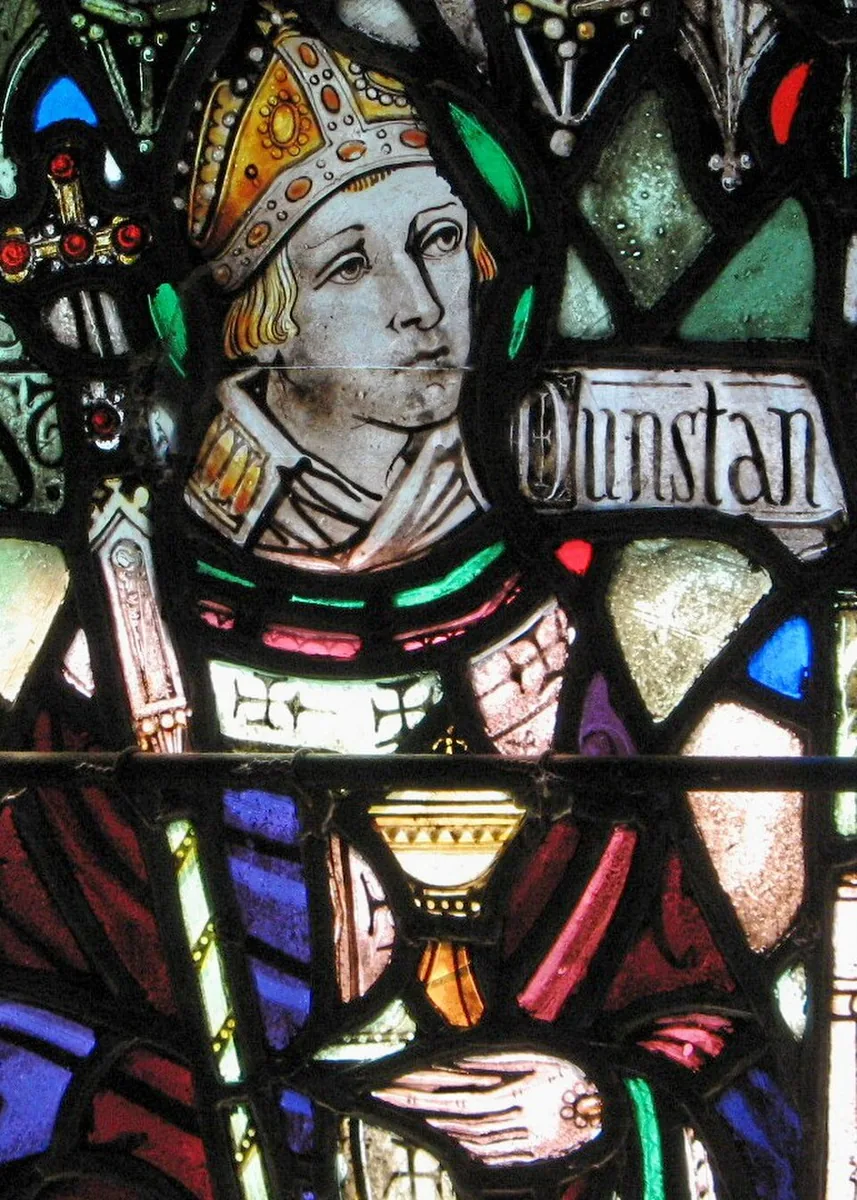
- Archbishop's vestments: miter and crozier, as Archbishop of Canterbury.
- A pair of tongs: often shown in his hand, recalling the legend of the devil and his metalwork.
- The devil: sometimes depicted being seized by the nose with the tongs or being shod.
- Kneeling before Christ: a famous tenth-century drawing, attributed to him, shows a monk at the feet of Christ.

Where to pray to Saint Dunstan
- Canterbury: Canterbury Cathedral, his archiepiscopal see, where he was buried; his medieval tomb no longer exists.
- Glastonbury: the ruins of Glastonbury Abbey, where he was abbot and reformer.
- Baltonsborough, Somerset: his native village, whose church is dedicated to him.
To pray with him, see the prayer to Saint Dunstan and the novena to Saint Dunstan.
Discover also
- Saint Benedict of Nursia, whose Rule he restored in England.
- Saint Edward the Martyr, the young king he supported and mourned.
- Saint Æthelwold of Winchester, his partner in the monastic reform.
- Saint Augustine of Canterbury, first archbishop of the see he occupied.
- Saint Anselm and Saint Thomas Becket, his successors in the see of Canterbury.