Fasting: definition
Fasting is a voluntary, total or partial, abstention from food, practiced in order to turn to God, to purify oneself and to share with the poor. In the Catholic Church, it is required on Ash Wednesday and Good Friday, and recommended throughout Lent.
Why fast?
Moses and Elijah fast forty days before meeting God, and Jesus fasts forty days in the desert before his mission. In the Gospel, he links fasting with prayer and almsgiving, asking that it be done in secret, without drawing attention. Fasting deepens our hunger for God, helps us master our desires and makes us one with those who are hungry.
The Fathers of the Church insist: a fast that is not accompanied by charity is useless. What we save can be given to the poor.
The rules of the Church
Fasting is required two days a year: Ash Wednesday and Good Friday. It applies to the faithful in good health from their eighteenth birthday until the beginning of their sixtieth year. It consists of taking only one full meal during the day, with possibly two small snacks.
It should not be confused with abstinence, which means refraining from meat, from age fourteen, on those same days and in principle on the Fridays of Lent. Finally, there is the Eucharistic fast: one abstains from food for one hour before receiving Communion, except water and medicine.
The fasting of the saints
Many saints practiced severe fasts, such as Saint Anthony the Great in the desert or Saint Catherine of Siena. Yet the Church urges prudence: fasting is not a feat, it must be suited to one's health. You can also fast in other ways, from screens, social media or idle words, during Lent or a spiritual retreat.
Saints to know
-
 January 17
Saint Anthony the Great
fourth-century Egyptian hermit, regarded as the father of Christian monasticism
Father of monks, he lived in the desert in prayer and rigorous fasting.
-
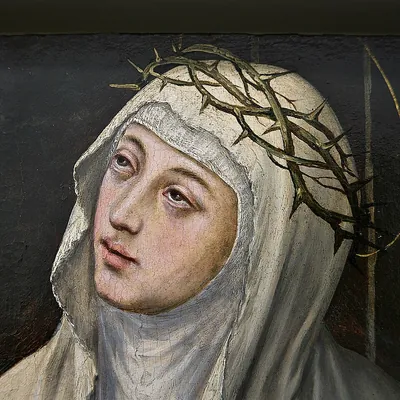 April 29
Saint Catherine of Siena
Dominican tertiary and mystic from Siena, Doctor of the Church, patron saint of Italy and co-patron of Europe
She practiced extreme fasts, which the Church does not propose as a model to follow.
-
 June 24
Saint John the Baptist
prophet and forerunner of Christ, who baptized Jesus in the Jordan and died a martyr
He lived in the desert, eating locusts and wild honey.
Frequently asked questions
What is the difference between fasting and abstinence?
Fasting limits the quantity of food to a single full meal a day. Abstinence concerns a specific food, meat, without limiting quantity.
Can you drink while fasting?
Yes. Catholic fasting does not apply to water or to drinks that do not amount to a meal.
Who is excused from fasting?
Those under eighteen, those over fifty-nine, the sick, pregnant women and anyone for whom fasting would be dangerous.
Related terms
Prayer and Devotions: other terms
- Acts of Faith, Hope and Charity
- Eucharistic Adoration
- Blessing
- Rosary
- Divine Mercy Chaplet
- Stations of the Cross
- Consecration
- Devotion
- Holy Water
- Ex-voto
- Examination of Conscience
- Indulgence
- Lectio Divina
- Litany
- Miraculous Medal
- Mysteries of the Rosary
- Novena
- Mental Prayer
- Ejaculatory prayer
- Pilgrimage
- Procession
- Complete Rosary
- Sacred Heart
- Scapular
- Triduum