Saint Wiro was an eighth-century missionary bishop who came from the British Isles to preach the Gospel in the valleys of the Meuse and the Roer, in what is now Dutch Limburg. With his companions Saint Plechelm, a bishop, and Saint Otger, a deacon, he founded a church and a small community on a hill near Roermond, today's Sint-Odiliënberg. He is counted among the apostles of the Netherlands. His feast day is May 8.
Who was Saint Wiro?
Wiro belongs to the great movement of monks and bishops from Ireland and England who, in the seventh and eighth centuries, carried the Gospel to the peoples of northern Gaul, Frisia and Germany. English-speaking Catholics will recognize the same missionary wave that produced Saint Willibrord and Saint Boniface.
His life is poorly documented. The main source is a Life written much later, probably in the tenth century in the circle of Utrecht, and its historical value is debated. The sources even disagree about his origins: Dutch tradition makes him an Irishman, while other historians think he was more likely an Anglo-Saxon from Northumbria.
What seems certain is that a group of missionaries, Wiro, Plechelm and Otger, settled in the eighth century on a height overlooking the Roer River with the support of the Carolingian mayors of the palace, and that a very ancient cult was paid to them at that place.

A missionary bishop
According to tradition, Wiro and Plechelm, after being consecrated bishops in Rome, set out for the still pagan regions of northern Europe, accompanied by the deacon Otger. They settled in the Meuse valley, on the border between Frankish and Frisian lands, in a region where Christianity was still fragile.
They were active in the same period as Saint Willibrord, the apostle of the Frisians, based in Utrecht, and as Saint Lambert and his successors in Maastricht and Liège.
Confessor of Pepin of Herstal
Wiro's Life reports that Pepin of Herstal, the powerful mayor of the palace, held him in such esteem that he chose him as his confessor and came to him barefoot to confess his sins. Pepin is said to have given him the hill then called Saint Peter's Mount, near the Roer, where the three missionaries built a church dedicated to Saint Peter and a dwelling. The place later took the name of Saint Odile, hence its present name, Sint-Odiliënberg.
Cult and relics
After their deaths, Wiro, Plechelm and Otger were buried in their church, which became a place of pilgrimage. A community of canons settled there in the Middle Ages before being transferred to Roermond toward the end of the medieval period. The relics of the three saints were moved several times over the centuries, notably to Utrecht and Roermond. Their cult has remained alive in Limburg. Plechelm is especially venerated in Oldenzaal, whose basilica bears his name.
The Romanesque church of Sint-Odiliënberg, restored several times, remains the main shrine of Saint Wiro and his companions. It was raised to the rank of minor basilica in the twentieth century.
Why is Saint Wiro the patron saint of Sint-Odiliënberg?
Saint Wiro is the patron of Sint-Odiliënberg because it was there, according to tradition, that he and his companions built the first church and lived out their mission. Their tomb made the hill a place of prayer, and the village grew around their shrine. For more than twelve centuries, local Catholics have honored the three missionaries as the founders of their faith.
Symbols and how to recognize Saint Wiro in art
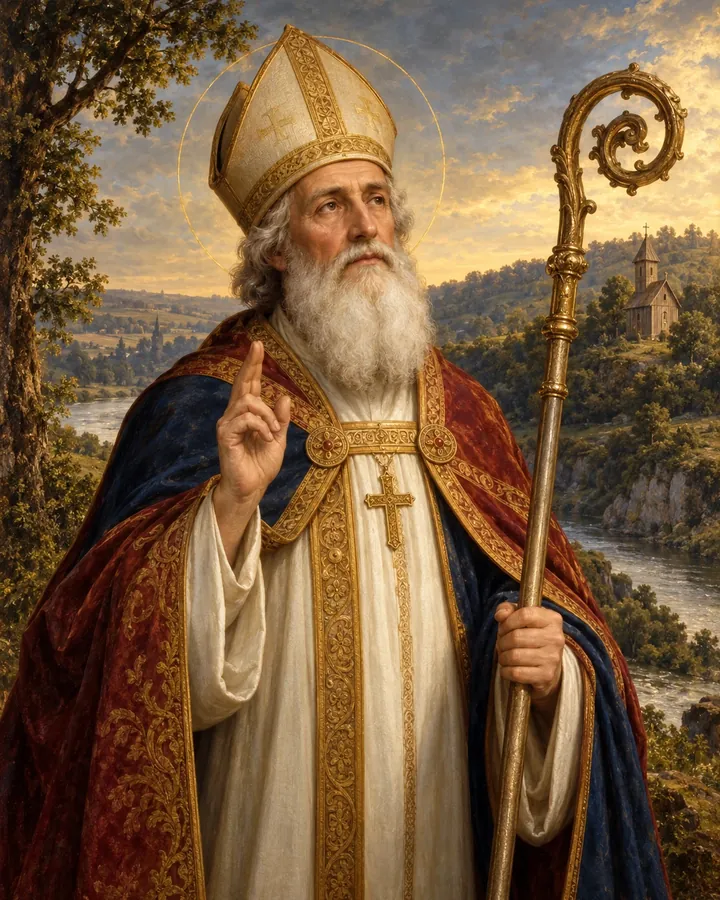
Saint Wiro is shown as a bishop, wearing a miter and holding a crozier. He usually appears together with Saint Plechelm, also vested as a bishop, and Saint Otger, dressed as a deacon. This trio is the surest way to identify him, especially in the basilica of Sint-Odiliënberg.
What can we learn from Saint Wiro?
Saint Wiro reminds us that the faith of the Netherlands and the Meuse valley was born from the courage of foreign missionaries who left their island to serve peoples they did not know. We know little about him, but his name remains tied to a hill where people have prayed for more than twelve centuries. We can pray to him for missionaries, for the Church in the Netherlands, and for all who proclaim the Gospel in lands that have grown indifferent to it.
His story also shows the strength of working together. Wiro is almost never remembered alone: a bishop, a second bishop and a deacon formed one missionary team, and the faithful have honored them together ever since. It is a quiet lesson for parishes and communities today, where mission is always a shared task.
To pray with him, read the prayer to Saint Wiro or follow the novena to Saint Wiro, which ends on May 8.
Where to pray to Saint Wiro
- Sint-Odiliënberg (Roerdalen, Limburg, Netherlands): the Basilica of Saints Wiro, Plechelm and Otger.
- Roermond (Limburg): the neighboring town, where the chapter of canons moved in the Middle Ages.
- Oldenzaal (Overijssel): the Basilica of Saint Plechelm, dedicated to his companion.
Discover also
- Saint Willibrord, apostle of the Frisians and first bishop of Utrecht, his contemporary.
- Saint Lambert of Maastricht, bishop and martyr of the Meuse valley.
- Saint Servatius of Tongeren, the great saint of Maastricht.
- Saint Boniface, another great missionary from the British Isles.