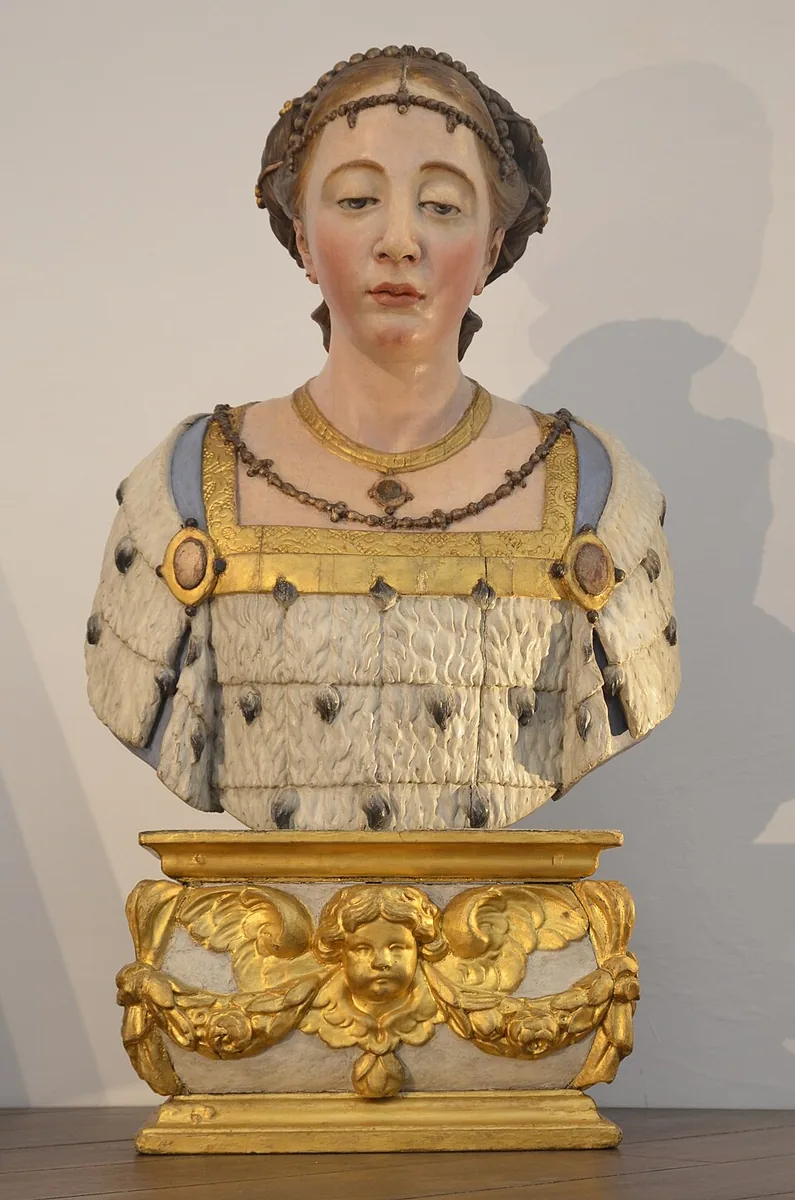
Saint Waltrude, known in French as Sainte Waudru and in Latin as Waldetrudis, was a Frankish noblewoman of the 7th century: a wife and the mother of saints, who later became a nun and founded the community around which the city of Mons, in Belgium, grew up. She died around 688 and is the patron saint of Mons and of Herentals. Every year, on Trinity Sunday, her reliquary is carried through Mons on the Golden Chariot during the Ducasse festival. Her feast day is April 9.
Who was Saint Waltrude?
Waltrude belonged to one of the great families of the Merovingian nobility that gave the Church founders of monasteries and many saints. Her father Walbert and her mother Bertilia are themselves honored as saints, and her sister is Saint Aldegund, foundress of Maubeuge. Her husband, Madelgarius, became a monk under the name of Saint Vincent and founded the abbey of Soignies. All four of their children are venerated as saints.
What we know about her comes mainly from a Latin Life written around the 9th century, later enriched by many traditions. Today's historians carefully distinguish the historical figure, an aristocrat who became an abbess in Hainaut, from legendary embellishments. But the essentials are solid: a married woman and mother who later chose consecrated life, and whose foundation gave birth to a city.

Wife and mother
Waltrude married Madelgarius, a Frankish lord close to the royal court. The couple lived as Christians, attentive to the poor, and raised their children in the faith. Theirs is one of the most remarkable families in the history of the saints. Landry became a bishop and abbot of Soignies; Dentlin died as a child; Aldetrude and Madelberte were, one after the other, abbesses of Maubeuge, alongside their aunt Aldegund. Artists often show Waltrude sheltering her two daughters under her cloak.
Choosing consecrated life
Once their children were raised, the couple decided by mutual agreement to give themselves entirely to God. Madelgarius withdrew to the abbey of Hautmont, which he had founded, and later founded the abbey of Soignies. After a time of discernment, Waltrude left behind her life as a great lady. According to her Life, she faced trials, criticism and temptations to turn back, but she persevered.
Guided by Saint Ghislain, a monk who lived nearby, she settled on a hill overlooking the Haine valley, the Castrilocus, and had a modest house and an oratory built there. Other women joined her. She lived there in prayer and poverty, serving the poor and the sick.
The mother of Mons
Waltrude died around 688, on April 9 according to tradition. The people at once venerated her as a saint. Her cousin Aye succeeded her. The community became an abbey, then, around the 12th century, a chapter of noble canonesses. Around the monastery grew the town of Mons, which became the capital of the County of Hainaut. In 1450 the canonesses began building the present collegiate church, one of the finest examples of Brabantine Gothic architecture.
The Ducasse and the Golden Chariot
Devotion to Saint Waltrude is inseparable from the Ducasse of Mons, celebrated every year on the weekend of Trinity Sunday. On Saturday evening her reliquary is lowered in a solemn ceremony inside the collegiate church. On Sunday morning it is placed on the Car d'Or, a gilded 18th-century chariot, and carried through the city in procession, accompanied by many groups in costume.
On the way back, the chariot must climb the cobbled slope leading to the church, pushed by the crowd. According to popular tradition, if it failed to make it in a single push, misfortune would fall on the city. In the afternoon comes the Lumeçon, the combat in which Saint George faces the dragon. These festivities belong to the processional giants and dragons recognized by UNESCO as Intangible Cultural Heritage.

Why is Saint Waltrude the patron saint of Mons and of families?
Mons was born around her monastery, so the city has always seen her as its mother and protector. Herentals, in the province of Antwerp, also took her as patron. Because she lived holiness as a wife, a mother and then a consecrated woman, and because her husband, children, parents and sister are all honored as saints, she is invoked for couples and families, for mothers and for anyone going through a major change in life.
Symbols and how to recognize Saint Waltrude in art
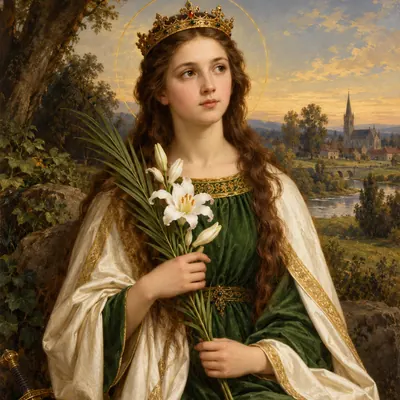
- She is usually shown as an abbess, sometimes crowned, holding a book.
- She often shelters her two daughters, Aldetrude and Madelberte, under her cloak.
- She is sometimes depicted with her husband, Saint Vincent, and their four children as a family of saints.
What can we learn from Saint Waltrude?
Waltrude shows that holiness can be lived at every stage of life: as a wife, as a mother, and then in consecrated life. Her whole family became a family of saints. Her foundation gave birth to a city that, thirteen centuries later, still carries its patron through the streets. You can pray to her for couples and families, for mothers, for those facing a change in life, and for the city of Mons and the region of Hainaut.
To pray with her, use the Prayer to Saint Waltrude or follow the Novena to Saint Waltrude, prayed from April 1 to her feast on April 9.
Where to pray to Saint Waltrude
- Mons, Belgium: the Collegiate Church of Saint Waltrude (Collégiale Sainte-Waudru), which keeps her reliquary and the reliquary of her head.
- Herentals, Belgium (province of Antwerp): the great church of Saint Waltrude, of which she is patron.
- Maubeuge, France: the town of her sister Saint Aldegund and of her daughters.
- Soignies, Belgium: the collegiate church of Saint Vincent, founded by her husband.
- Hautmont, France: the site of the abbey where Saint Vincent withdrew.
Discover also
- Saint Gertrude of Nivelles, another great 7th-century abbess in Belgium.
- Saint Amand, the apostle of Belgium, a contemporary of her family.
- Saint Rictrude of Marchiennes, a mother who became an abbess, like her.
- Saint Eligius, Bishop of Noyon and evangelizer of the north in the same period.