Saint Ursula is the central figure of one of the most famous legends of the Middle Ages: a princess from Britain massacred at Cologne with "eleven thousand virgins" for remaining faithful to Christ. Behind this greatly embellished story lies a more modest but real fact: the veneration, at Cologne, of a group of young martyrs of the early centuries, honored in a basilica as early as the 4th or 5th century. Patron saint of Cologne and of the Ursulines, Saint Ursula is listed in the Roman Martyrology on October 21.
Who was Saint Ursula?
Two things must be kept apart from the start: what history allows us to say, and what tradition has told. History is sober. In Cologne, an ancient inscription, still preserved in the Basilica of Saint Ursula, records that a certain Clematius rebuilt a church on the spot where virgins had shed their blood for Christ. So there was, very early, a local cult of martyrs whose number and names were probably already unknown.
The name Ursula, Latin for "little she-bear", appears later. According to the most common explanation, it came from a nearby epitaph, that of an eight-year-old girl named Ursula. As for the figure of eleven thousand, it is thought to come from a misreading of an abbreviation: where "eleven virgin martyrs" was meant, "eleven thousand" was read. The existence of an Ursula who was a princess and leader of a pilgrimage is therefore not established.
The story told in the Golden Legend
The most widespread version makes Ursula the daughter of a Christian king in Britain. Asked in marriage by a pagan prince, she obtains a delay of three years to make a pilgrimage, accompanied by many young women. The company sails up the Rhine, reaches Rome, then returns toward Cologne, which is besieged by the Huns. Ursula refuses to marry their chief and to deny her faith: she is killed by an arrow, and her companions are massacred with her. Some versions date these events to the 3rd, 4th or 5th century, which alone shows how uncertain the chronology is.
This story, enriched from generation to generation, does not have the value of a historical document. Yet it expresses an ancient conviction of the Church of Cologne: young women preferred death to abandoning their faith, and their memory deserves to be kept.
Why is Saint Ursula the patron saint of Cologne, schools and young women?
In the Middle Ages, devotion to Ursula spread far beyond the Rhineland. The eleven flames on the coat of arms of Cologne recall the virgin martyrs. The Sorbonne, then other universities, took her as their patron. She was invoked for a good death and a happy marriage, and as protector of young women. Drapers, too, placed themselves under her protection.
In the 16th century, Saint Angela Merici gave her name to the Company of Saint Ursula, devoted to the Christian education of girls. The Ursulines then spread to France, Canada and the whole world, making this legendary martyr the patron of generations of women educators. In the United States, the Ursulines arrived in New Orleans in 1727, and many Ursuline schools in America, Ireland and elsewhere still bear her name.

The basilica and the Golden Chamber
The Basilica of Saint Ursula stands north of Cologne's old town, on the site of a Roman-era cemetery. After the discovery of 1106, the many bones found nearby were taken to be the remains of Ursula's companions. The Romanesque church, badly damaged in the Second World War and then restored, has a tower topped by a crown, a reminder of the princess of the legend. Inside, the Golden Chamber, fitted out in the 17th century, has walls entirely covered with bones arranged in patterns and inscriptions, beneath rows of reliquary busts. The display surprises visitors, but it expresses the fervor of an age that wanted to honor every martyr, even those without a name.
Symbols and how to recognize Saint Ursula in art
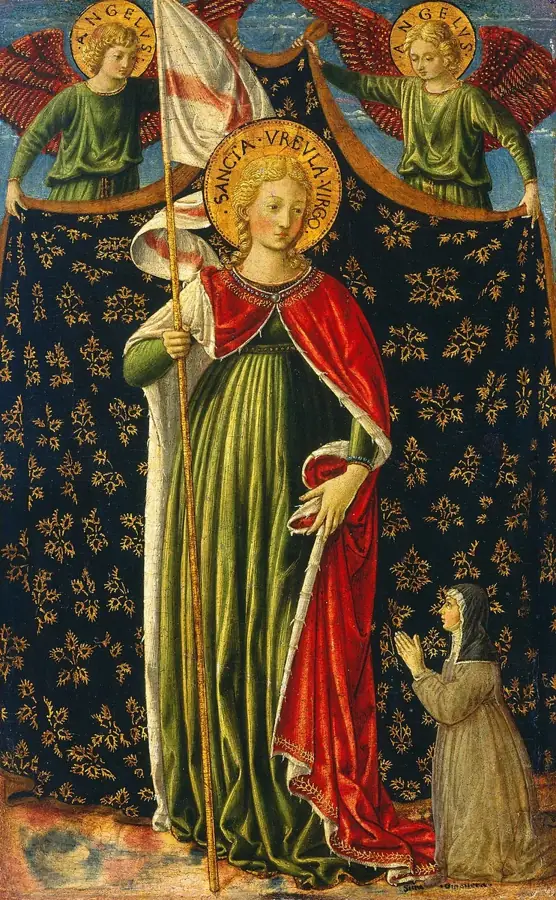
Artists have produced many narrative cycles of her story: the shrine painted by Hans Memling in Bruges, the great canvases of Vittore Carpaccio in Venice, Caravaggio's Martyrdom of Saint Ursula in Naples. She is recognized by:
- a crown, as a princess;
- an arrow, the instrument of her martyrdom;
- sometimes a banner;
- a wide cloak under which she often shelters her companions.
What does her story teach?
Saint Ursula invites a clear-sighted piety. We can admire the beauty of her legend without taking it for a chronicle, and honor through her real martyrs whose names God alone knows. Her cult recalls the faithfulness of young Christian women in a violent age, and the fruitfulness of that memory: centuries later, women gave their lives to educating the young under her patronage.
To pray with her, see the prayer to Saint Ursula and the novena to Saint Ursula.

Where to pray to Saint Ursula
- Cologne (Germany): the Basilica of Saint Ursula, which keeps the relics attributed to the virgin martyrs, the Golden Chamber and the Clematius inscription.
- Bruges (Belgium): Hans Memling's Shrine of Saint Ursula, in the former Saint John's Hospital.
- Venice (Italy): Carpaccio's cycle of the Legend of Saint Ursula, at the Gallerie dell'Accademia.
- The chapels of Ursuline convents and schools around the world.
Discover also
- Saint Angela Merici, foundress of the Company of Saint Ursula.
- Saint Agnes of Rome, another young virgin martyr of the early centuries.
- Saint Cecilia, a Roman martyr whose legend also inspired artists.
- Saint Margaret of Antioch, another saint much loved in the Middle Ages thanks to the Golden Legend.
- Saint Sebastian, a martyr pierced by arrows like her.