Saint Telesphorus was the eighth bishop of Rome in the list drawn up by Saint Irenaeus of Lyon, serving roughly between 125 and 138, under the emperors Hadrian and Antoninus Pius. Almost everything told about him comes from late traditions, but one fact is solidly attested: he died a martyr. He is in fact the first bishop of Rome after Saint Peter whose martyrdom is affirmed by a reliable early source. The old Roman calendar commemorated him on January 5.
Who was Saint Telesphorus?
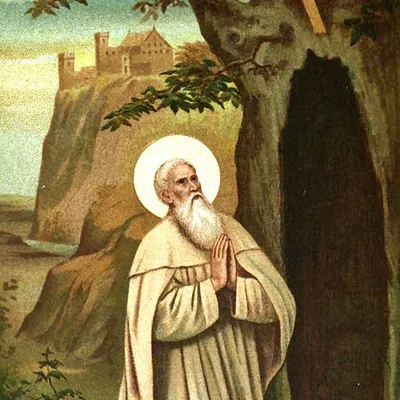
Tradition says he was Greek by origin and places his birth in Calabria, in southern Italy, at Terranova da Sibari. The Liber Pontificalis, a chronicle of the popes composed several centuries later, adds that he lived for a long time as a hermit, in Palestine or in Egypt, before coming to Rome. Some writers placed him among the hermits of Mount Carmel, and this is why the Carmelite Order counts him among its patron saints. None of these stories can be verified.
Historians also invite caution about his very title. In the second century, the Church of Rome was probably still led by a college of priests (presbyters) rather than by a single bishop. Irenaeus himself presents him as one of the "presbyters" who presided over the Roman Church before Soter. Whatever the exact shape of that leadership, Telesphorus was a leading figure of the Roman Christian community in his day.
Rome in the time of Hadrian and Antoninus Pius
The years of his ministry fall in a period often described as calm for the Empire. For Christians, however, faith remained a risk. There was no general persecution, but believers could be denounced and condemned at any time, simply for bearing the name of Christian. Leading the Church of the capital meant being visible, and therefore exposed. Telesphorus accepted that exposure to the end.

The first attested papal martyrdom after Peter
Around 180, in his treatise Against Heresies, Saint Irenaeus of Lyon lists the bishops of Rome from the apostles onward, to show that the teaching of the apostles had been handed down without a break. When he reaches Telesphorus, he adds a single striking detail: he "suffered a glorious martyrdom." Eusebius of Caesarea repeats this in the fourth century.
This matters. Later chronicles readily gave the title of martyr to almost all the early popes. For Telesphorus, by contrast, the claim rests on testimony written barely two generations after his death, by a bishop who had himself spent time in Rome. On the other hand, the circumstances of his death are unknown: we do not know how he was arrested, judged or put to death. Tradition holds that he was buried on the Vatican Hill, near Saint Peter.
Easter, Christmas and the Gloria: what tradition attributes to him
In his time, Rome drew many Christian teachers from across the Mediterranean, among them the Gnostic Valentinus, who came from Egypt. The Church of Rome had to discern between faithful teaching and new speculations.
A letter of Irenaeus preserved by Eusebius gives another precious detail. Telesphorus was among the Roman bishops who celebrated Easter on a Sunday, while remaining in communion with the Churches of Asia Minor that followed a different custom. This breadth of spirit would be recalled later, when the date of Easter came to divide the Churches. Irenaeus held it up as an example: unity does not require every local custom to be identical.
The Liber Pontificalis attributes many other decisions to him: the institution of the Lenten fast, of the Mass during the night of Christmas, and the introduction of the Gloria in excelsis into the liturgy. Historians doubt these attributions. They mostly reflect the desire of later centuries to connect familiar liturgical customs to the earliest days of the Church. Still, many Catholics who sing the Gloria at Midnight Mass have heard his name connected with it.

Why is Saint Telesphorus honored by the Carmelites?
Saint Telesphorus is not invoked as the patron of a profession or a cause, as many later saints are. His particular link is with the Carmelite Order. Because a medieval tradition made him one of the hermits of Mount Carmel before he came to Rome, the Carmelites counted him among their patron saints and spiritual forerunners. Historians cannot confirm this tradition, but it shows how much the Order wished to root its contemplative life in the earliest centuries of the Church.
For Catholics today, he is above all a witness: a shepherd of the Church of Rome who gave his life for Christ, and a pastor who kept communion with Churches whose customs differed from his own.
What his holiness teaches
From Telesphorus we remember above all a witness given to the point of shedding his blood, at a time when being a Christian in Rome remained dangerous. We also remember a way of preserving unity despite differences in practice. His feast has varied from one calendar to another: the old Roman calendar commemorated him on January 5, some sources give January 2, and the Eastern Churches celebrate him on February 22. In Quebec, the municipality of Saint-Télesphore bears his name.
Symbols and how to recognize Saint Telesphorus in art
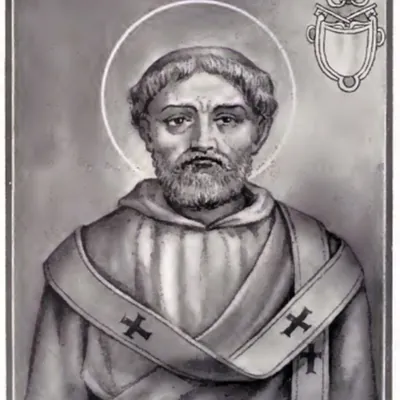
No authentic portrait of Telesphorus exists. Later artists imagined him as a pope in pontifical vestments, as in the series of papal portraits produced in the nineteenth century. When he is shown as a martyr, the palm is the usual sign of martyrdom in Christian art. In Carmelite settings, he may appear among the saints whom the Order regarded as its forerunners.
Where to pray to Saint Telesphorus
Tradition places his tomb on the Vatican Hill, near the tomb of Saint Peter, in the area of the ancient necropolis that lies beneath Saint Peter's Basilica. Pilgrims who visit the basilica and its grottoes pray close to the place associated with the first bishops of Rome. Carmelite communities, who honor him as one of their patrons, also keep his memory.
Discover also
- Saint Sixtus I, his predecessor as bishop of Rome.
- Saint Hyginus, his successor.
- Saint Evaristus, another bishop of Rome of the early second century.
- Saint Justin Martyr, Christian philosopher martyred in Rome in the same century.
- Saint Soter, before whom Irenaeus lists him among the presbyters of Rome.