Saint Evaristus was one of the very first bishops of Rome, counted as the fifth pope after Saint Peter. He led the Roman Church for about eight years, around the year 100, at the time when the last direct witnesses of the apostles were dying. Very little is known about him for certain, but his place in the oldest lists of the bishops of Rome shows that he truly held this office. The Roman Martyrology commemorates him on October 26 (some sources give October 27).
Who was Saint Evaristus?
Evaristus, whose Greek name means "well pleasing," succeeded Saint Clement of Rome. The lists of the bishops of Rome drawn up in the second century, handed down by Saint Irenaeus of Lyon and then by the historian Eusebius of Caesarea, place him fourth after the apostle Peter, following Linus, Anacletus and Clement. A later catalogue, the Liberian Catalogue, calls him Aristus. Eusebius says that he led the Church of Rome for eight years and died during the reign of Emperor Trajan.
Everything else comes from the Liber Pontificalis, a chronicle of the popes written several centuries later. It says that he was Greek by birth, the son of a Jew named Judah who came from Bethlehem. These details are late and cannot be verified.
This scarcity of information is not unusual. For the first generations of Christians in Rome, the essential thing was not to record the personal story of their bishop, but to keep an unbroken line of teachers who passed on the faith received from the apostles. That is precisely why Evaristus's name was carefully preserved.
The end of the apostolic age
The interest of Evaristus's pontificate lies above all in its timing. According to tradition, Saint John, the last of the Twelve, died in Ephesus around the year 100. With him ended what is called the apostolic age.
From then on, the Churches were no longer led by eyewitnesses of Jesus, but by their successors, who received and handed on what they had heard. This is the meaning of apostolic succession, which Catholics still profess when they say in the Creed that the Church is "apostolic."
This was also the time when Saint Ignatius of Antioch, taken to Rome to be martyred, wrote his letters to the Churches, including one addressed to the Christians of Rome. In it, Ignatius speaks of the Roman Church with deep respect, as the Church that "presides in love."
The Church of Rome around the year 100
In Rome, the Christian community did not yet have buildings of its own. It met in houses, under the guidance of a group of leaders among whom a bishop gradually took a central place. Christians were a small and often suspected minority in the capital of the empire, and the memory of Nero's persecution, a few decades earlier, was still alive.
What tradition attributes to him
The Liber Pontificalis credits him with dividing Rome into districts entrusted to priests, the future "titles" or parish churches of the city, and with ordaining seven deacons. Historians see this as a projection backward in time: these institutions came about a century and a half later.
Two letters attributed to him, addressed to the bishops of Africa and of Egypt, are medieval forgeries belonging to the collection known as the False Decretals.
The Liber Pontificalis also presents him as a martyr, but no ancient source confirms this, and the Roman Martyrology mentions him without that title.
His burial
According to the Liber Pontificalis, he was buried near the tomb of Saint Peter on the Vatican Hill, like the first bishops of Rome. Another tradition places his remains in Naples, in the church of Santa Maria Maggiore alla Pietrasanta.
Why is Saint Evaristus remembered?
Saint Evaristus is not the patron saint of any particular cause or profession. He is remembered as a link in the chain that connects today's Church to the apostles. His name is almost all we have. But that name, inscribed in the oldest lists, says what matters most: as the apostles passed away, the Church of Rome continued to live and to hand on the faith it had received.
His holiness is the quiet holiness of pastors who ensured continuity without leaving any writings behind. He can be prayed to for the faithfulness of the Church to the teaching of the apostles, for the pope and the bishops, and for all who serve the Church without being noticed.
To pray with him, see the prayer to Saint Evaristus and the novena to Saint Evaristus, from October 17 to 25.
Symbols and how to recognize Saint Evaristus in art
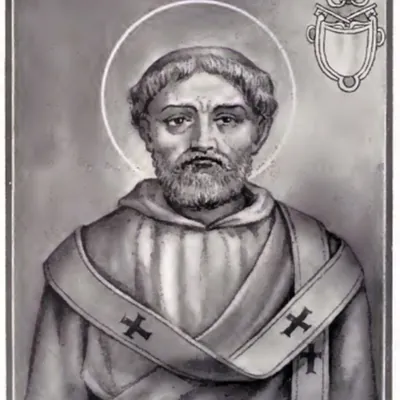
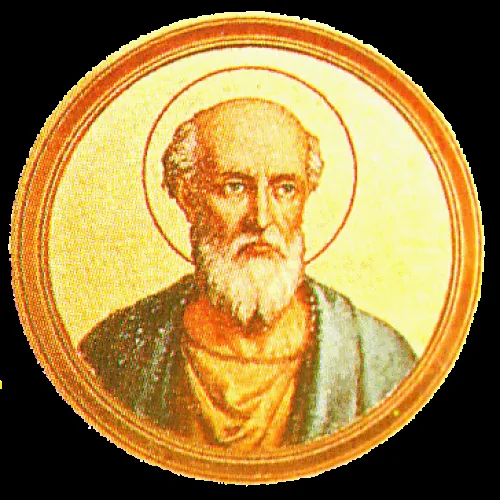
No portrait of Evaristus from his own time exists. He appears mainly in the long series of mosaic medallions of the popes in the Basilica of Saint Paul Outside the Walls in Rome, where he is shown as a bishop of Rome among his successors. In later art, like other early popes, he may be shown with papal vestments and a book, the sign of the faith he transmitted.

Where to pray to Saint Evaristus
- Saint Peter's Basilica (Vatican): near the tomb of Saint Peter, where the first bishops of Rome were buried according to the Liber Pontificalis.
- Naples (Italy): the church of Santa Maria Maggiore alla Pietrasanta, which according to another tradition holds his remains.
- Basilica of Saint Paul Outside the Walls (Rome): his medallion in the series of papal portraits.
Discover also
- Saint Clement of Rome, his predecessor, author of a famous letter to the Corinthians.
- Saint Linus and Saint Anacletus, the first successors of Peter.
- Saint Ignatius of Antioch, martyred in Rome in the same period.
- Saint John the Apostle, the last of the apostles, who according to tradition died during his pontificate.