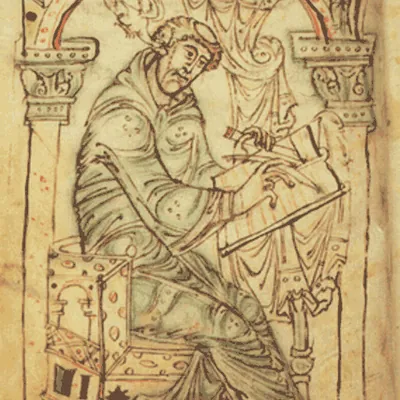
Saint Swithbert (Suitbert or Suidbert) was an Anglo-Saxon monk who became a missionary on the Continent at the end of the 7th century. A companion of Saint Willibrord among the Frisians and consecrated bishop by Saint Wilfrid, he then evangelized the Bructeri, on the right bank of the Rhine, before founding a monastery on the island of Werth, today Kaiserswerth, a district of Düsseldorf. He died there in March 713. His feast day is March 1.
Who was Saint Swithbert?
Swithbert was one of those monks from England who carried the Gospel to the still pagan Germanic peoples, in what are now the Netherlands and western Germany. Our main source on him is the Ecclesiastical History of the English People by Saint Bede the Venerable, completed in 731, less than twenty years after his death. Bede devotes only a few lines to him, but they are precious and reliable. Later Lives, written centuries afterward, added many legendary stories that should be treated with caution. What we know for certain, however, gives the portrait of a courageous missionary, ready to start again elsewhere when his work was destroyed, who ended his life in prayer and austerity.

Companion of Willibrord in Frisia
At the end of the 7th century, several English monks, often trained in Ireland, dreamed of proclaiming Christ to the Germanic peoples, whom they knew to be their kin. Around 690, Willibrord left for Frisia with twelve companions; Swithbert was one of them. The group settled in the lower Rhine region, under the protection of Pepin of Herstal, mayor of the palace of Austrasia, who was then extending his authority over Frisia.
Bede tells us that Willibrord went to Rome to receive the blessing of Pope Sergius I. During his absence, his brothers chose Swithbert to be their bishop. He crossed the sea again and received episcopal ordination from Wilfrid, the former bishop of York, then in exile in Mercia. This was not rivalry with Willibrord: the mission needed a bishop, and Willibrord himself would be consecrated in Rome a few years later, in 695, as archbishop of the Frisians.
Apostle of the Bructeri
On his return, Swithbert did not stay in Frisia. He turned to the Bructeri, a people living south of the Lippe, in present-day Westphalia, and began to evangelize them. According to Bede, many were converted by his preaching. But the work was soon ruined: the Saxons, still pagan, invaded the land and scattered the new Christians. Swithbert had to flee.
The monastery on the island of Werth
Swithbert took refuge with Pepin of Herstal. At the request of his wife Plectrude, Pepin gave him an island in the Rhine, called Werth, so that he could found a monastery there. Swithbert settled there with monks and spent his last years there. Bede writes that he led "a life of great austerity" there until his death. The Annals of Saint-Amand date it to March 713. The monastery he founded later became a house of canons, and the place took the name Kaiserswerth when the emperors built a palace there.
Devotion and art
Swithbert was venerated as a saint soon after his death. He is celebrated on March 1, the traditional day of his death, and on September 4, the anniversary of the translation of his relics. These still rest at Kaiserswerth, in the church that bears his name, now a basilica, in a great shrine of medieval goldsmith's work. He is especially honored in the Düsseldorf area and the archdiocese of Cologne, as well as in the Netherlands. He is shown as a bishop, with miter and crozier, often with a book, as a missionary to the Germanic peoples.

What can we learn from Saint Swithbert?
Swithbert knew failure: the mission among the Bructeri, begun successfully, was swept away by war. He did not lose heart. He agreed to start again differently, by founding a place of prayer that has lasted through the centuries. His example speaks to those whose work has been destroyed, to missionaries who must change their field, and to all who discover that the prayer of a monastery can bear more fruit than visible activity. You can pray to him for the mission, for the Church in Germany and the Netherlands, and for those who must start over from scratch.
To pray with him, see the prayer to Saint Swithbert and the novena to Saint Swithbert.
Where to pray to Saint Swithbert
- Basilica of Saint Suitbertus (Kaiserswerth, Düsseldorf, Germany): the church built on the site of his monastery, where his relics rest.
- Churches of Saint Suitbertus in the Rhineland and Westphalia, numerous in the lower Rhine region.
Discover also
- Saint Willibrord, the apostle of the Frisians, whose companion he was.
- Saint Wilfrid, the bishop who conferred episcopal ordination on him.
- Saint Bede the Venerable, the historian who handed down his memory.
- Saint Boniface of Mainz, another great Anglo-Saxon missionary to Germany.