Saint Rabanus Maurus, also known as Hrabanus Maurus or Raban Maur, was a 9th-century Benedictine monk who became abbot of Fulda and then Archbishop of Mainz. A student of Alcuin, he was one of the greatest scholars of the Carolingian Renaissance: he commented on the Bible, wrote a handbook for training priests, compiled an encyclopedia and composed picture poems in honor of the Cross. Tradition credits him with the hymn Veni Creator Spiritus, sung at Pentecost for more than a thousand years. Called the "teacher of Germany" (Praeceptor Germaniae), he is remembered on February 4.
Who was Saint Rabanus Maurus?
Rabanus was born around 780 in Mainz, into a noble family. While still a child, he was entrusted to the Abbey of Fulda, founded a few decades earlier by a disciple of Saint Boniface, the apostle of Germany. He received his first education there and became a monk.
After his ordination as a deacon, he left in 802 for the Abbey of Saint Martin in Tours, where Alcuin taught. Alcuin was the most famous teacher in the empire of Charlemagne, and he grew fond of this brilliant student. He gave him the nickname Maurus, in memory of Saint Maurus, the favorite disciple of Saint Benedict. Back in Fulda, Rabanus kept the name, which spoke both of his monastic faithfulness and of his debt to his teacher.

The teacher of Fulda
From 803 onward, Rabanus directed the monastic school of Fulda and made it one of the great intellectual centers of the West. It trained monks, but also priests and future leaders of the Church. His students included Walafrid Strabo, Lupus of Ferrières, Otfrid of Weissenburg and Rudolf of Fulda, who in turn became well-known scholars and writers.
Elected abbot in 822, he completed the buildings begun by his predecessor, built new ones and enriched the library. His monks produced mosaics, tapestries and reliquaries under his direction. He also increased the number of priests serving the countryside and expanded the help the abbey gave to the poor.
A body of work at the service of the faith
The writings of Rabanus are immense. He commented on almost every book of the Bible, gathering what the Fathers of the Church had said about each one. Around 810 he composed On the Instruction of Clerics (De institutione clericorum), a handbook to train priests in the liturgy, in preaching and in study.
Poems in the shape of the Cross
His Book in Praise of the Holy Cross (De laudibus sanctae crucis) brings together picture poems, true calligrams in which the letters of the Latin text trace the Cross, the figure of Christ or angels. Each page can be read as a poem and contemplated as an image, a remarkable union of faith, art and learning.

An encyclopedia for the Middle Ages
Between 842 and 847 he wrote On the Nature of Things (De rerum naturis), also called De universo, the only true encyclopedia of the Carolingian age. Inspired by Saint Isidore of Seville, it explains the things of nature and draws out their spiritual meaning. It remained a reference work until the 13th century.
Rabanus also wrote a treatise on grammar, sermons, letters, poems and a martyrology. Through his glosses in a Germanic language, he contributed to the development of written German.
Archbishop of Mainz
Caught up in the struggles between the sons of Emperor Louis the Pious, Rabanus supported Emperor Lothair. After Lothair's defeat, he gave up his office as abbot and withdrew to the Petersberg, near Fulda, where he prayed and wrote.
Once reconciled with King Louis the German, he became Archbishop of Mainz in 847, the see once held by Saint Boniface. He gathered synods to reform the life of the clergy and of the Christian people, and he took part in the doctrinal debates of his time. During the famine of 850, he gave away most of the revenues of the Church and fed more than three hundred people every day. He died at Winkel, in the Rheingau, on February 4, 856.
The Veni Creator Spiritus
Tradition attributes to Rabanus the hymn Veni Creator Spiritus, "Come, Creator Spirit." The attribution is ancient and widely accepted, though not certain. The hymn is sung at Pentecost, at ordinations, at confirmations and at the opening of great assemblies of the Church, including the conclave that elects a pope. English-speaking Catholics know it in several versions, the best known being "Come, Holy Ghost, Creator blest."
If the hymn is indeed his, as tradition holds, then every Pentecost, every ordination and every confirmation still sings his words.
What does his holiness teach us?
Rabanus Maurus was neither a martyr nor a hermit, but a scholar monk for whom study was a form of prayer and a service to the Church. He spent his life handing on what he had received: the Bible, the Fathers, ancient learning and the faith. Dante placed him in his Paradise, among the doctors. The Roman Martyrology remembers him as a saint on February 4.
Is Saint Rabanus Maurus a patron saint?
Rabanus Maurus has no official patronage. Yet the man known as the "teacher of Germany" is a natural intercessor for teachers, catechists, students, librarians and all who serve the faith through study and education. His care for the hungry during the famine of 850 also makes him a fitting friend for those who serve the poor.
Symbols and how to recognize Saint Rabanus Maurus in art
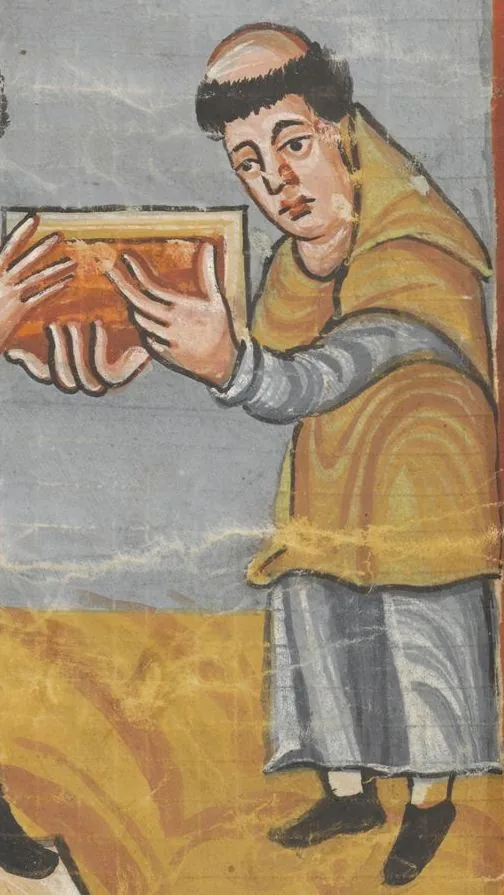
Rabanus is best known through the manuscripts of his own time. The most famous illumination shows him, with Alcuin at his side, presenting his book to the Archbishop of Mainz. He is usually depicted as a Benedictine monk or as a bishop, holding a book, the sign of his teaching. The picture poems of his Book in Praise of the Holy Cross, with their crosses and figures formed of letters, are the most striking image of his work.

Where to pray to Saint Rabanus Maurus
Fulda, in Hesse, is the place most closely linked to his life. Its Baroque cathedral stands on the site of the abbey church where he was a monk, schoolmaster and abbot, and it keeps the tomb of Saint Boniface. Mainz, his birthplace and the see he governed as archbishop, also keeps his memory.
Wherever you are, you can pray with him through the Veni Creator Spiritus, attributed to Saint Rabanus Maurus, or the novena to Saint Rabanus Maurus.
Discover also
- Saint Boniface, apostle of Germany and first Archbishop of Mainz, whose disciple founded Fulda.
- Saint Benedict of Nursia, whose Rule he followed.
- Saint Isidore of Seville, whose encyclopedia inspired his own.
- Saint Bede the Venerable, another scholar monk of the early Middle Ages.
- Saint Benedict of Aniane, monastic reformer of the same Carolingian age.