Saint Psote (also called Pichoté, Abashadi or Amba Sada) was an Egyptian bishop, martyred at the beginning of the 4th century. Shepherd of Psoi, in Upper Egypt, he was beheaded around 300, at the time of the great persecutions of the Roman Empire, on the orders of the governor of Ptolemais. His feast day is December 21.
Who was Saint Psote?
Psote belongs to the multitude of martyrs of Egypt, the region of the Empire most harshly struck by the persecution of Diocletian and his successors. His memory has been kept above all by the Coptic tradition, which honors him under several names. The reliable information about him is very scanty: his title of bishop, his martyrdom by beheading and the place where it happened. The more detailed accounts of his passion, handed down in Coptic and Arabic, are late and of uncertain historical value. This page therefore keeps to the essentials.

A bishop in a time of persecution
At the end of the 3rd century, Christianity was firmly rooted in the Nile valley. Christian communities were numerous as far as Upper Egypt, organized around their bishops, in communion with the see of Alexandria. Psote was one of these local pastors. The see of Psoi, a town close to ancient Ptolemais, lay in the region of present-day Sohag.
At the beginning of the 4th century, the Empire launched against Christians the most violent persecution in its history. The edicts ordered churches to be destroyed, the Scriptures burned, the clergy arrested and everyone forced to sacrifice to the gods. In Egypt, bishops were targeted first, for to strike the shepherd is to scatter the flock. Several of them gave their lives at that time, like Saint Phileas of Thmuis.
The martyrdom
According to tradition, Psote was arrested and brought before the governor of Ptolemais. Having refused to sacrifice and to deny Christ, he was condemned to death and beheaded. The date of his death remains approximate, around the year 300; the Coptic accounts of his passion add details, but these are too late to be accepted with certainty.
Devotion
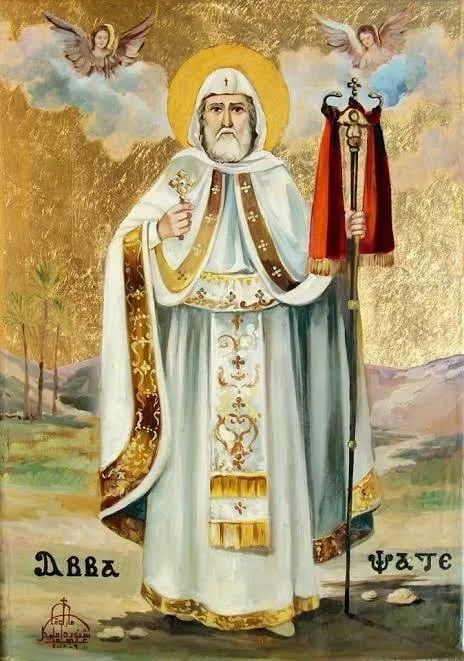
Saint Psote is honored above all by the Christians of Egypt, who have kept the memory of their martyrs alive. In the Latin tradition, he is celebrated on December 21, the date given by the Nominis calendar of the Church in France; the Coptic Church commemorates him on another date in its own calendar. He is shown as a bishop, wearing liturgical vestments, sometimes with the palm of martyrdom.
What can we learn from Saint Psote?
We know little about Psote, but we know the essential: he was a shepherd who did not leave his flock and preferred to die rather than deny his faith. He recalls the faithfulness of the Churches of the East, and especially of Christian Egypt, which have come through so many persecutions. You can pray to him for Christians persecuted today, especially in Egypt, and for bishops called to stand firm.
Where to pray to Saint Psote
- In your parish: no known Catholic shrine is dedicated to him; you can pray to him anywhere, especially for the Christians of the East.
- Sohag region (Upper Egypt): the land where he was bishop and martyr.
Discover also
- Saint Phileas of Thmuis, another Egyptian bishop martyred in the same persecution.
- Saint Menas, an Egyptian soldier martyred at the beginning of the 4th century.
- Saint Anthony the Great, father of the monks of Egypt, who lived at the same time.