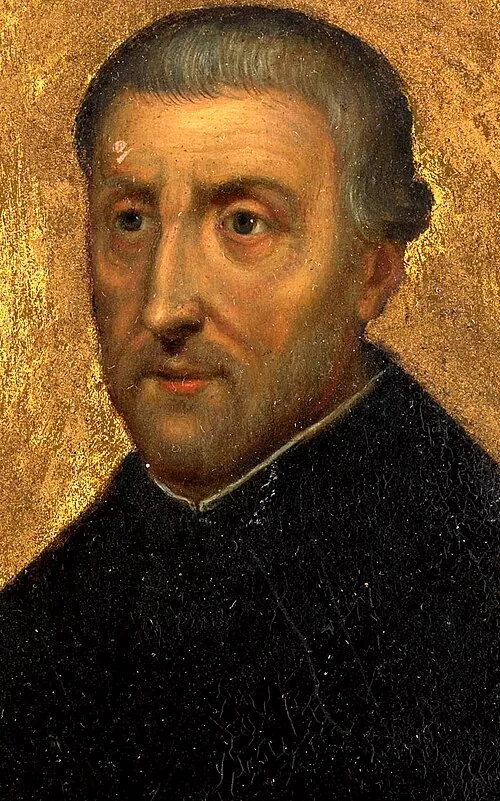
Saint Peter Canisius (1521-1597) was one of the first companions of the Society of Jesus. Born in the Netherlands, he spent his life as a priest in Germany, Austria and Switzerland, at the very moment when the Protestant Reformation was transforming northern Europe. A tireless preacher, founder of colleges and author of a catechism read for centuries, he is called the "second apostle of Germany," after Saint Boniface. A Doctor of the Church, he is celebrated on December 21.
Who was Saint Peter Canisius?
Peter Kanis was born on May 8, 1521, in Nijmegen, in the Habsburg Netherlands. His father, Jacob Kanis, a wealthy burgher, would serve nine times as mayor of the city; his mother, Ægidia van Houweningen, died shortly after his birth. At fifteen he left to study the liberal arts and law in Cologne. Little by little he discovered his calling to the priesthood and turned his studies toward Sacred Scripture and the Fathers of the Church. He earned his master of arts in 1540, after a stay at the University of Louvain.
In the spring of 1543, in Mainz, he met Peter Faber, the first companion of Ignatius of Loyola. Under his guidance he made the Spiritual Exercises for thirty days. He came out of them resolved: on May 8, 1543, his twenty-second birthday, he was admitted into the Society of Jesus. Soon afterward, with the support of the Carthusians of the city, he founded in Cologne the first Jesuit house in Germany.

A Jesuit formed by Ignatius
Ordained a priest in 1546, Canisius took part the following year in the Council of Trent as theologian to Cardinal Otto Truchsess von Waldburg, bishop of Augsburg. When the council was suspended, Ignatius called him to Rome to make his novitiate under his personal direction. In 1548 he was sent to Messina, in Sicily, with about ten Jesuits, to open the first college of the Society; there he taught Latin and rhetoric. This experience of education marked his whole life.
Thirty years in the service of the Church in Germany
In 1549, Pope Paul III, at the request of Duke William IV of Bavaria, sent him to teach at the University of Ingolstadt, where he became rector the following year. Then began an immense activity across the Holy Roman Empire. The Catholic Church there was weakened by the ignorance of part of the clergy and by the rapid spread of Protestant ideas, often supported by the princes.
Preacher in Vienna
In Vienna, from 1552, he preached at the cathedral and advised King Ferdinand I. The king wanted to make him archbishop of the city; faithful to the Jesuit vow of refusing honors, Canisius declined several times and agreed only to administer the diocese for a time. He took part in the diets of Augsburg and Regensburg, then, in 1557, in the Colloquy of Worms, where he defended the Catholic position against Philip Melanchthon.
Founder of colleges
Appointed in 1556 as the first provincial of the Jesuits of Upper Germany, a province stretching from Swabia to Hungary, he founded or had founded eighteen colleges in Central Europe, notably in Ingolstadt, Prague, Augsburg and Fribourg, while continuing to teach. Jesuit schools in the English-speaking world still bear his name, such as Canisius University in Buffalo, New York.

The catechism of Canisius
During his travels, Canisius saw the success of Luther's catechisms, published in 1529: clergy and lay people found in them a simple presentation of the faith. He understood that the Catholic Church had to offer the same service. In 1554 he published in Latin a summary of Christian doctrine, known as the Large Catechism. He soon drew from it a Small Catechism for children, then an intermediate version. Translated into German and many other languages, these works went through hundreds of editions; in some regions of Germany, "Canisius" even became a common noun for the catechism.
Canisius firmly opposed the doctrines of the Reformation, but he showed great consideration for persons. He preferred to speak of the "renewal" of the Church rather than reform, and he was convinced that this renewal had to begin with the fight against ignorance, that of the clergy as well as that of the faithful. He also translated Fathers of the Church and left an immense correspondence, published in eight volumes at the beginning of the twentieth century.
The last years in Fribourg
In 1580, Canisius settled in Fribourg, Switzerland. There, in 1582, he founded the College of Saint Michael, established a Marian congregation at the church of Notre-Dame and opened a printing press, convinced that the book was an instrument of evangelization. He spent his last years preaching, writing and guiding the faithful. He died on December 21, 1597, and was buried in the college church of Saint Michael, where his tomb is still venerated.
Why is Saint Peter Canisius a patron saint?
Saint Peter Canisius is the patron of the diocese of Innsbruck, in Austria, a land where he worked. Because of his life's work, he is also prayed to for catechists, teachers, Christian publishers and all who pass on the faith in a divided world. He did not seek to win debates, but to give believers, children included, the words of their faith. His work unites study, prayer and the patient labor of education.
To pray with him, see the prayer to Saint Peter Canisius and the novena to Saint Peter Canisius, prayed from December 12 to 20.
Symbols and how to recognize Saint Peter Canisius in art
- The black cassock of the Jesuits, often in the features of an old man, as in the early engravings.
- A book, recalling his catechism and his many writings.
- A pen or writing desk, for the author and the founder of a printing press.
Where to pray to Saint Peter Canisius
- Fribourg (Switzerland): his tomb in the church of Saint Michael, at the heart of the college he founded.
- Fribourg: the Basilica of Notre-Dame, where he founded a Marian congregation.
- Nijmegen (Netherlands): his hometown.
- Vienna: Saint Stephen's Cathedral, where he preached.
Discover also
- Saint Ignatius of Loyola, who received his vows and directed his novitiate.
- Saint Peter Faber, who guided him through the Spiritual Exercises.
- Saint Boniface, the first "apostle of Germany."
- Saint Robert Bellarmine, another Jesuit Doctor of the Church and author of catechisms.
- Saint Francis de Sales, another Doctor of the Catholic Reformation, in neighboring Savoy and Geneva.