Saint Polycarp was one of the very first bishops of the Church, at Smyrna, today's Izmir, on the western coast of Turkey. Presented by tradition as a disciple of the apostle Saint John, he knew the generation that had seen the apostles. He was burned alive at Smyrna at the age of eighty-six, probably in 155, and the account of his death is one of the oldest Christian texts devoted to a martyr. His feast day is February 23.
Who was Saint Polycarp?
Polycarp (in Greek Polykarpos, "bearing much fruit") belongs to the Apostolic Fathers, the Christian writers who were in contact with the apostles or with their close disciples. His origins, his youth and much of his life escape us. What we know of him comes from a few reliable witnesses: the letter Saint Ignatius of Antioch wrote to him, his own Letter to the Philippians, the memories of Saint Irenaeus of Lyon, who had heard him in his youth, and above all the Martyrdom of Polycarp, a letter sent by the Church of Smyrna shortly after his death. A later Life of Polycarp, from the late 4th or early 5th century, is very fanciful and can hardly be used.

The disciple of the apostles
Saint Irenaeus, who later became bishop of Lyon, remembered seeing Polycarp when he was a boy in Asia Minor. He recalled that the old bishop spoke of his conversations with John and with others who had seen the Lord, and that he repeated their words about the miracles and teaching of Jesus. For Irenaeus, Polycarp was therefore a precious link: he connected the communities of the 2nd century with the preaching of the apostles. That is why he called on him as a witness to the true faith against new doctrines, such as those of the Gnostics and of Marcion.
Saint Ignatius of Antioch, taken in chains to Rome, stopped at Smyrna and met Polycarp. Further along the road, he wrote him an affectionate letter, urging him to stand firm "like an anvil under the blows" and to care for everyone, especially the weak. Polycarp, for his part, gathered Ignatius's letters and sent them to the Christians of Philippi, together with his own letter. This simple, pastoral text calls for faithfulness, charity and the rejection of the love of money.
The meeting with Pope Anicetus
Around 154, already old, Polycarp made the long journey to Rome to meet Pope Saint Anicetus. The Churches of Asia celebrated Easter on the 14th of the Jewish month of Nisan, whatever the day of the week, while Rome kept it on Sunday. The two bishops could not agree, each wishing to remain faithful to the custom received from his predecessors. But they did not break communion: according to Irenaeus, Anicetus even let Polycarp preside at the Eucharist in Rome. This episode has remained an example of peace between Churches that do not share the same customs.
The martyrdom at Smyrna
The Martyrdom of Polycarp tells how a persecution broke out at Smyrna. Several Christians, including the young Saint Germanicus, had already been thrown to the beasts when the crowd demanded the old bishop. His friends hid him in a house outside the city. He was found and arrested at night, and asked only for time to pray. Brought to the stadium, he was ordered by the proconsul to deny Christ. He answered with words that became famous: "Eighty-six years I have served him, and he has done me no wrong. How can I blaspheme my King who saved me?"
Condemned to the stake, he prayed one last time, thanking God for judging him worthy to share the cup of Christ. According to the account, the flames curved around him without consuming him, and an executioner had to finish him with a dagger. The text deliberately compares his passion with that of Jesus: he withdraws outside the city, he is betrayed by people close to him, the officer who arrests him is called Herod. Historians see in it a carefully composed work, but the substance of the account, written by witnesses shortly afterward, is considered sound.
The date of his death is debated: the clues in the text, a "great Sabbath" and the seventh day before the Kalends of March, lead many historians to February 23, 155, but Eusebius of Caesarea places it in 167, and other dates have been proposed.
The first cult of a martyr
The authorities wanted to prevent the Christians from honoring the martyr. Yet after the burning, the faithful were able to gather his bones, "more precious than costly stones", and lay them in a fitting place. They announced that they would gather there every year, in joy, to celebrate the day of his birth into heaven. This is one of the oldest testimonies to the cult of martyrs and their relics. The model of the Martyrdom of Polycarp later inspired a great many accounts of martyrs.
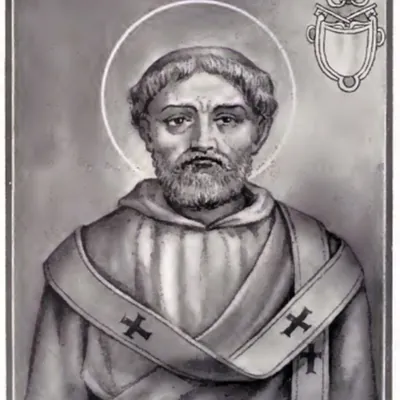
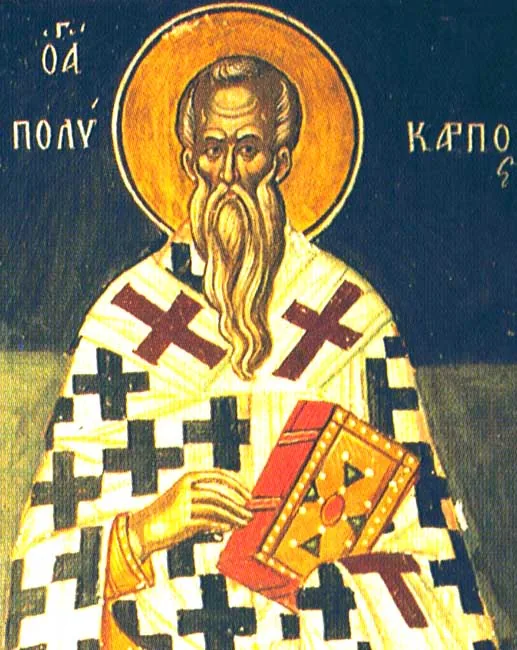
In the 6th century, a Burgundian tradition made Polycarp the spiritual father of several evangelizers of Gaul, such as Saint Benignus of Dijon and Saint Andochius of Saulieu. These accounts are legendary, but they reflect the real links between the Churches of Asia Minor and the Church of Lyon, where Irenaeus, who had once listened to him, became bishop. Polycarp is shown as a bishop, with the pallium and crozier, a book in his hand, often with the palm of martyrdom or amid the flames of the stake.
What can we learn from Saint Polycarp?
Polycarp is first of all a witness. He faithfully kept what he had received from the apostles and handed it on without adding anything. He was able to remain at peace with the bishop of Rome while defending the custom of his own Church. And at the end of a long life, he preferred death to denial, with disarming simplicity: one does not betray the one who has done us nothing but good. We can pray to him for faithfulness in the faith, for the unity of Christians, for bishops, and for elderly people who carry the memory of the Church.
To pray with him, see the prayer to Saint Polycarp and the novena to Saint Polycarp.
Where to pray to Saint Polycarp
- Izmir (Turkey), the ancient Smyrna: the Catholic church of Saint Polycarp, in the city of his martyrdom.
- Lyon (France): the church of Saint-Polycarpe, on the slopes of the Croix-Rousse, in the city where his disciple Irenaeus was bishop.
- In any church on February 23, the day the Church keeps his memory.
Discover also
- Saint Ignatius of Antioch, who wrote to him on the way to his martyrdom.
- Saint John the Apostle, whom tradition makes his teacher.
- Saint Anicetus, the pope with whom he discussed the date of Easter.
- Saint Germanicus of Smyrna, a martyr of the same persecution.