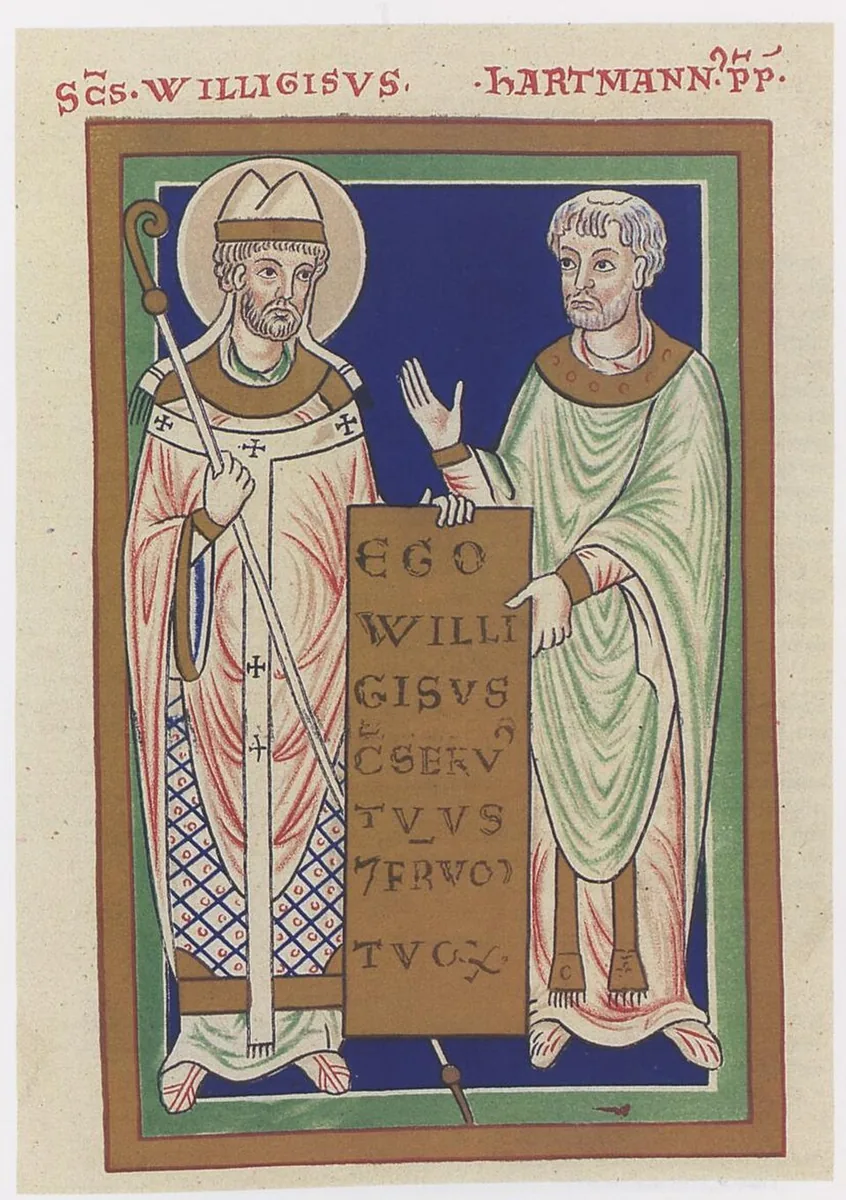
Saint Willigis was archbishop of Mainz at the end of the tenth century and one of the most influential men in the Holy Roman Empire. Born into a family of modest standing, he became chancellor of the emperors, acted as regent during the minority of Otto III and crowned King Henry II. A great builder, he founded Mainz Cathedral. He died on February 23, 1011, and his feast day is February 23.
Who was Saint Willigis?
Willigis was born around 940 at Schöningen, in Saxony, in today's Lower Saxony, Germany. His father was a free man but a commoner. A tradition says that his father was a wheelwright, and the city of Mainz has kept a wheel in its coat of arms to this day. This explanation belongs to popular tradition, but it expresses well the astonishment of his contemporaries at the rise of a man from such humble origins.
Thanks to his protector, Bishop Volkold of Meissen, he was admitted around 969 to the court of Emperor Otto I. From 971 he served as chancellor, an office he kept under Otto II. In 975 the cathedral chapter of Mainz elected him archbishop. He would remain archbishop for thirty-six years, until his death. In the Ottonian Empire, the archbishop of Mainz was one of the leading princes of the realm, so this election placed a man of humble birth at the very center of political and religious life.
The "father of emperors"
As soon as he was elected in 975, Willigis obtained from Pope Benedict VII primacy over the other bishops of the Empire. In 983, at the Diet of Verona, Otto II granted the Church of Mainz vast territories along the Rhine and the Nahe, which shaped the future Electorate of Mainz. That same year Otto II died, leaving a three-year-old son, Otto III. Empress Theophano ruled as regent; after her death in 991, Willigis effectively governed until the young king came of age in 994.
In 996 he went with Otto III to Rome, where the emperor supported the papacy against the powerful Crescentii family. After the death of Pope John XV, Otto had his relative Bruno elected, who became Gregory V; it was under the influence of Willigis that he was consecrated. When Otto III died young in 1002, it was again Willigis who made possible the accession of the Duke of Bavaria, Saint Henry II, whom he crowned in Mainz on June 6, 1002. His contemporaries called him "the father of the emperors and of the Empire."
The builder of Mainz Cathedral
Willigis founded Saint Martin's Cathedral in Mainz. He wanted a building worthy of his Church's place in the Empire: the cathedral was said to be so large that all the inhabitants of the city could fit inside. It was the first building of such size north of the Alps. It is not known for certain whether work began as early as 975 or only around 998. Kings Henry II and Conrad II were crowned there.
The cathedral was completed in 1009, but a fire ravaged it on the very day of its consecration, or the day before, probably because of the torches lit for the celebration. Nearly seventy years old, Willigis immediately ordered it rebuilt. Around 990 he had also founded the Church of Saint Stephen in Mainz, where he was buried, since the cathedral had not yet been restored. He is also credited with the bronze doors of the cathedral, the Basilica of Saint Martin in Bingen and a stone bridge over the Nahe.
Why pray to Saint Willigis?
Willigis is honored above all in Mainz, the city he served for thirty-six years. He is not widely known as the patron of a particular profession, but his life makes him a natural intercessor for those who hold public responsibilities, for people of modest origins called to high office, and for all who must rebuild after a failure. The story of the cathedral burning on its consecration day and being rebuilt at once speaks to anyone who has seen years of work destroyed.
What can we learn from Saint Willigis?
Willigis belonged to an age when bishops were also statesmen. His holiness is not shown in miracles, but in the faithfulness of a pastor who put his talents at the service of the Church and of peace in the Empire, and in the perseverance of a builder who, standing before his ruined cathedral, chose to begin again. His life shows that power can be exercised as a service, and that humble beginnings are no obstacle to the plans of God.
Symbols and how to recognize Saint Willigis in art
Willigis is depicted as an archbishop, with miter, pallium and crozier. A wheel may appear with him, recalling the tradition that his father was a wheelwright and the wheel in the coat of arms of Mainz.
Where to pray to Saint Willigis
- Mainz (Germany): the Church of Saint Stephen, which he founded and where he is buried.
- Mainz: Saint Martin's Cathedral, whose construction he began, and its bronze doors.
- Bingen (Germany): the Basilica of Saint Martin.
To pray with him, Saintspedia offers a prayer to Saint Willigis and a novena to Saint Willigis ending on February 23.
Discover also
- Saint Boniface, apostle of Germany and first archbishop of Mainz.
- Saint Henry II, the emperor he crowned.
- Saint Cunigunde, wife of Henry II.
- Saint Adelaide, empress of the Ottonian dynasty.
- Saint Rabanus Maurus, another great archbishop of Mainz.