Saint Anicetus was, according to the traditional list of popes, the eleventh bishop of Rome, in the middle of the second century. A native of Syria, he led the Church of Rome at a time when it was shaken by currents of thought that threatened its unity, such as Gnosticism and the teaching of Marcion. His name remains linked to a brotherly meeting with Saint Polycarp of Smyrna, who came to Rome to discuss the date of Easter with him. He is listed in the Roman Martyrology on April 17, though he is often celebrated on April 20.
Who was Saint Anicetus?
According to the Liber Pontificalis, a collection of entries on the popes written much later, Anicetus was a Syrian from the city of Emesa, today's Homs. We do not know why he came to Rome. He succeeded Saint Pius I and was followed by Saint Soter.
The dates of his time as bishop remain uncertain. Historians place him roughly between the years 150 and 168, and the Annuario Pontificio, the official yearbook of the Holy See, gives 153 as a possible starting date. Like the other bishops of Rome of his century, he led a community that was growing, diverse and often exposed to danger.

Defending the faith of the apostles
The first years of Anicetus's ministry were marked by the success of Marcion in Rome. Marcion rejected the Old Testament and kept only part of the writings of the apostles. The Gnostics, for their part, promised a secret knowledge reserved for a few initiates.
Anicetus opposed these movements by relying on apostolic succession: the authentic faith is the one the bishops received from the apostles and handed on publicly, not a hidden teaching for an elite. This principle, which Saint Irenaeus would develop a few years later, remains at the heart of the Catholic understanding of Tradition.
During his time as bishop, the philosopher Saint Justin Martyr taught in Rome, and the historian Hegesippus came from the East to verify the tradition of the Churches. According to Hegesippus, Eleutherius, a future pope, was then a deacon of Anicetus.
The meeting with Polycarp
The best-attested episode of his life is reported by Saint Irenaeus of Lyon and passed on by Eusebius of Caesarea. Polycarp, bishop of Smyrna and a disciple of the apostle John, came to Rome despite his great age.
The Churches of Asia Minor celebrated Easter on the fourteenth day of the Jewish month of Nisan, whatever the day of the week; Rome always kept it on a Sunday. The two bishops could not agree. Polycarp held to the custom he had received from John; Anicetus held to the custom of the presbyters who had gone before him. Yet they parted in peace and shared communion together. According to Irenaeus, Anicetus even let Polycarp celebrate the Eucharist in his place, as a sign of respect.
Irenaeus later held up this meeting as a model, when another pope wanted to break with the Churches of Asia over the same question. Disagreement on a practice need not break the communion of faith.

The first monument over Peter's tomb?
Historians often date to the time of Anicetus the building, in the Vatican necropolis, of the small monument erected over the presumed tomb of Saint Peter. This "trophy," the first core of the future basilica, was found during the excavations of 1939-1949 beneath Saint Peter's Basilica.
Martyr or not?
Tradition counts Anicetus among the martyr popes who died during the persecutions. No early document confirms this, and accounts even differ on the day of his death, placed between April 16 and 20. According to tradition, he was buried in the cemetery on the Appian Way that would become the Catacomb of Saint Callixtus. In 1604, Pope Clement VIII had his remains transferred to the chapel of the Palazzo Altemps, in Rome.
What his holiness teaches
Saint Anicetus is the pope of faithfulness and patience. Firm on the essentials in the face of teachings that disfigured the Gospel, he was able to welcome a brother from another tradition without breaking with him. For Christians today, his example invites us to join the defense of the faith with care for unity. He is not the patron saint of a particular cause, but he is a natural intercessor for ecumenical dialogue and for those who must hold to the truth while keeping peace.
Symbols and how to recognize Saint Anicetus in art
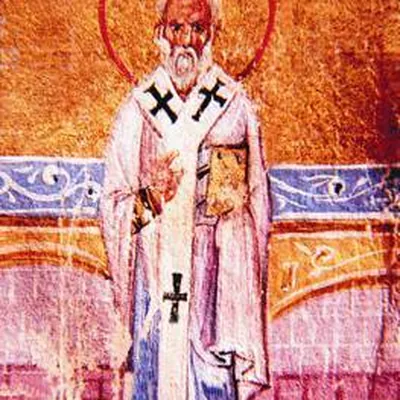
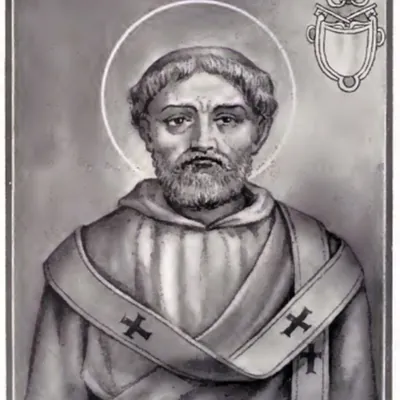
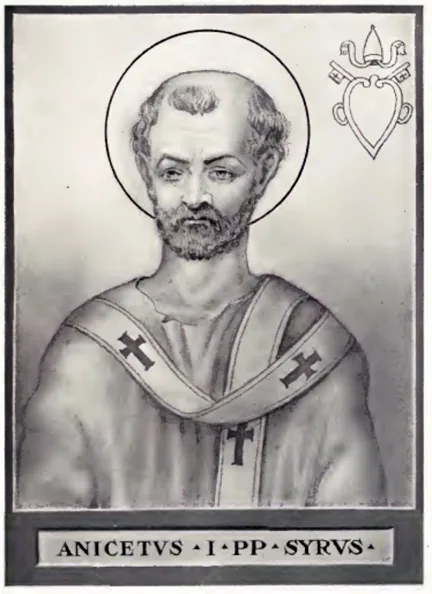
No authentic portrait of Anicetus exists. Like the other early popes, he appears in the gallery of papal portrait medallions in the Basilica of Saint Paul Outside the Walls, in Rome, dressed as a pope. When he is honored as a martyr, the palm may accompany him, as it does other martyr popes in Christian art.

Where to pray to Saint Anicetus
The remains attributed to Saint Anicetus have rested since 1604 in the chapel of the Palazzo Altemps, in Rome, near Piazza Navona. Pilgrims can also pray in the Catacomb of Saint Callixtus on the Appian Way, where tradition places his first burial, and in Saint Peter's Basilica, built over the tomb of the apostle that the monument of his time honored.
To pray with him, see the prayer to Saint Anicetus or the novena to Saint Anicetus.
Discover also
- Saint Pius I, his predecessor.
- Saint Soter, his successor.
- Saint Eleutherius, who, according to Hegesippus, was his deacon.
- Saint Justin Martyr, philosopher and martyr, active in Rome during his time as bishop.
- Saint Ignatius of Antioch, another great Syrian bishop of the second century.