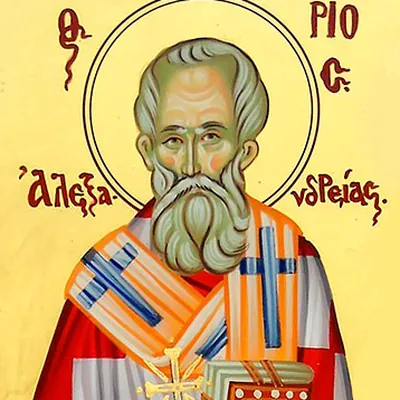
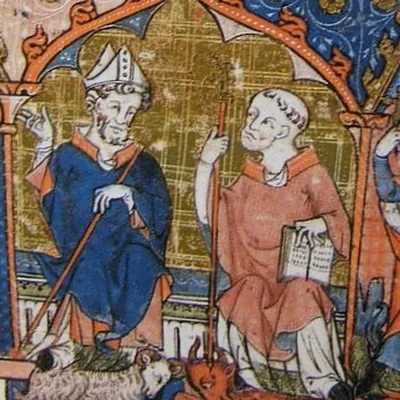
Saint Nymphas was a Christian of the 1st century, a member of the Church of Laodicea, in Phrygia, in present-day Turkey. Saint Paul greets him at the end of his letter to the Colossians, mentioning the Church that met in his house. We know almost nothing else about him, and some manuscripts even read "Nympha", a woman's name. His feast day is February 28, together with Saint Eubulus.
Who was Saint Nymphas?
All we know of Nymphas fits into one verse of the New Testament. At the end of the letter to the Colossians, the apostle writes: "Give my greetings to the brothers at Laodicea, and to Nymphas and the church in his house" (Colossians 4:15). These few words are nevertheless enough to sketch a portrait: Nymphas was a Christian of Laodicea, well-off enough to own a house where a community could gather, and well enough known to Paul and his co-workers to be greeted by name. He belongs to that generation of believers, often anonymous, who welcomed the first Churches into their homes and allowed the Gospel to take root.

A Church in a house
In Saint Paul's time, Christians did not yet have churches in the sense of buildings. They met at the home of one of their members to hear the Scriptures and the teaching of the apostles, to pray and to share the Lord's Supper. The New Testament mentions several of these "house churches": that of Prisca and Aquila, that of Philemon at Colossae, and that of Nymphas at Laodicea. The master or mistress of the house offered hospitality and space, and no doubt some form of responsibility in the community. This was probably the role Nymphas played.
Laodicea was a wealthy city of the Lycus valley, neighbor to Colossae and Hierapolis. The letter to the Colossians in fact asks that it also be read at Laodicea, and that a letter addressed to the Laodiceans be read at Colossae (Colossians 4:16). A few decades later, the Book of Revelation contains a message from Christ to the Church of Laodicea, calling it out of lukewarmness: "Behold, I stand at the door and knock" (Revelation 3:20). This verse takes on particular depth for a Church born in homes.
Nymphas or Nympha?
The ancient manuscripts of the letter to the Colossians do not agree. Some write "Nymphas and the church in his house" in the masculine, others "Nympha and the church in her house" in the feminine, and others again "their house". Many scholars today think it was a woman, Nympha, but the question remains open. Liturgical tradition, for its part, has kept the masculine form. This debate takes nothing away from the essential point: a person of Laodicea opened their home to the Church.
Devotion
Nymphas is honored as a saint by the Catholic Church and by the Orthodox Churches. Tradition celebrates him on February 28 with Saint Eubulus, a Christian of Rome whom Paul mentions in the second letter to Timothy (2 Timothy 4:21). No reliable tradition tells us about his life after Paul's letter, nor about his death, and neither tomb nor relics are known. No iconography of his own is known in the West.

What can we learn from Saint Nymphas?
Saint Nymphas reminds us that the Church began in homes. Before basilicas and cathedrals, there were Christians who opened their doors, shared their tables and welcomed their brothers and sisters to pray. His example speaks to families, to households that host prayer groups, and to communities seeking to live true fraternity. We can pray to him for hospitality, for small Christian communities and for those who serve the Church quietly.
To pray with him, see the prayer to Saint Nymphas and the novena to Saint Nymphas.
Where to pray to Saint Nymphas
- At home, with your family or a prayer group, on February 28.
- Laodicea (near Denizli, Turkey): the ancient site of the city where his community lived.
- In your parish, reading the end of the letter to the Colossians.
Discover also
- Saint Paul, the apostle who greets him in the letter to the Colossians.
- Saint Epaphras, the evangelizer of Colossae and Laodicea.
- Saint Philemon, another Christian of the Lycus valley who welcomed the Church into his house.
- Saint Onesimus, the slave who became a brother, sent by Paul to Colossae.