Saint Bruno is the founder of the Carthusian Order, one of the oldest contemplative orders in the Church, often said never to have needed reform. A brilliant master of the cathedral school of Reims, he left a prestigious career at around fifty to live in solitude. In 1084 he settled with six companions in the Chartreuse mountains of the French Alps, near Grenoble. Called to Rome by the pope, he ended his life in a hermitage in Calabria, where he died on October 6, 1101. He is celebrated on that day.
Who was Saint Bruno?
Bruno was born around 1030 in Cologne, in the Holy Roman Empire. Almost nothing is known of his family or childhood. As a young man he came to study at Reims, one of the great intellectual centers of the West, and stayed there.
Around 1056 he became scholasticus, the head of the cathedral school. For some twenty years he taught philosophy and theology and trained students who would become bishops, abbots and even a pope: Odo of Châtillon, the future Pope Urban II. His contemporaries described him as a learned and respected master, a "fountain of wisdom."
The master of Reims
At Reims, Bruno was not only a teacher: he was also a canon and took part in governing the diocese. When Archbishop Manasses of Gournay behaved like a greedy lord and sold Church offices, Bruno was among the clerics who denounced him to the legates of Pope Gregory VII. He had to leave Reims for several years, until Manasses was deposed in 1080.
It was at that time, Bruno himself recounts in a letter written much later, that he and two friends, in a garden, vowed to leave the world and give themselves to God. The others did not keep their promise; he did. He could have become Archbishop of Reims, but he renounced every honor.

The wilderness of the Chartreuse
After a first attempt near Molesme, with the abbot Saint Robert, Bruno sought a deeper solitude. With six companions, four clerics and two laymen, he went to Grenoble to see Bishop Hugh. According to tradition, the bishop had seen in a dream seven stars guiding him to a deserted place in his mountains. In 1084, around the feast of Saint John the Baptist according to tradition, Hugh himself led the seven men into a high, isolated valley of the Chartreuse massif. There they built wooden cells around a small church.
The life they created joined the solitude of hermits with the common life of monks. Each one lives alone in his cell, where he prays, reads, works and eats; all gather in church for the night office, Mass and Vespers, and share a meal and a walk on Sundays. Bruno did not write a rule: his successor Guigo set down the customs of the Chartreuse in writing around 1127.
The name of the place, Chartreuse, gave the order its name: Carthusians in English, and their monasteries are called charterhouses. Today Carthusians live in Europe and the Americas, including Saint Hugh's Charterhouse at Parkminster in England and the Charterhouse of the Transfiguration in Vermont. Many English speakers discovered their life through the documentary Into Great Silence (2005), filmed at the Grande Chartreuse.

From Rome to Calabria
Only six years after the foundation, in 1090, Pope Urban II, who needed reliable advisers, called his former teacher to Rome. Bruno obeyed, leaving behind a community at a loss, which scattered for a time before returning. In Rome he could not bear life at court. He refused the archbishopric of Reggio, in Calabria, and obtained the pope's permission to return to solitary life, but in southern Italy. With new companions, around 1091, he founded the hermitage of Santa Maria della Torre, on land given by the Norman count Roger.
He spent the last ten years of his life there. From Calabria he wrote two letters that have come down to us: one to his friend Raoul le Verd, to remind him of their youthful vow, and the other to his brothers at the Chartreuse. Before he died, on October 6, 1101, he made before his brothers a profession of faith that has been preserved.
A hidden saint
Bruno was never canonized by the ordinary procedure: the Carthusians, devoted to hiddenness, never sought to promote his cult. Only in 1514 did Pope Leo X allow them to celebrate his feast, which Pope Gregory XV later extended to the whole Church in 1623. In the seventeenth century the painter Eustache Le Sueur devoted a famous cycle of paintings to him for the Paris charterhouse, now in the Louvre.
Why do Catholics pray to Saint Bruno?
Saint Bruno reminds a noisy world of the value of silence and of a solitude filled with God. He did not flee out of contempt for people: he chose to pray for them in secret. His life also shows that it is never too late to answer a call, and that obedience can overturn even our dearest plans. He is invoked to find inner peace, for contemplative vocations, and by those who are trying to discern their path.
Symbols and how to recognize Saint Bruno in art
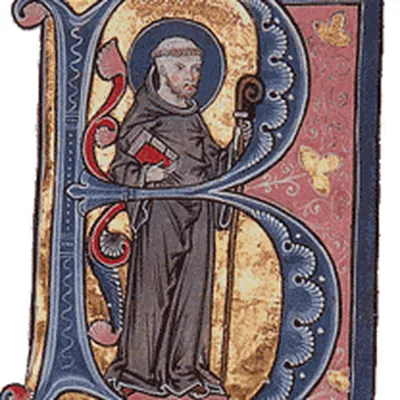
- The white Carthusian habit, with its hood.
- A crucifix that he contemplates, sometimes with a skull, sign of meditation on death.
- A finger on the lips, a sign of silence.
- A miter or crozier at his feet, recalling the honors he refused.
- Seven stars, recalling the dream of Saint Hugh and the seven founders.
Where to pray to Saint Bruno
- Saint-Pierre-de-Chartreuse (Isère, France): the Grande Chartreuse (the monastery itself is closed to visitors), the chapel of Saint Bruno and the chapel of Notre-Dame-de-Casalibus on the site of the first hermitage, and the Correrie museum.
- Serra San Bruno (Calabria, Italy): the charterhouse where his relics rest, and the hermitage of Santa Maria del Bosco.
- Reims: the Cathedral of Notre-Dame, whose school he directed.
- Rome: the Basilica of Santa Maria degli Angeli, a former Carthusian church, which houses a large statue of the saint by Houdon.
To pray with him, read the prayer to Saint Bruno, which quotes his letters, or follow the novena to Saint Bruno from September 27 to October 5, ending on the eve of his feast.
Discover also
- Saint Robert of Molesme, with whom he made his first attempt at solitary life.
- Saint Hugh of Grenoble, the bishop who led him into the Chartreuse.
- Saint Benedict of Nursia, father of Western monasticism.
- Saint Romuald, founder of the Camaldolese, another great hermit.
- Saint Anthony the Great, father of the desert hermits.