Saint Morand was a Benedictine monk of the abbey of Cluny, born in the Rhineland around 1050, who died on June 3, 1115, at the priory of Altkirch, in Alsace. A disciple of Saint Hugh of Cluny, he was sent to the Sundgau, of which he became the patron and "apostle". Since the Middle Ages he has also been invoked as the protector of winegrowers. His feast day is June 3.
Who was Saint Morand?
Morand (in Latin Morandus) lived at a time when the abbey of Cluny, in Burgundy, shone across all of Europe and reformed many monasteries. He was one of those Cluniac monks sent to found or restore communities. His life is known through his first biographers, taken up in the 17th century by the Acta Sanctorum. These accounts mix solid facts, such as his mission to Altkirch, with wondrous episodes. Historians hesitate on some points, such as the date and place of his birth. What is beyond doubt is the devotion his tomb aroused for centuries in southern Alsace.

From pilgrim to monk of Cluny
According to his biographers, Morand came from a noble family and received a good education at Worms, an important episcopal city on the Rhine. Once a priest, he set out on pilgrimage to the tomb of Saint James at Compostela. On the way, he stopped at Cluny and was struck by the life of the monks and by the personality of Abbot Hugh. On his return, he asked to join the community. Hugh then sent him to Auvergne, where Cluny was extending its influence: Morand took part in the reform of several houses, notably the abbey of Mozac, where he helped restore the Rule of Saint Benedict.
The apostle of the Sundgau
In 1105, Count Frederick of Ferrette gave Cluny the church of Saint Christopher at Altkirch, in the Sundgau, in the south of Alsace. The first monks who came from Burgundy spoke the Romance language and did not understand the Alemannic speech of the inhabitants. Hugh then chose Morand, who knew both languages. At the priory, he became known for his fervor, his faithfulness to prayer and his gift for restoring peace between people. His biographers describe him as very thin, white haired, gentle and modest. Healings are attributed to him, including that of Count Frederick, and the deliverance of troubled people. He died in his cell on June 3, 1115.
The protector of winegrowers
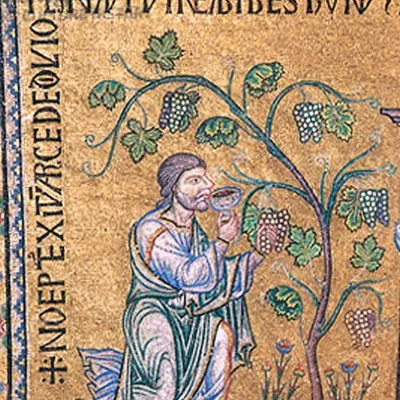
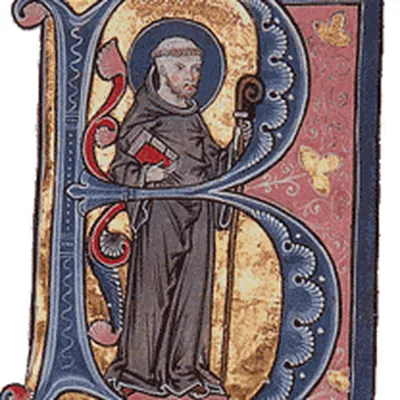
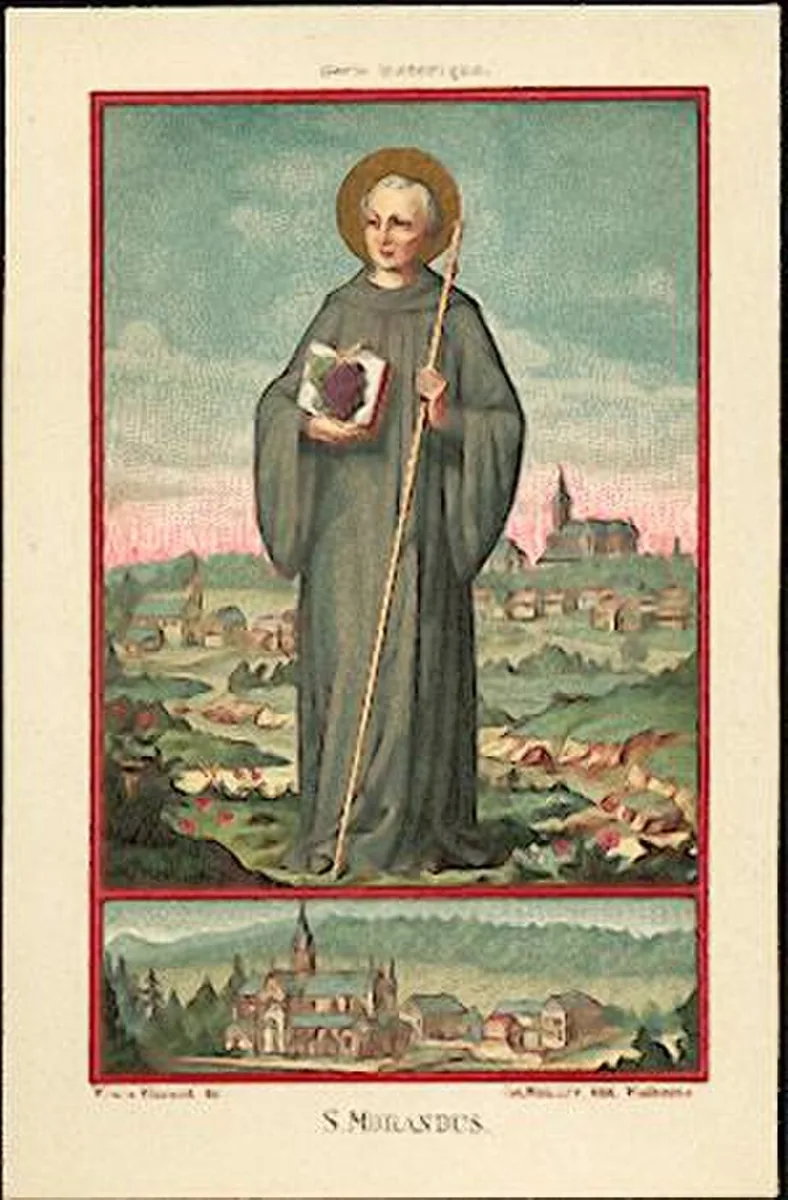
Several traditions made Morand the patron of the vine and of wine, in Alsace, but also in Burgundy, Champagne, Lorraine, the Rhineland and Franconia. It is said that he lived through a whole Lent on a single bunch of grapes. Another story says that one day, when the priory had no wine to receive guests, he made the Sign of the Cross over an empty barrel, which filled with excellent wine. One tradition even credits him with bringing the vine to Alsace, which belongs to legend. He is therefore shown as a monk, with a bunch of grapes in one hand and a pilgrim's staff in the other.
Devotion and relics
Morand's tomb, covered with a slab and a recumbent effigy, soon became a place of pilgrimage. Sick people who suffered in the head or limbs would place them in the two hollows of the tomb slab. A confraternity of Saint Morand was founded by the end of the 13th century. The Habsburgs, lords of the region, made him a saint of their house: in 1360, Duke Rudolf IV had part of his skull taken to Saint Stephen's Cathedral in Vienna, and in 1428, Archduke Frederick gave a head reliquary to the priory. At nearby Walheim, a chapel called the "Rest of Saint Morand" keeps the memory of a rock under which, according to legend, he sheltered during a storm.

What can we learn from Saint Morand?
Saint Morand put what he had received at the service of the Gospel: his learning, his knowledge of two languages, his experience as a monk. He knew how to make himself understood by a people that was not his own and to build a community of prayer among them. You can pray to him for winegrowers and work on the land, for Alsace and the Sundgau, for monks and nuns, for those who must learn a new language or culture, and for pilgrims.
To pray with him, see the prayer to Saint Morand and the novena to Saint Morand.
Where to pray to Saint Morand
- Church of Saint-Morand (Altkirch, Haut-Rhin): his recumbent effigy and head reliquary, on the site of the former priory.
- Chapel of the Rest of Saint Morand (Walheim, Haut-Rhin): the rock linked to a legend of his life.
- Saint Stephen's Cathedral (Vienna, Austria): part of his skull was placed there in the 14th century.
Discover also
- Saint Hugh of Cluny, the abbot who welcomed him to Cluny and sent him to Altkirch.
- Saint Odilo of Cluny, another great abbot of Cluny.
- Saint James the Greater, toward whose tomb he set out on pilgrimage.
- Saint Vincent of Saragossa, another patron of winegrowers.