Noah is the hero of the flood story in the book of Genesis. In a world overrun by violence, he is the only "righteous and blameless man" who "walked with God." At God's command he builds an ark, which he enters with his family and a pair of every kind of animal. After the flood he sends out the dove, which comes back with an olive branch, then God makes a covenant with him and with all creation under the sign of the rainbow. The Fathers of the Church saw in the ark an image of the Church and of baptism.
Who was Noah?
According to Genesis, Noah is the son of Lamech, a descendant of Adam through Seth. His name evokes "rest" or "comfort." He is the father of three sons, Shem, Ham and Japheth, from whom the Bible traces all the peoples of the earth. The flood story (Genesis 6 to 9) is not a news report: like other ancient Near Eastern stories it speaks of a great flood, but it turns it into a teaching about evil, God's judgment and his mercy, which never gives up on his creation.
The ark
"The Lord saw how great the wickedness of human beings was on earth" (Genesis 6:5). But "Noah found favor with the Lord." God asks him to build an ark of wood, coated with pitch, with three decks, a door and an opening. Noah obeys without argument: "Noah complied; he did just as God had commanded him" (Genesis 6:22). He enters it with his wife, his three sons and their wives, and animals of every kind. The Lord himself shuts the door behind him.
The flood and the dove
Rain falls for forty days and forty nights; the waters cover even the highest mountains. Then God "remembers Noah," a wind blows and the waters subside. The ark comes to rest on the mountains of Ararat. Noah sends out a raven, then a dove, which comes back having found nowhere to rest. Seven days later he sends it out again: it returns in the evening with a fresh olive leaf in its beak. The earth is saved. The dove and the olive branch have become universal symbols of peace.
The rainbow of the covenant
Coming out of the ark, Noah builds an altar and offers a sacrifice. God blesses Noah and his sons: "Be fertile and multiply." Then he makes a covenant with him, with his descendants and with every living creature: never again will a flood destroy the earth. "I set my bow in the clouds to serve as a sign of the covenant between me and the earth" (Genesis 9:13). It is the first covenant of the Bible, offered not to one people but to all humanity and to all creation.
Why do Christians honor Noah?
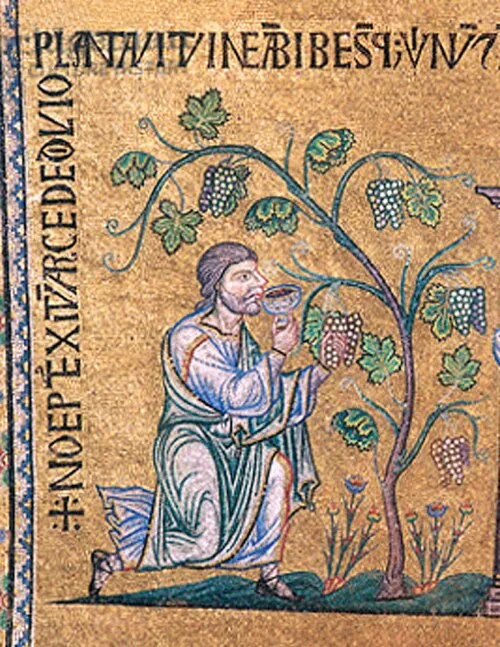
Noah is the righteous man who stays faithful when everyone else does otherwise, and who obeys God without understanding everything. The letter to the Hebrews names him among the great witnesses of faith (Hebrews 11:7). Saint Peter sees in the ark a figure of baptism, which saves "through water" (1 Peter 3:20-21), and the Fathers of the Church see in it the Church, where salvation is found in the midst of storms. The Bible also tells that he planted a vineyard and became drunk: even the righteous remain human. People pray with Noah for trust in trials, protection of their family and care for creation.
To pray with him, read the prayer with Noah, or follow the novena with Noah.
Discover also
- Abraham, with whom God made a covenant after Noah.
- Moses, saved from the waters in a little ark of papyrus.
- Saint Francis of Assisi, friend of all creation.
- Job, another righteous man of the Bible who kept his faith in trial.