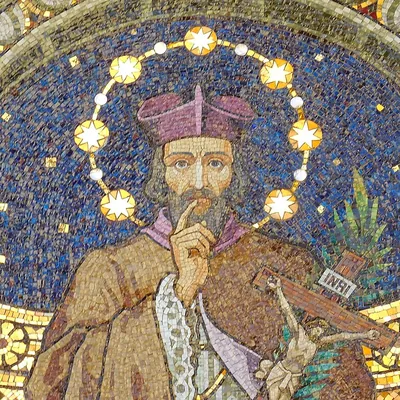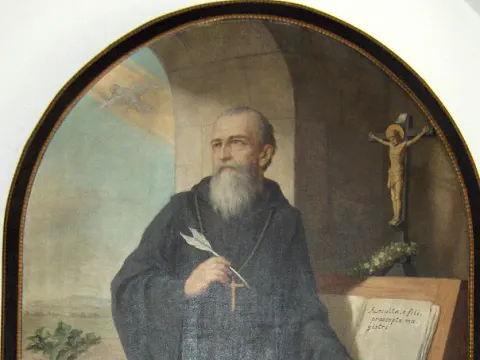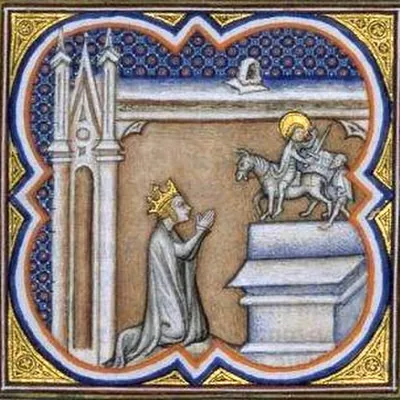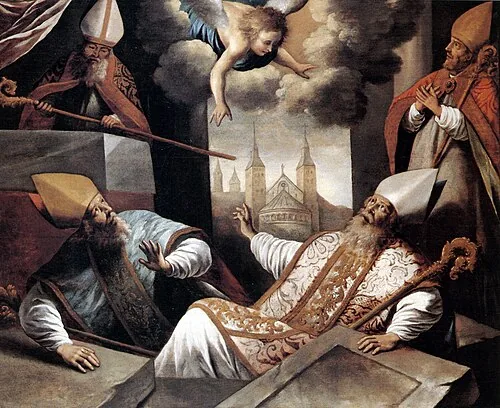
Saint Monulph (Monulphe in French, Monulfus in Latin) was a bishop of Tongeren-Maastricht in the 6th century, successor of Saint Domitian. According to Gregory of Tours, he built at Maastricht a great church over the tomb of Saint Servatius, the ancestor of the present basilica. Liège tradition also credits him with founding a small oratory in the valley of the Légia, from which the city of Liège is said to have grown. He died around 599 and is celebrated on July 16, together with his successor Saint Gondulph.
Who was Saint Monulph?
Monulph belongs to the line of bishops who governed, in the Merovingian period, the diocese of Tongeren, whose see had settled at Maastricht, near the tomb of Saint Servatius. He succeeded Saint Domitian, who died around 560, and preceded Saint Gondulph. Older historians do not agree on the length of his episcopate: he is often credited with thirty-nine years of ministry, with his death placed in 599 or 609 depending on the author. We know little of his personal life. Two memories nevertheless make him important for the religious history of the Meuse region: the great church he raised over the tomb of Saint Servatius, and the tradition that makes him the first Christian builder on the site of Liège.

The builder over the tomb of Saint Servatius
In the 6th century, the tomb of Saint Servatius at Maastricht already drew many faithful. Gregory of Tours, the historian of the Franks, records that a bishop named Monulf built a great church over this tomb, to welcome pilgrims and honor the saint. It is one of the few facts of his life attested by an almost contemporary witness. This church is the ancestor of the present basilica of Saint Servatius, one of the great shrines of the Netherlands. Monulph thus helped make Maastricht a center of pilgrimage for the whole Meuse region.
The prophecy of Liège
Liège tradition tells that one day Monulph was traveling from Dinant to Maastricht. He stopped in a small valley where a few huts stood on the bank of a stream, the Légia. Struck by the beauty of the place, he is said to have declared that God had chosen this spot for the salvation of many, and that a powerful city would one day rise there. He had a small oratory built there in honor of Saints Cosmas and Damian, the physician martyrs.
Little by little, the faithful came to settle around the chapel. Later, Saint Lambert, bishop of Maastricht, liked to withdraw to this place to pray; it was there that he was murdered, at the beginning of the 8th century. His successor, Saint Hubert, settled there and had a church built in honor of the martyr. The village became a town, surrounded by walls. This story is partly legendary, but it expresses Liège's gratitude to the bishop who is said to have first consecrated this place to God. A street in Liège bears his name, the rue Monulphe.
Devotion and memory
Saint Monulph is celebrated on July 16, together with Saint Gondulph, his successor. The two bishops are often linked in the memory of the diocese and in older works, such as Alban Butler's Lives of the Saints. His memory is tied to two cities: Maastricht, where he raised the church of Saint Servatius, and Liège, which sees him as the herald of its birth. He is shown as a bishop, with mitre and crozier.

What can we learn from Saint Monulph?
Saint Monulph was a builder. He honored the memory of those who had gone before him in the faith, by raising a church over the tomb of Saint Servatius, and he was able to see the future in a place that was still modest. His example invites us to hand on the heritage we have received and to prepare what others will complete. You can pray to him for bishops and church builders, for the cities of Maastricht and Liège, and for all who begin a work they will not see completed.
To pray with him, see the prayer to Saint Monulph and the novena to Saint Monulph.
Where to pray to Saint Monulph
- Maastricht (Netherlands): the basilica of Saint Servatius, heir to the great church he built over the saint's tomb.
- Liège (Belgium): the city that, according to tradition, grew up around the oratory he built in the valley of the Légia.
Discover also
- Saint Servatius of Tongeren, over whose tomb he raised a great church.
- Saint Domitian of Tongeren, his predecessor in the episcopal see.
- Saint Lambert of Maastricht, bishop and martyr at Liège.
- Saint Hubert of Liège, who made Liège the seat of the diocese.