Saint Marculf (in French, Marcoul or Marcouf) was a sixth-century priest and abbot from Normandy. Born in Bayeux, he founded the monastery of Nanteuil in the Cotentin peninsula and lived as a hermit on the islands that now bear his name. His relics, carried to Corbeny, near Laon, to keep them safe from the Vikings, became the goal of a royal pilgrimage: after their coronation in Reims, the kings of France came to pray there before touching people suffering from scrofula, the "King's Evil." His feast day is May 1.
Who was Saint Marculf?
Marculf (in Latin, Marculfus) was one of the evangelizers of western Normandy in the time of the Merovingian kings. His oldest Life was written several generations after his death, and its details must be received with caution.
His fame rests above all on what happened after his death. For centuries his relics, invoked against scrofula, were associated with the healing power attributed to the kings of France. The historian Marc Bloch devoted long pages to him in his famous book The Royal Touch (Les Rois thaumaturges, 1924).
Missionary of the Cotentin
According to tradition, Marculf was born in Bayeux around 490. Orphaned young, he was entrusted to the bishop of Coutances, who taught him and ordained him a priest. He then traveled through the countryside of the Cotentin, still largely pagan, to proclaim the Gospel.
With disciples, he founded the monastery of Nanteuil on the eastern side of the peninsula, on an estate given by King Childebert I according to his Life. The place is now called Saint-Marcouf.
The hermit of the islands
Like many monks of his time, Marculf loved to withdraw into solitude to pray, especially during Lent. Tradition has him staying on the small islands off the coast, known ever since as the Îles Saint-Marcouf. There he is said to have met Saint Helier, another hermit of the Channel Islands, well known to the people of Jersey. He died around 558, on a May 1, and was buried at Nanteuil.
From Nanteuil to Corbeny
At the end of the ninth century, Viking raids threatened the monasteries of the Norman coast. The monks of Nanteuil carried their founder's relics inland. King Charles III, called the Simple, received them at Corbeny, between Laon and Reims, on a royal estate, and had a priory built for them.
The relics stayed there and became the object of great devotion. People invoked them above all against scrofula, a tuberculous disease of the lymph nodes of the neck, and more broadly against skin diseases, abscesses and boils.

"The king touches you, God heals you"
From the eleventh century, the kings of France were believed to have the power to heal scrofula by their touch. The chronicler Guibert of Nogent claimed, in the early twelfth century, to have seen King Louis VI touch the sick. English readers may know the same belief from England, where the disease was called the "King's Evil" and English monarchs also practiced the royal touch.
Little by little, the French royal gift was linked to Saint Marculf. One tradition explained that God had granted it to the kings in thanks for the welcome Charles the Simple had given his relics.
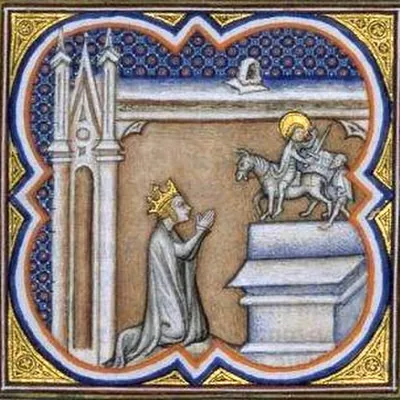
From the fourteenth century, it became customary for the king, after his coronation in Reims, to go on pilgrimage to Corbeny to venerate the saint's relics before touching the sick. The king laid his hand on the sick person, tracing a sign of the cross, and said: "The king touches you, God heals you." The rite was practiced from Louis X to Louis XIV. Later, because of wars, the relics were brought to Reims, to the Abbey of Saint-Remi. Charles X was the last king to touch for scrofula, in Reims in 1825.
Devotion to this day
During the French Revolution, the priory of Corbeny was suppressed and the reliquary melted down, but a villager hid the relics, which were returned to the parish church. In 1917, during the Battle of the Chemin des Dames, the village was completely destroyed; local people saved the relics. Today they are venerated in the rebuilt church of Corbeny.
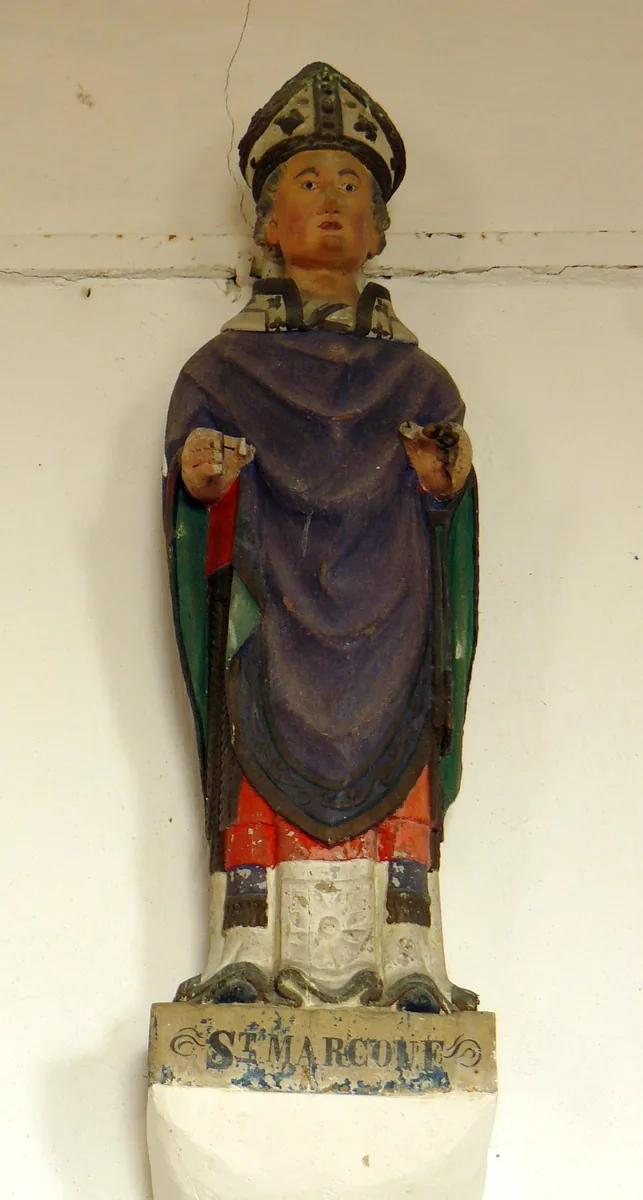
In Normandy, Saint Marculf is honored at Saint-Marcouf, in both the Manche and Calvados departments, as well as at Gouville-sur-Mer and in Honfleur, where the church of Saint Catherine has a seventeenth-century wooden statue of him.
Why is Saint Marculf the patron saint of the sick with skin diseases?
For centuries, people suffering from scrofula came on pilgrimage to his relics at Corbeny, and the royal touch itself was placed under his protection. Devotion extended to other skin conditions, abscesses and boils. He is also the patron of Corbeny, the village that has kept his relics for more than a thousand years.
Symbols and how to recognize Saint Marculf in art
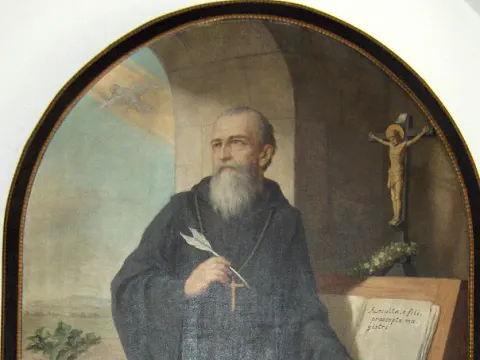
Marculf is shown as an abbot, with a crozier. Old prints of the royal touch sometimes show him standing beside the king as the sick are presented.

What can we learn from Saint Marculf?
Saint Marculf was first of all a missionary and a man of prayer, who proclaimed the Gospel in Normandy and sought God in the solitude of the islands. His cult also recalls the long Christian tradition of praying for the sick, and the conviction that authority must be a service, even to the point of touching the most shunned of the sick. We can ask his prayers for people with skin diseases, for caregivers and for those who hold authority.
To pray with him, see the prayer to Saint Marculf for the sick and the novena to Saint Marculf.
Where to pray to Saint Marculf
- Corbeny (Aisne, France): the parish church, which keeps his relics, and the Saint Marculf oratory.
- Saint-Marcouf (Manche): the site of his monastery of Nanteuil, facing the Îles Saint-Marcouf.
- Saint-Marcouf (Calvados): the church dedicated to him.
- Honfleur (Calvados): the church of Saint Catherine and its statue of the saint.
- Reims: the Basilica of Saint-Remi, where his relics were once brought for the royal touch.
Discover also
- Saint Remigius of Reims, who baptized Clovis, at the origin of the coronation of French kings.
- Saint Louis IX, king of France, who also touched for scrofula.
- Saint Malo (Machutus), another missionary monk of western Gaul in the sixth century.
- Saint Ouen (Audoin) of Rouen, great bishop of Merovingian Normandy.