Saint Remigius (in French, Saint Remi) was the bishop of Reims who, at the end of the 5th century, baptized Clovis, king of the Franks, together with many of his warriors. A pastor of exceptional longevity, he led his Church for more than sixty years, in a Gaul where the Roman Empire had just disappeared. He died around 533 and is celebrated in France on January 15; Reims also keeps October 1, the anniversary of the translation of his relics.
Who was Saint Remigius?
Remigius was born around 437 in the region of Laon, into a wealthy Christian Gallo-Roman family. Tradition names his parents Emilius and Celinia, and makes his older brother Principius a bishop of Soissons. The young man received a solid education in Latin letters, as the few letters in his own hand that have survived show: a careful Latin, still marked by the culture of the Roman schools.
Around 459, when he was only about twenty, he was chosen as bishop of Reims, the metropolitan see of the province of Belgica Secunda. The choice of such a young layman was surprising, but not rare at the time: cities were looking for men able to defend and administer them as well as to teach them. Remigius held this see until his death, one of the longest episcopates known.
A bishop in the Gaul of the Franks
When Remigius became bishop, Roman authority was fading north of the Loire. The Salian Franks, settled around Tournai, were gradually extending their rule. Their king Childeric, then his son Clovis, were pagans, while other Germanic peoples, such as the Burgundians and the Visigoths, had adopted Arianism, a form of Christianity that denies the full divinity of Christ. Catholic bishops, drawn from the Gallo-Roman aristocracy, were often the only stable leaders in the cities.
Remigius understood the importance of the young Frankish king very early. In the letter he sent him on his accession, he urged him to surround himself with good counselors, to honor the bishops, to protect widows and orphans and to judge fairly. This text, preserved in a collection known as the Austrasian Letters, is a precious witness: it shows a bishop dealing with power not through flattery but to steer it toward the common good.
The baptism of Clovis
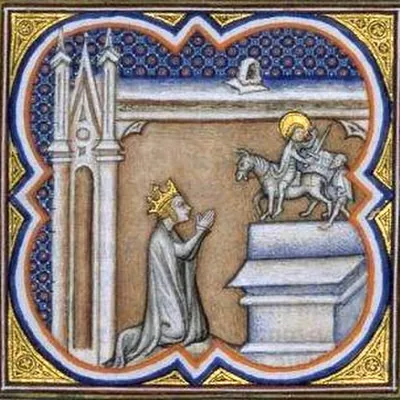
The best-known account comes from Gregory of Tours, who wrote his History of the Franks nearly a century later. According to him, Queen Clotilde had long urged her husband to convert. During a hard battle against the Alamanni, Clovis is said to have called on "Clotilde's God," promising to be baptized if he won. Remigius, summoned by the queen, then instructed him in the faith. On Christmas Day, in the cathedral of Reims hung with tapestries and lit with candles, he baptized him along with, Gregory says, more than three thousand of his warriors.
Gregory puts in the mouth of Remigius a famous saying: "Bow your head humbly, Sicambrian; adore what you have burned, burn what you have adored." Historians today debate the exact date of the baptism and some of the circumstances told by Gregory, who modeled his account on the conversion of Emperor Constantine. But the fact itself is certain, and its consequences were immense. By choosing Catholic baptism rather than Arianism, Clovis brought the Franks closer to the Gallo-Roman population and the bishops, and opened a long alliance between the Frankish monarchy and the Church. This is why France is sometimes called the "eldest daughter of the Church."
Later, in the 9th century, Archbishop Hincmar of Reims added in his Life of Saint Remigius the episode of the Holy Ampulla: a dove was said to have brought from heaven a vial of holy oil for anointing the king. This story belongs to legend, but it founded the tradition of crowning the kings of France at Reims, down to Charles X in 1825.

Pastor and organizer
Beyond this founding moment, Remigius was first of all a bishop close to his people. Tradition credits him with creating or reorganizing several dioceses of northern Gaul, especially Laon, and with sending missionaries to regions that were still pagan. A will bearing his name, whose authenticity historians debate, details gifts of land and goods to his Church and to the poor. The stories of miracles that grew up around him, told by later biographers, often belong more to tradition than to history.
He died in Reims at a very great age around 533, on January 13 according to tradition. He was buried in a small chapel outside the city walls, which quickly became a place of pilgrimage and later the heart of a great Benedictine abbey.

Why is Saint Remigius the patron saint of Reims?
Remigius was the bishop of Reims for more than sixty years, and his tomb has been venerated there for fifteen centuries, so the city naturally took him as its patron. He is also honored as one of the founders of Christian France, because of the baptism of Clovis. Catholics pray to him for the baptized and for catechumens preparing for baptism, for those who hold public responsibility, and for France.
Saint Remigius is the saint of patient beginnings. For decades he kept his Church standing in a world that was changing masters, and he never gave up proclaiming the Gospel to those who seemed farthest away, even a pagan king. He reminds us that faith is handed on by words, but also by the faithfulness of a pastor who stays at his post.
Symbols and how to recognize Saint Remigius in art
- Miter and crozier: he is shown as a bishop in full vestments.
- The baptism of Clovis: his most frequent scene, with the king standing in the font.
- The dove carrying a vial: the legend of the Holy Ampulla, used for the anointing of the kings of France.
To pray with him, read the prayer to Saint Remigius, or follow the novena to Saint Remigius from January 6 to 14, to finish it on the eve of his feast.
Where to pray to Saint Remigius
- Reims: the Basilica of Saint-Remi, the former abbey church that holds his tomb.
- Reims: the Cathedral of Notre-Dame, heir to the church where Clovis was baptized.
- Laon: the Cathedral of Notre-Dame, seat of the diocese that tradition says he founded.
- Saint-Rémy-de-Provence and the many towns of France that bear his name, a sign of how old his cult is.
Discover also
- Saint Clotilde, the wife of Clovis, who prepared his conversion.
- Saint Genevieve, his contemporary, patron saint of Paris.
- Saint Gregory of Tours, the historian who told the story of the baptism of Clovis.
- Saint Martin of Tours, the evangelizer of Gaul, whose tomb Clovis venerated.
- Saint Leo IX, the pope who consecrated the abbey church of Saint-Remi in 1049.