Saint Serenicus (Céneri in French, also called Sérénic, Cérénic or Sénery) was a 7th-century Italian hermit, born in Spoleto, who came to live in solitude on the borders of Maine and Normandy with his brother Saint Serenidus (Cénéré). He settled in a bend of the river Sarthe, near Alençon, where he founded a small monastery and died around 669. The village of Saint-Céneri-le-Gérei, in the Orne, bears his name. His feast day is May 7.
Who was Saint Serenicus?
Serenicus is one of the monks and hermits who brought the Gospel to the countryside of western Gaul in the Merovingian period. What we know of him comes from an old hagiographical tradition taken up by Norman writers: it is sober, but already mixes history and piety. Dates vary according to the sources: he is said to have been born between 620 and 625 and to have died around 669. His memory remains attached to the place he chose, a rocky spur above the Sarthe, where a church and a chapel are dedicated to him and where pilgrims still come to pray.

From Spoleto to Maine
According to tradition, Serenicus was born in Spoleto, in Umbria, into a noble Christian family. He became a deacon, in the service of the Church. But, like his brother Serenidus, he longed for a poorer and more hidden life. Around 649, the two brothers left Italy and crossed Gaul as far as Maine, under the Merovingian kings. They first settled together near Saulges, in a region still marked by pagan cults, to live as hermits in fasting and prayer.
The hermit of the bend of the Sarthe
After some time, Serenicus left his brother at Saulges and went further north in search of greater solitude. He found it in a meander of the Sarthe, at the foot of the hills now called the Alpes mancelles, in the diocese of Sées. The place was wild and steep. Yet the hermit's reputation drew men who wanted to live near him. In the end he accepted them, and began to build a church dedicated to Saint Martin of Tours, the great model of the monks of Gaul, with a few buildings for the small community. The bishop of Sées, Saint Milehard, completed the church.
Serenicus died around 669, among his disciples. His monastery survived him by more than two centuries, before being destroyed by the Vikings in 903. The church then came under the abbey of Saint-Évroult.
Devotion and art
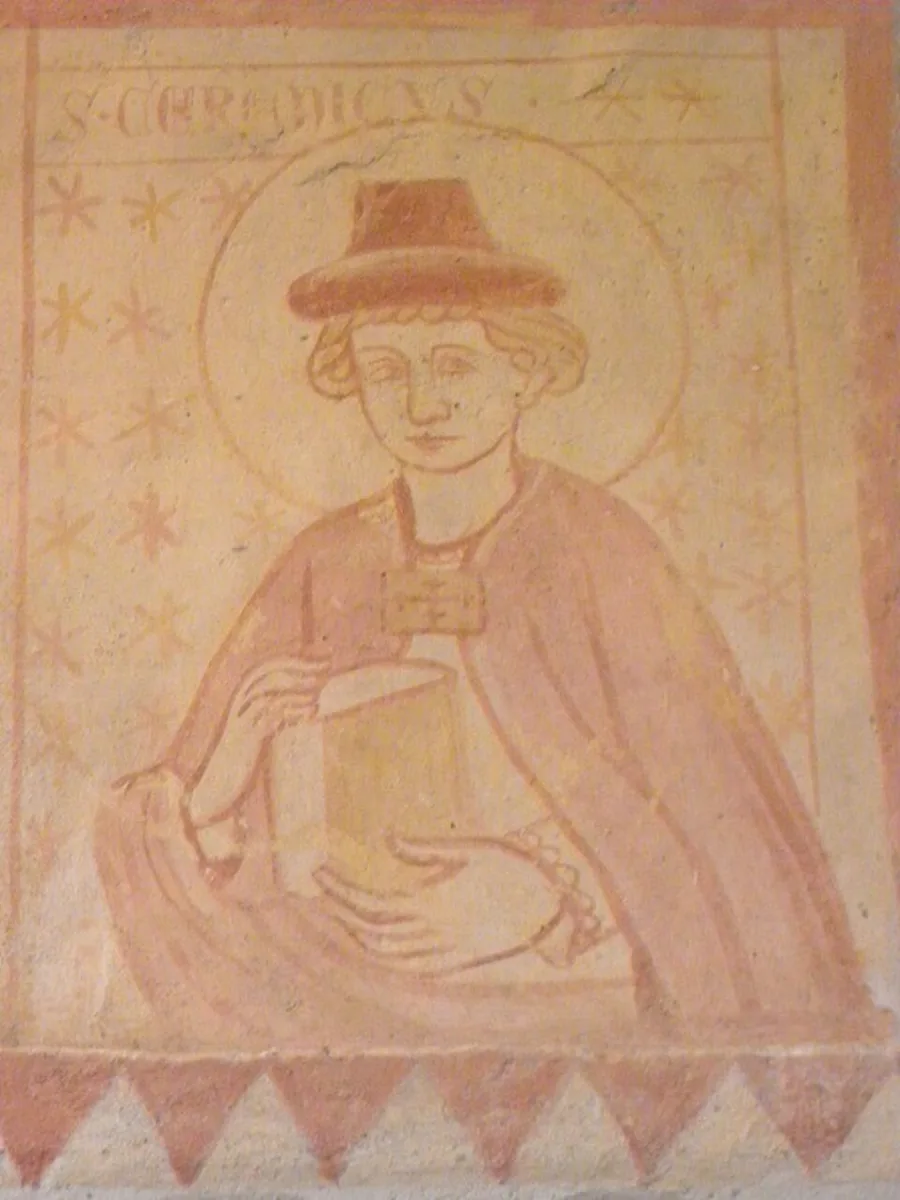
Saint Serenicus is celebrated on May 7, the same day as his brother Saint Serenidus. The village that grew up around his hermitage took his name: Saint-Céneri-le-Gérei, now listed among the most beautiful villages of France. The 11th-century Romanesque church, built on the rocky spur, preserves 14th-century wall paintings. Below, by the river, a small 15th-century chapel keeps the memory of his hermitage; a stone called the "saint's bed" is shown there. A spring on the opposite bank has long been venerated.
Popular Norman devotion calls on him for skin diseases, for colic in small children and to obtain the gift of children.

What can we learn from Saint Serenicus?
Serenicus left his homeland and its honors to seek God in silence. He parted from his brother to go further still, then accepted that others should come and share his life: solitude did not close him off from others. You can pray to him for those who seek silence, for brothers and sisters separated by life, for sick children and for couples hoping for a child.
To pray with him, see the prayer to Saint Serenicus and the novena to Saint Serenicus.
Where to pray to Saint Serenicus
- Saint-Céneri-le-Gérei (Orne): the Romanesque church dedicated to him, the chapel of the "saint's bed" and the spring, by the Sarthe.
- Saulges (Mayenne): the area where he first lived with his brother Saint Serenidus.
Discover also
- Saint Serenidus of Saulges, his brother, a hermit on the banks of the Erve.
- Saint Martin of Tours, to whom he dedicated his church.
- Saint Benedict of Nursia, another monk from Umbria.