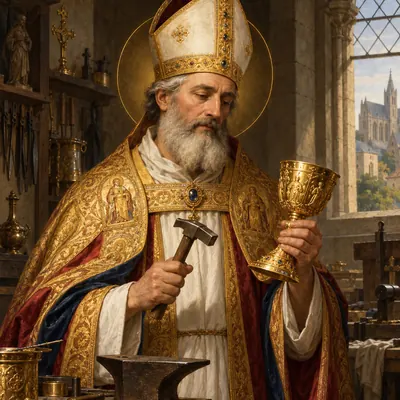
Saint Ithamar was an Anglo-Saxon bishop of the 7th century, a native of Kent. Consecrated bishop of Rochester around 644, he was the first Anglo-Saxon to receive the office of bishop, after the missionaries who had come from Rome with Saint Augustine. He died between 655 and 664 and was buried at Rochester. His feast day is June 10.
Who was Saint Ithamar?
Ithamar belongs to the first generation of English Christians trained on the spot by the mission sent by Pope Gregory the Great in 597. Until him, the bishops of southern England were Italians or Franks. His elevation therefore marks a milestone: the Church born of the mission gradually becomes a local Church, with its own shepherds. What we know of him comes almost entirely from Bede the Venerable, who mentions him briefly in his Ecclesiastical History of the English People, and from a collection of miracles written at Rochester in the 12th century.

The first English bishop
Bede reports that after the death of Paulinus, the former bishop of York who had become bishop of Rochester, Archbishop Honorius consecrated Ithamar to succeed him. He states that Ithamar was of the people of Kent and that he equaled his predecessors in learning. This remark matters: it shows that half a century after Augustine's arrival, the missionaries' schools had trained clerics capable of governing a diocese. Rochester was then the second see of Kent, founded in 604 for Saint Justus.
A name taken from the Bible
Ithamar's birth name is unknown. The name he bears is that of a son of Aaron, in the Old Testament, and he probably took it when he became bishop. Anglo-Saxons who changed their names usually chose that of a great saint from the history of the Church; names taken from the Old Testament were rather the custom of Christians in Ireland and Celtic Britain. Some historians see in this a sign of Irish influence on the young English Church, about which Bede says nothing.
His death and cult
In 655, Ithamar consecrated at Canterbury the new archbishop Deusdedit, also an Anglo-Saxon. He died a few years later, before 664, and was buried at Rochester. His cult developed above all after the Norman Conquest. In the mid-12th century, an anonymous monk of Rochester gathered nineteen miracles attributed to his intercession. This text tells of two translations of his relics: the first under Bishop Gundulf, in the 1080s, the second under a Bishop John, in the 12th century, who is said to have been cured of blindness by the saint. Ithamar is celebrated on June 10. The sources do not say what became of his relics after the Reformation.

What can we learn from Saint Ithamar?
Ithamar is the fruit of a patient mission. Monks from Rome sowed the Gospel in Kent, opened schools and trained young people; fifty years later, one of them became bishop of his own people. You can pray to him for young Churches, for seminaries and houses of formation, and for all who prepare, without seeing it, the next generation.
To pray with him, see the prayer to Saint Ithamar and the novena to Saint Ithamar.
Where to pray to Saint Ithamar
- Rochester (Kent, England): the cathedral, on the site of the church where he was bishop and was buried. It now belongs to the Church of England.
- Canterbury (Kent): the city where he consecrated Archbishop Deusdedit and where the first archbishops rest.
Discover also
- Saint Paulinus of York, his predecessor in the see of Rochester.
- Saint Honorius of Canterbury, the archbishop who consecrated him.
- Saint Deusdedit of Canterbury, the archbishop he consecrated in 655.
- Saint Justus of Canterbury, first bishop of Rochester.