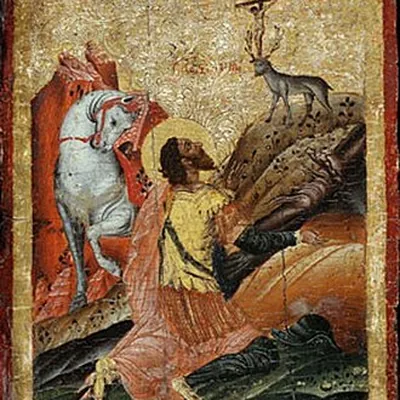
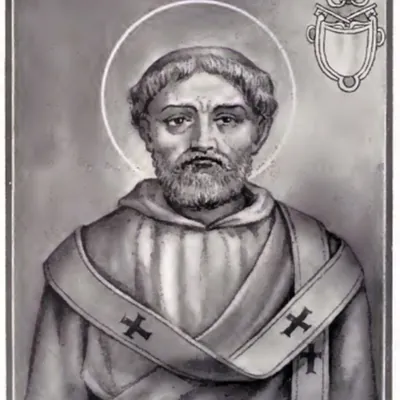
According to tradition, Saint Getulius was a Roman officer who became a Christian, the husband of Saint Symphorosa and the father of seven sons, martyred in Sabina, near Tivoli, under Emperor Hadrian in the 2nd century. With him, tradition honors Caerealis, who came to arrest him and was converted by him, as well as Amantius and Primitivus. His feast day is June 10.
Who was Saint Getulius?
Getulius belongs to those martyrs of the early centuries whose existence and cult are attested, but whose life has come down to us through a late account, a Passion written long after the events and largely legendary. According to this account, he was an officer in the Roman army. Converted to Christ, he left the emperor's service and withdrew to his estates in Sabina, northeast of Rome, where he gathered a small community of Christians around him. He is presented as the husband of Saint Symphorosa of Tivoli, herself a martyr with her seven sons. These details should be read with caution: above all, they show how the early Church kept the memory of a family that remained faithful even to martyrdom.
An officer won over by Christ
The Passion of Saint Getulius says that he served in the imperial army. Like other soldiers of the early centuries, he discovered Christ and chose to give him his whole life. He gave up his career and went back to his lands in Sabina to live his faith. His house became a place of prayer, where Christians of the region gathered.
The account dwells on one episode: Emperor Hadrian sent an officer of the court, Caerealis, to arrest him. But through his contact with Getulius, Caerealis was touched by the Christian faith and asked for baptism. The persecutor became a brother. This is a frequent theme in the stories of the martyrs, and it carries a simple message: the witness of a Christian can change the heart of the one who comes to condemn him.
Martyrdom in Sabina
Arrested, Getulius, his brother Amantius, Caerealis and Primitivus were tried and condemned. According to the Passion, they were thrown into a fire that the flames did not harm, then put to death by the sword. The account dates these events to the reign of Hadrian, in the early 2nd century. Historians cannot verify these details, but the cult of these martyrs in Sabina is ancient.
Tradition reports that his relics were first kept in Sabina, then moved in the 9th century to the abbey of Farfa, the great monastery of the region.
A family of martyrs
Tradition makes Getulius the husband of Saint Symphorosa. After his death, she in turn is said to have been summoned by Hadrian, who wanted to dedicate his villa at Tibur, today's Tivoli. Refusing to sacrifice to the gods, she was put to death, and then her seven sons, Crescens, Julian, Nemesius, Primitivus, Justin, Stacteus and Eugene, who are honored on July 18. The ruins of an ancient basilica dedicated to Saint Symphorosa still stand on the Via Tiburtina, between Rome and Tivoli. This link between the two accounts is mainly a tradition, but it offers a beautiful image: a whole family passing on the faith and keeping it to the end.

Devotion and art
Saint Getulius is listed in the Roman Martyrology on June 10, with his companions. His cult has remained mostly local, in Sabina and the area around Tivoli. There is no well-established early iconography of his own: he is shown as a Roman soldier, with the palm of martyrdom, sometimes alongside Saint Symphorosa and their sons.
What can we learn from Saint Getulius?
Even if his life is known to us through a legendary account, Saint Getulius offers a strong figure: a man who left his career for Christ, who opened his home to prayer, and whose witness converted his persecutor. He is also the image of a father who passes the faith on to his family. You can pray to him for fathers, for Christian couples, for believers in the military, and for those who must choose between success and conscience.
To pray with him, see the prayer to Saint Getulius and the novena to Saint Getulius.
Where to pray to Saint Getulius
- Farfa Abbey (Fara in Sabina, Lazio): the great monastery of Sabina where tradition places his relics.
- Tivoli (Lazio): the town of Saint Symphorosa and the seven brothers.
- Via Tiburtina, between Rome and Tivoli: the ruins of the Basilica of Saint Symphorosa.
Discover also
- Saint Symphorosa of Tivoli, his wife according to tradition, martyred with her seven sons.
- Saint Felicity of Rome, another mother martyred with her seven sons.
- Saint Maurice, a Roman officer who died for his faith.
- Saint Sebastian, soldier and martyr of Rome.