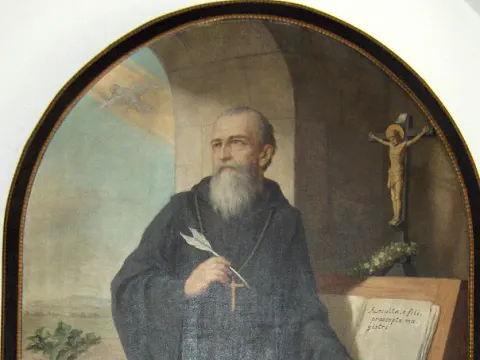
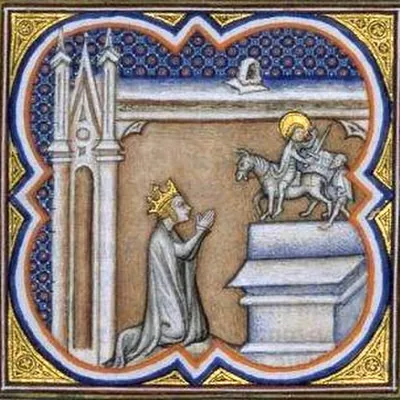
Saint Budoc (Budocus in Latin, Beuzec or Budog in Breton) is a Breton saint of the early Middle Ages, honored both as the teacher of Saint Winwaloe on the island of Lavret, near Bréhat, and as bishop of Dol, successor of Saint Magloire. His life, known through late accounts full of wonders, is placed by the sources in the 5th or 6th century. His feast day is December 8.
Who was Saint Budoc?
Budoc is one of the monks from Britain or Ireland who marked the beginnings of Christianity in Armorica. His Old Breton name means "victorious" or "rich in virtues". There is no ancient Life devoted to him: he is known through mentions in the Lives of other Breton saints (Winwaloe, Maudez, Magloire), through the Chronicle of Dol from the end of the 11th century, and through legends collected much later, notably by Albert Le Grand in the 17th century.
These sources do not agree. Some have him born in Ireland around 538, others in Wales; the Life of Winwaloe presents him as a teacher already established at the end of the 5th century, which fits poorly with a birth in the 6th. It is therefore hard to say whether all these traditions speak of one and the same man. This page presents what they tell, without claiming to settle the question.

A birth amid the waves
The best-known legend about Budoc concerns his mother, Saint Azenor. Daughter of Even, count of Léon, she is said to have married the king of Goëlo. Falsely accused of adultery, she was imprisoned in the castle of Brest and then thrown into the sea in a barrel. Fed by an angel, she drifted to the coast of Ireland, to a place called Beauport, and gave birth to a son during the crossing. The abbot of the place baptized the child and named him Budoc.
This story belongs to a well-known type of tale, that of the slandered woman saved by God. It also played on the saint's name: in Breton, Budoc was linked to the verb meaning "to drown", so that it could be heard as "the one saved from the waters", like Moses. Because of this birth at sea, Budoc came to be invoked as patron of boatmen.
The teacher of Lavret
The most solid role the sources give him is that of a teacher of monastic life. The Latin Life of Saint Winwaloe, written at Landévennec in the 9th century, tells that Fragan took his son to the island of Lavret, in the Bréhat archipelago, to be trained by Budoc. On this small island, Budoc taught prayer, the study of Scripture and asceticism. The Life of Saint Maudez, for its part, mentions a Bothmael, a disciple of Maudez, who is identified with Budoc.
Tradition says that he came to Brittany in a stone trough. Many see in this the memory of the light boats used by the island Britons, which were weighted with a stone. Another legend shows him at Porspoder, harassed by people demanding miracles: he then loaded his stone onto a cart drawn by oxen, and built his oratory where the cart stopped. This is said to be the origin of the church of Plourin, in Finistère.
Bishop of Dol
The Life of Saint Magloire and the Chronicle of Dol make Budoc the successor of Magloire at the head of the Church of Dol, itself founded by Saint Samson. Magloire, warned by an angel, is said to have left him his office in order to withdraw to the island of Sark. Tradition credits Budoc with an episcopate of twenty-six years and a journey to Jerusalem, from which he brought back relics. Albert Le Grand mentions him again in connection with Saint Rioc, with a date (633) that shows how uncertain the chronology of these accounts is.
He is said to have died on a December 8, around 585, in the area of Léhon, near Dinan. His relics, kept at Dol, were lost over the centuries. A Merovingian sarcophagus found at Dol, and called the "trough of Saint Budoc", is now kept at the Musée de Bretagne in Rennes.
Devotion and art
Devotion to Saint Budoc is most alive in Finistère, where several parishes bear his name in the form Beuzec: Beuzec-Cap-Sizun, Beuzec-Conq (now part of Concarneau) and the former parish of Beuzec-Cap-Caval, joined to Plomeur. He is also the patron of Trégarvan, Plourin and Porspoder. As a bishop, he is generally shown with miter and crozier. Dictionaries of saints celebrate him on December 8; some lists place him on December 9.

What can we learn from Saint Budoc?
Behind legends that often cannot be verified, Budoc appears as a teacher and someone who passed things on. He trained other saints, such as Winwaloe, and he received from Magloire the care of a Church. His story, that of a child saved from the waters, speaks of trust in God amid the storms. You can pray to him for sailors and boatmen, for educators and those who form others in the faith, and for Brittany.
To pray with him, see the prayer to Saint Budoc and the novena to Saint Budoc.
Where to pray to Saint Budoc
- Plourin and Porspoder (Finistère): the churches of Saint Budoc, linked to the legend of his arrival in Brittany.
- Trégarvan (Finistère): the parish of which he is patron, with his statue at the entrance of the cemetery.
- Beuzec-Cap-Sizun and Beuzec-Conq, in Concarneau (Finistère): parishes that bear his name.
- The island of Lavret (Bréhat archipelago, Côtes-d'Armor): the place where, according to tradition, he trained Saint Winwaloe.
Discover also
- Saint Winwaloe of Landévennec, his most famous disciple.
- Saint Magloire, bishop of Dol, whom he is said to have succeeded.
- Saint Maudez, a Breton hermit whose Life counts him among his disciples.
- Saint Samson of Dol, founder of the Church of Dol.