Saint Frumentius is the apostle of Ethiopia. Born in Tyre, in today's Lebanon, early in the fourth century, he was brought as a young captive to the kingdom of Aksum, rose to become an adviser at its court, gathered the first Christian communities of the country and became their first bishop, consecrated by Saint Athanasius of Alexandria. Ethiopians call him Abba Salama, "Father of Peace." The Catholic Church celebrates him on October 27.
Who was Saint Frumentius?
Frumentius was a Greek-speaking young man from Syria, born around 315 in Tyre. We know his story from the Ecclesiastical History of Rufinus of Aquileia, written at the end of the fourth century and later taken up by the Greek historians Socrates, Sozomen and Theodoret. Rufinus says he heard the account from Aedesius, Frumentius's own brother, who had become a priest in Tyre.
A second, independent witness comes from Athanasius himself. For a figure of that period, this is unusually good documentation, and it allows us to follow the main lines of his life with some confidence.
From slavery to the palace of Aksum
According to Rufinus, the philosopher Meropius of Tyre set out on a voyage to "India," meaning the distant shores of the Red Sea, taking his two young nephews, Frumentius and Aedesius, with him. On the way back, their ship put in at a port of the kingdom of Aksum, which was then in conflict with Rome. The crew was massacred. Only the two boys were spared because of their youth, and they were brought to the king.
Aedesius became the king's cupbearer and Frumentius his secretary. Before he died, the king set them free. The queen, left alone with a son too young to reign, begged them to stay, and Frumentius took on a leading role in governing the kingdom.
It was then that he began to gather the Christians living in the kingdom, mostly merchants from the Roman Empire. He obtained places of prayer for them and had the first churches built. Ethiopian tradition adds that he was the tutor of the young King Ezana, who would become the first Christian ruler of Aksum.
Bishop of Aksum
When Ezana came of age, Aedesius went home to Tyre. Frumentius, however, went to Alexandria to see Bishop Athanasius. He described the communities that had grown up in Aksum and asked him to send them a shepherd. After consulting his bishops, Athanasius replied that he knew no one more worthy than Frumentius himself. He consecrated him bishop and sent him back to Ethiopia.
This decision tied the Ethiopian Church to the patriarchate of Alexandria for sixteen centuries: Alexandria supplied Ethiopia with its bishops until the twentieth century.
A witness from Athanasius
Athanasius's own writings confirm how strong this bond was. In 356, driven from his see, he quoted a letter from Emperor Constantius II to the rulers of Aksum, Ezana and his brother Saizana. The emperor, who favored the Arians, demanded that Frumentius be sent to Alexandria to be "instructed" by George of Cappadocia, the Arian bishop imposed in place of Athanasius. The letter shows that Frumentius had remained faithful to the faith of Nicaea, and that his mission was known as far as the imperial court.

Questions of chronology
Rufinus writes that Frumentius met Athanasius shortly after the start of his time as bishop, which began in 328. That would place the shipwreck around 310. Other clues, noted as early as the seventeenth century by the historian Le Nain de Tillemont, point to a later date: the voyage of Meropius would rather belong to the 330s, and Frumentius's consecration would have taken place around 346. Historians remain divided. The core of the story, however, is not disputed.
What does his holiness teach us?
Frumentius turned a trial, captivity in a foreign land, into the starting point of a mission. He first served loyally those who had enslaved him. Then he put the trust he had earned at the service of the faith, imposing nothing, beginning simply by gathering the Christians who were already there. Finally, he chose not to go home when he could have.
His Ethiopian name, "Father of Peace," sums up the way he sowed the Gospel. For Christians who live far from home, for migrants and for those who have to serve in a place they did not choose, he remains a close and encouraging figure.
Why is Saint Frumentius the patron saint of Ethiopia?
Frumentius is honored as the patron of Ethiopia because he was the first bishop of the Aksumite kingdom, the heart of ancient Ethiopia, and because the Church of the country traces its organized life back to his mission. Through him, Ethiopia became one of the oldest Christian nations in the world. His memory is shared by Catholics and by the Ethiopian and Eritrean Orthodox Churches.
To entrust the Churches of Ethiopia and Christians living far from home to him, you can say the prayer to Saint Frumentius or follow the novena to Saint Frumentius.
Symbols and how to recognize Saint Frumentius in art
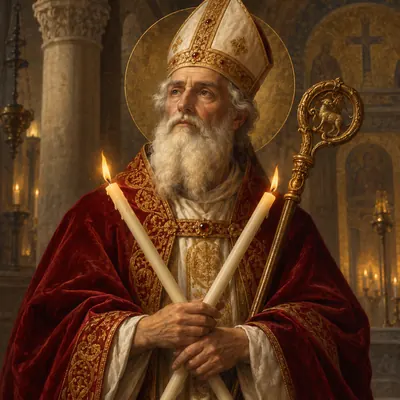
Saint Frumentius is usually shown as a bishop, holding a book of the Gospels and raising his hand in blessing. Ethiopian paintings also depict him in prayer, wearing a bishop's robes. The book recalls his mission of teaching, and the bishop's dress his consecration by Saint Athanasius.
Where to pray to Saint Frumentius
Aksum, in northern Ethiopia, remains the historic heart of Ethiopian Christianity. Frumentius is venerated there by the Ethiopian Orthodox Church, which celebrates him in December. The Orthodox Churches celebrate him on November 30. In the Catholic Church, his memory is especially alive in the Catholic communities of Ethiopia and Eritrea, and among the Ethiopian and Eritrean faithful living abroad.
Discover also
- Saint Anthony the Great, father of the monks of Egypt and friend of Athanasius, in the same period.
- Saints Cyril and Methodius, other apostles of an entire people.
- Saint Ansgar, the apostle of the North, who also knew captives and merchants.
- Saint Paul of Thebes, a fourth-century hermit of Egypt.
- Saint Martin of Tours, his contemporary, who evangelized the countryside of Gaul.