Saint Euthymius the Great was a 5th-century monk, born in 377 at Melitene, in Roman Armenia, and died on January 20, 473, in his laura in the Judean Desert, near Jerusalem. A priest who came to the Holy Land, he was one of the great founders of Palestinian monasticism and the master of Saint Sabas. His feast day is January 20, the day of his death, for Catholics and Orthodox.
Who was Saint Euthymius the Great?
Euthymius is one of the major figures among the monks of the Judean Desert. His life is known to us through Cyril of Scythopolis, a 6th-century monk who gathered the memories of the disciples of Euthymius and Sabas. His account, more sober than many hagiographies, mixes precise historical information with miracle stories. It presents Euthymius as a man of prayer and discernment, drawn to solitude, who nevertheless guided many monks, welcomed Arab tribes into the Church and defended the faith of the Council of Chalcedon in troubled times.

A child of prayer
According to Cyril of Scythopolis, Euthymius's parents, long childless, obtained him through prayer. His name means "good cheer" or "joy of soul." His father died while he was still small. His mother, who became a deaconess, entrusted him to the Bishop of Melitene, who oversaw his education. Ordained a priest while young, Euthymius was given the task of visiting the monasteries of the region. But he himself longed for a more withdrawn life. At about twenty-nine, he left his country for the Holy Land, venerated the holy places of Jerusalem and entered the laura of Pharan, one of the oldest in Palestine.
The desert monk
At Pharan he became friends with another monk, Theoctistus. Every year, after the feast of the Epiphany, they went together deep into the desert to live in prayer and fasting until close to Easter, eating wild plants. Around 411 they discovered a cave in a ravine and settled there. Disciples joined them and a monastery took shape. Euthymius entrusted its direction to Theoctistus and kept a more solitary life for himself.
Euthymius had the gift of reading hearts. His advice, as Cyril reports it, stresses vigilance, obedience, humility and above all charity. "Always keep," he said in substance, "sincere charity as the beginning and end of every action, for it is the bond of perfection." According to his biographer, he also healed the son of an Arab tribal chief. The father, Aspebetos, was converted with his people and received baptism under the name of Peter; he later became bishop of these nomadic tribes. Euthymius thus stands at the origin of one of the first Arab Churches of Palestine.
Founder and father of monks
In 428, Euthymius founded his own laura in the Judean Desert, east of Jerusalem. Its church was consecrated by the Bishop of Jerusalem. The monks lived in separate cells during the week and gathered for the liturgy. Euthymius formed many disciples, some of whom became bishops or founders. The most famous is Saint Sabas: arriving young, he was sent by Euthymius to the monastery of Theoctistus to learn community life first. Sabas would later found the great laura that bears his name.
In 451, the Council of Chalcedon defined faith in one Christ in two natures, divine and human. Many monks in Palestine rejected these decisions and rebelled. Euthymius, however, received them and remained faithful to the faith of the council, which earned him much opposition. For a time he withdrew further into the desert. His biographer reports that Empress Eudocia, living in retirement in Jerusalem, was reconciled with the Church on his advice.
His death and cult
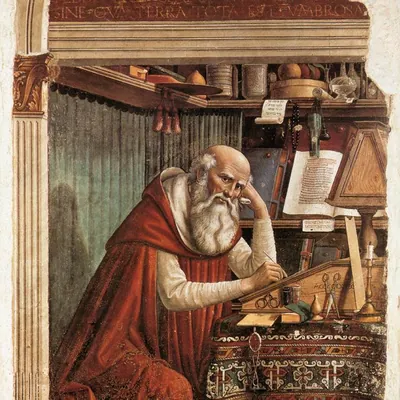
Euthymius died on January 20, 473, after announcing his end to his disciples and urging them to humility and charity. He was nearly ninety-six. His laura was turned into a monastery in 482, and his body was laid in a crypt of the church. The monastery remained active until the 12th century; its ruins survive today east of Jerusalem. He is venerated as a saint by the Catholic Church and the Orthodox Churches, who celebrate him on January 20. He is shown as an old man with a long white beard, in monastic dress, often holding a scroll.
What can we learn from Saint Euthymius the Great?
Euthymius united the solitude of the desert with great spiritual fruitfulness. He did not seek to lead, but many came to him. He was able to welcome foreign nomads into the Church, to form disciples who surpassed him, and to remain faithful to the faith of the Church when it would have been easier to follow the majority. You can pray to him for monks and vocations, for the Church in the Holy Land, for those who must stay faithful despite opposition, and for those who accompany others spiritually.
Where to pray to Saint Euthymius the Great
- Judean Desert, east of Jerusalem: the ruins of his monastery, where his tomb was.
- Mar Saba Monastery: the great laura founded by his disciple Saint Sabas, still inhabited by monks.
- Everywhere: on January 20, in prayer for monastic life and for the Christians of the Holy Land.
Discover also
- Saint Sabas the Sanctified, his most famous disciple.
- Saint Hilarion of Gaza, pioneer of monasticism in Palestine.
- Saint Leo the Great, the Pope whose teaching was received at the Council of Chalcedon.
- Saint Anthony the Great, the father of the desert monks.