Saint Eugippius (Eugippe in French) was a monk and abbot of the late 5th and early 6th centuries. A disciple of Saint Severinus, the apostle of Noricum (on the Danube, in present-day Austria), he accompanied his relics to Italy and became abbot of the monastery founded near his tomb, at the Castellum Lucullanum, near Naples. He is best known as the author of the Life of Saint Severinus, written around 511. He died after 533, and his feast day is January 15.
Who was Saint Eugippius?
Eugippius belongs to the generation that saw the collapse of the Western Roman Empire. On the banks of the Danube, the Roman population then lived in fear of invasions. It was there that he met Saint Severinus, a monk who had come from the East and who supported the inhabitants through his prayer, his advice and his works of charity. Having become an abbot in Italy, Eugippius was also a man of learning, in contact with several great Christian writers of his time. We know little about his personal life: what we know comes mainly from his own writings and from letters addressed to him.
The disciple of Saint Severinus
The origins of Eugippius are obscure. He has been said to have been born in Campania, but many historians think that he came rather from a Roman family of Noricum or Raetia, those Danube provinces that Rome could no longer protect. He joined Saint Severinus, probably in the last years of the saint's life. With him he discovered an austere monk who fasted and prayed, but who also organized the sharing of food, ransomed captives and negotiated with barbarian chiefs to protect the weakest.
Severinus died in 482. Six years later, King Odoacer ordered the Romans of Noricum to leave the region and settle in Italy. Before leaving, the monks opened the tomb of their father: the Life of Saint Severinus says that they found his body incorrupt. Eugippius was among those who carried it away. After several stages, the relics were received at the Castellum Lucullanum, the former villa of Lucullus by the sea, near Naples, on the site of the present Castel dell'Ovo. A monastery was established there, and Eugippius became its abbot.
The biographer and man of learning
Around 511, Eugippius put into writing the monks' memories of their founder. He sent his text to the Roman deacon Paschasius, asking him to polish it; Paschasius replied that there was nothing to add. This Life of Saint Severinus is a precious witness to the end of the Empire in the West: it describes with precision the towns of the Danube, the life of the inhabitants and the relations with the Germanic peoples. It is also the portrait of a saint who made charity a way of getting through crises.
Eugippius also compiled a vast collection of extracts from the works of Saint Augustine, much copied in the Middle Ages, which gave monks access to the thought of the bishop of Hippo. He was in contact with several figures of his time: the monk Dionysius Exiguus dedicated one of his translations to him, and Saint Fulgentius of Ruspe and the deacon Ferrandus of Carthage wrote to him. Cassiodorus, who had known him, mentions him with esteem. Finally, Isidore of Seville reports that he left a rule to his monks; some scholars think they have found it in an ancient manuscript, though this attribution is not unanimous.
Devotion and memory
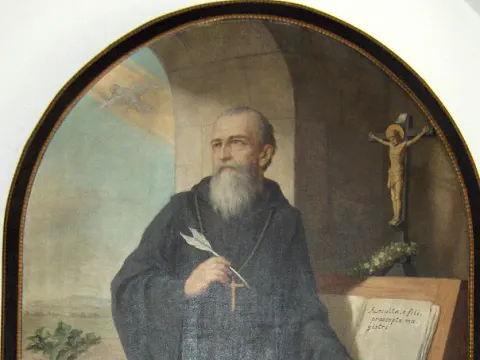
Eugippius died after 533, on an unknown date. The location of his tomb is unknown, and his cult has remained discreet. He is honored as a saint, with a feast on January 15. His memory has lived on above all through his work: the Life of Saint Severinus made the apostle of Noricum known throughout Europe, and it is thanks to it that Austria and Bavaria still honor Severinus. No iconography specific to Eugippius is known: one can imagine him as a monk or abbot, with a book in his hand.

What can we learn from Saint Eugippius?
Eugippius is the saint of faithful memory. He knew how to keep and hand on the memory of his master, so much so that fifteen centuries later we still know Saint Severinus thanks to him. In a troubled age, he chose prayer, study and community life. You can pray to him for biographers, historians, copyists and all who hand on the memory of the saints, but also for refugees who must leave their land, like the Romans of Noricum.
To pray with him, see the prayer to Saint Eugippius and the novena to Saint Eugippius.
Where to pray to Saint Eugippius
- Naples (Italy): the Castel dell'Ovo stands on the site of the ancient Castellum Lucullanum, where his monastery was.
- In any church, on January 15, his feast day, while reading a passage from the Life of Saint Severinus.
Discover also
- Saint Augustine, whose finest texts Eugippius gathered.
- Saint Fulgentius of Ruspe, the African bishop with whom he corresponded.
- Saint Valentine of Passau, bishop of the Raetias, mentioned in the Life of Saint Severinus.
- Saint Benedict of Nursia, his contemporary, father of the monks of the West.