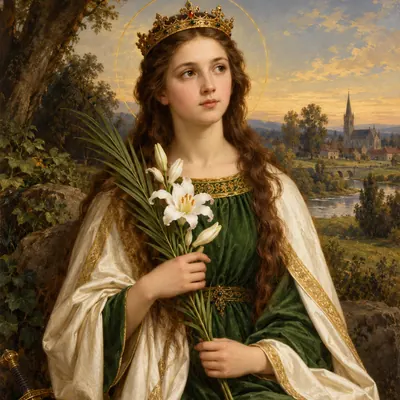
Saint Eanswythe (also spelled Eanswith) was an Anglo-Saxon princess of the first half of the 7th century, a granddaughter of Æthelberht, the first Christian king of Kent. According to tradition, she founded at Folkestone, on the Kent coast, one of the first monasteries for women in England, and died very young. Her feast day is September 12, the day of the translation of her relics, and sometimes August 31.
Who was Saint Eanswythe?
Eanswythe belongs to the first Christian generation of the kingdom of Kent, converted thanks to the mission sent by Pope Saint Gregory the Great and led by Saint Augustine of Canterbury, which arrived in 597. Historical information about her is scarce. A group of early texts, known as the "Mildrith legend", which tells the lives of the saints of the Kentish royal family, says only that she was the daughter of King Eadbald and his second wife, Ymme (or Emma), a Frankish princess, and that she was buried at Folkestone.
A much more detailed Life was written in the 13th century by an anonymous monk of Folkestone. It is known only from a summary, preserved in the collection of saints' lives of John of Tynemouth. This account, full of marvels, cannot be read as a biography in the modern sense. Yet it keeps the memory of a young woman who chose consecrated life and whose cult has come down through the centuries.

A princess in Christian Kent
Eanswythe was born into a royal family where the Christian faith was very recent. Her grandfather Æthelberht had welcomed Saint Augustine at Canterbury and was baptized. Her father Eadbald, who at first remained pagan, later converted. Her mother, Ymme, came from the kingdom of the Franks, Christian for more than a century. Eanswythe thus grew up where two worlds met: that of the old Germanic gods, still present in people's memories, and that of the Gospel, which was beginning to shape the life of the kingdom.
The foundation of Folkestone
According to the 13th century Life, Eanswythe wished to withdraw from the world to devote herself to God. Her father built for her, at Folkestone, a small oratory and a church dedicated to Saint Peter. There she gathered a community of women. This monastery is considered one of the very first monasteries for women founded in England.
The account tells that a pagan king of Northumbria wanted to marry her, and that she escaped his advances through a miracle. It also reports other wonders that took place while the monastery was being built, and after her death. These episodes, typical of medieval saints' lives, above all express the firmness of her choice: to belong to Christ alone. Tradition holds that she died young, on an August 31, and was buried in her monastery.
Her cult and the rediscovered relics
The first monastery at Folkestone disappeared, destroyed by the Vikings or carried away by coastal erosion. In 1137, the community moved to a new site: Folkestone Priory, founded by the baron William of Avranches. Eanswythe's relics were transferred there, and the anniversary of this translation, September 12, became her main feast. The priory was closed in 1535, at the time of the dissolution of the monasteries. Its church became the parish church of Folkestone, dedicated to Saint Mary and Saint Eanswythe.
In 1885, during building work, a lead reliquary containing part of a human skeleton was discovered in a wall of the church. It had probably been hidden at the time of the Reformation, to escape destruction. In 2020, analysis showed that the bones belonged to a single person, very probably a young woman of about seventeen to twenty, and radiocarbon dating places them around the middle of the 7th century. Everything fits: these are very likely the remains of Saint Eanswythe, which makes them some of the rare Anglo-Saxon relics preserved in England.
What can we learn from Saint Eanswythe?
Saint Eanswythe lived only a short time, but her life was given entirely. As a princess, she could have sought a royal marriage; she preferred to found a house of prayer by the sea. She shows that holiness does not depend on the number of one's years. The rediscovery of her relics, after centuries of oblivion, also reminds us that what is given to God is never lost. We can pray to her for young people seeking their vocation, for nuns, and for the Church in England.
Where to pray to Saint Eanswythe
- Folkestone (Kent, England): the church of St Mary and St Eanswythe, now an Anglican church, where her relics are kept.
- In any church, on September 12, entrusting young people and vocations to God.
Discover also
- Saint Æthelberht of Kent, her grandfather, the first Christian king in England.
- Saint Augustine of Canterbury, the apostle of England.
- Saint Mildred, another saint of the royal family of Kent.
- Saint Gregory the Great, the pope who sent the mission to England.