Saint Dubricius, Dyfrig in Welsh and Dubricius in Latin, is one of the fathers of the Church in Wales. A bishop and abbot at the turn of the fifth and sixth centuries, he founded monasteries in the region of Ergyng, on today's border between England and Wales, trained many disciples and ordained Saint Samson. He ended his days as a hermit on Bardsey Island, around 550. Tradition makes him the first bishop of Llandaff. His feast day is November 14.
Who was Saint Dubricius?
Dubricius lived in an age that has left very few documents. The oldest and most reliable witness is the Life of Saint Samson, written around 700, which presents him as a venerable bishop, much older than Samson.
Most of his biography comes from a Life written in the 12th century for the Book of Llandaff, when his relics were moved to that cathedral. This text mixes ancient traditions with the concerns of its own time: historians regard as late, for example, the idea that he was archbishop of all southern Britain. So we must distinguish the little that is known from what tradition has told.
A legendary birth
The 12th-century Life tells of a dramatic birth. His mother, Efrddyl, was the daughter of Peibio, king of Ergyng. Furious to learn that she was expecting a child, the king is said to have tried to have her drowned, then burned, but she was saved. The name Dyfrig has sometimes been linked to the Welsh word for water.
Still according to the story, the newborn touched the face of his sick grandfather, who was healed and reconciled with his daughter. These episodes belong to legend, but they express the conviction of the Welsh: from his birth, Dubricius was a sign of God's mercy.
A teacher of monks
Dubricius was above all a formator. At Hentland (Hennllan in Welsh, "the old church"), he taught for years disciples who came from all over the region. He then founded Moccas, on the River Wye. Many churches in Herefordshire and southeast Wales still bear his name, which shows how far his influence reached.
The master of Saint Samson
His most famous disciple is Saint Samson, future bishop of Dol in Brittany. The Life of Saint Samson shows Dubricius coming to spend Lent in the monasteries and conferring holy orders on Samson. Through Samson, the Welsh monastic movement then passed into Armorica, today's Brittany.
The hermit of Bardsey
At the end of his life, weighed down by years and illness, Dubricius laid down his responsibilities and withdrew to Bardsey Island (Ynys Enlli), off the Llyn Peninsula in northwest Wales. This island, a refuge for monks and hermits, became a place of pilgrimage, nicknamed "the island of twenty thousand saints." He died there around 550 and was buried there.
Dubricius and King Arthur
In Arthurian literature, from Geoffrey of Monmouth in the 12th century onward, Dubricius becomes the archbishop who crowns King Arthur. This role belongs to legend, not to history.

Devotion to Saint Dubricius
In 1120, Urban, bishop of Llandaff, obtained permission from the king of Gwynedd to move the relics of Dubricius from Bardsey to Llandaff, near Cardiff. From then on, Llandaff Cathedral honored him as its founder, together with Saint Teilo and Saint Euddogwy. The Roman Martyrology mentions him on November 14 as a bishop and abbot who died on Bardsey Island.
Why pray to Saint Dubricius?
Dubricius sowed more than he reaped. He trained monks, founded communities and handed on the priesthood to disciples who went further than he did. Then he knew how to step aside and end his life in prayer. He is a model for those who teach and accompany others, and for those who must one day hand over to someone else. He has no official patronage, but Christians can pray to him:
- for teachers and formators;
- for priests and for vocations;
- for the Christians of Wales.
Symbols and how to recognize Saint Dubricius in art
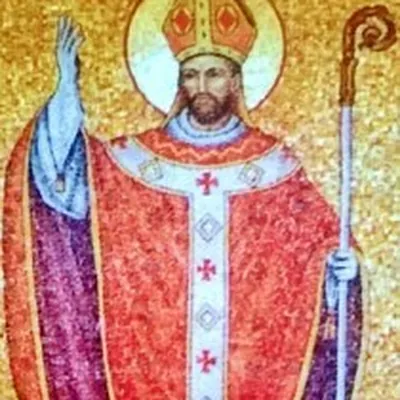
He is shown as a bishop, with the miter and the crozier, in stained glass windows in Wales and England.
Where to pray to Saint Dubricius
- Llandaff (Cardiff, Wales): the cathedral that received his relics in 1120.
- Bardsey Island (Ynys Enlli, Gwynedd, Wales): the pilgrimage island where he died.
- Hentland and Moccas (Herefordshire, England): the churches that keep the memory of his monasteries.
To pray with him at home, you can use the prayer to Saint Dubricius or the novena to Saint Dubricius.
Discover also
- Saint Samson of Dol, his disciple, who carried the Gospel to Brittany.
- Saint David of Wales, patron of Wales, from the next generation.
- Saint Brioc, another monk who came from Britain to Armorica.
- Saint Patrick, the apostle of Ireland, a great figure of Celtic Christianity.