Saint Devota was a virgin and martyr of Corsica, put to death according to tradition at the beginning of the fourth century, during the persecution of Diocletian. According to her Passion, the boat carrying her body was guided by a dove to the shore of present-day Monaco, where devotion to her has never ceased. Patron saint of the Principality of Monaco and of Corsica, she is celebrated on January 27. On the evening before, in Monaco, a boat is set on fire in front of her church, in memory of the stories of her legend.
Who was Saint Devota?
Devota (Dévote in French, Santa Devota in Monegasque, Santa Divota in Corsican) is one of the most popular saints of the Ligurian coast and of Corsica. Her story is known from a Passion preserved in an eleventh-century manuscript, now in the National Library of France. This account, written several centuries after the events, tells of the death of a young Christian woman of Corsica and then of the miraculous arrival of her body in Monaco.
Historians remain cautious. They accept that a young Christian may have been martyred in Corsica during the Great Persecution, between 303 and 312, but they point out that the Passion of Devota closely resembles that of Saint Julia of Corsica, the island's other patron saint. Some even think that the name Devota comes from an epithet, Deo devota, "consecrated to God," given to a martyr. What is certain is the age and fervor of a devotion that, since the Middle Ages, has united Monaco and Corsica around this young martyr.

The martyr of Corsica
According to her Passion, Devota was a young Christian woman of Corsica, consecrated to God, who lived under the protection of a Roman notable named Eutychius. He kept her in his household and respected her faith. But the governor, charged with enforcing the edicts of persecution, got rid of Eutychius and had the young woman arrested. Ordered to sacrifice to the gods, she refused. She was then tortured and died for Christ.
The governor ordered her body to be burned so that Christians could not honor it. But at night a priest and a deacon of the community, helped by a sailor, took the body and laid it in a boat, intending to bring it to Africa, where there were many Christians.
The dove and the boat
During the crossing a storm arose. The story tells that a dove then came out of the martyr's mouth and guided the boat northward. It came ashore at the end of a small valley, the Gaumates valley, on the coast of present-day Monaco, where there was a chapel. The body was buried there, and the place became a shrine. This is the origin of the church of Saint Devota in Monaco.
Another legend, written down in the seventeenth century, tells that in the eleventh century thieves tried to carry off the relics by sea; when they were caught, their boat was set on fire. Historians consider this story late, but it explains the rite of the burning boat that takes place in Monaco every year on the evening of January 26.

A saint at the heart of Monaco
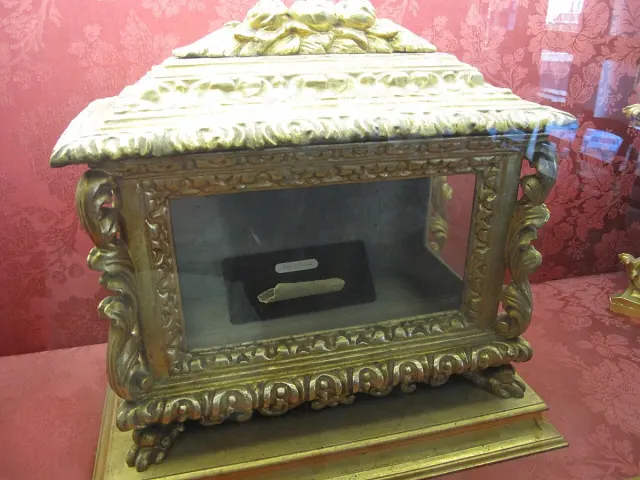
Devotion to Saint Devota is closely tied to the history of the principality. She is its patron, and her feast on January 27 is a public holiday in Monaco. On the evening before, the prince and his family attend the burning of a boat in front of the church of Saint Devota, a very popular rite that grew into a great ceremony in the nineteenth century. The next day a solemn Mass is celebrated and the relics of the saint are carried in procession through the town.
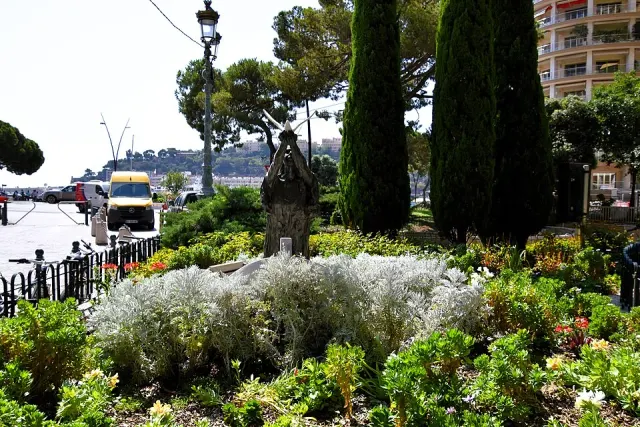
Devota appears throughout Monegasque art: on the Saint Nicholas altarpiece painted by Louis Bréa, on a late sixteenth-century altarpiece in the cathedral, and in the chapel of the Prince's Palace. In 1997, Prince Rainier III had a monument by the sculptor Cyril de La Patellière erected in front of the church. Motor racing fans know her name too: the first corner of the Monaco Grand Prix circuit, which passes right in front of the church, is called Sainte Dévote.
Why is Saint Devota the patron saint of Monaco and Corsica?
Monaco honors her because, according to tradition, her body came to rest on its shore and has been venerated there ever since. In Corsica, her native island, devotion grew mainly from the seventeenth century, when the Corsicans asked for and obtained relics from Monaco. Proclaimed patron of Corsica in 1820 along with Saint Julia, she is especially honored at Lucciana, where one tradition places her birth, near the Romanesque cathedral of La Canonica, on the site of ancient Mariana. In 2003, Prince Rainier III went to La Canonica for the celebrations of the seventeenth centenary of her martyrdom, his last official journey. She is also patron of Pietranera, near Bastia.
Devota is the saint of faithfulness to the end and of hope in the storm. Young and powerless, she preferred to die rather than deny Christ. The dove of her legend says that the Holy Spirit guides those who trust him, even when all seems lost. Catholics pray to her for Monaco and Corsica, for sailors and travelers at sea, for young people who must bear witness to their faith, and for anyone going through a trial.
To pray with her, see the prayer to Saint Devota and the novena to Saint Devota, prayed from January 19 to 27.
Symbols and how to recognize Saint Devota in art
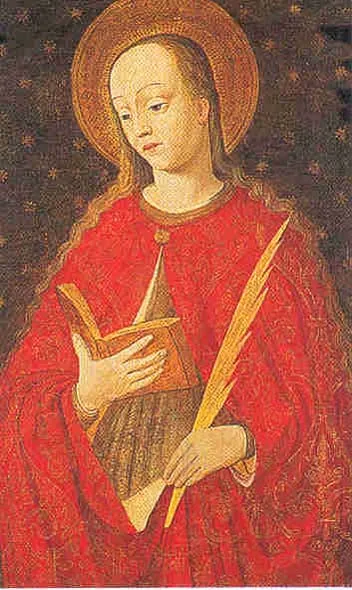
Saint Devota is shown as a young woman holding the palm of martyrdom. Her main attribute is the dove that guided her boat, often accompanied by the boat itself. Some images show her with her eyes raised toward the dove.
Where to pray to Saint Devota
- Monaco: the church of Saint Devota, in the Gaumates valley, where tradition places the landing of her boat and where her relics are kept; the Cathedral of Our Lady Immaculate, with its altarpieces.
- Lucciana (Upper Corsica): the cathedral of La Canonica and the place called Quercio, where one tradition places her birth.
- Pietranera (San-Martino-di-Lota, Upper Corsica): the parish of which she is patron.
- Dolceacqua (Liguria, Italy): the parish church and its altarpiece of Saint Devota.
Discover also
- Saint Julia of Corsica, the other patron of Corsica, whose Passion resembles hers.
- Saint Reparata, a young martyr whose body, according to tradition, reached Nice in a boat.
- Saint Agnes of Rome, another young virgin martyr of the early persecutions.
- Saint Vincent of Saragossa, a martyr of the same persecution.