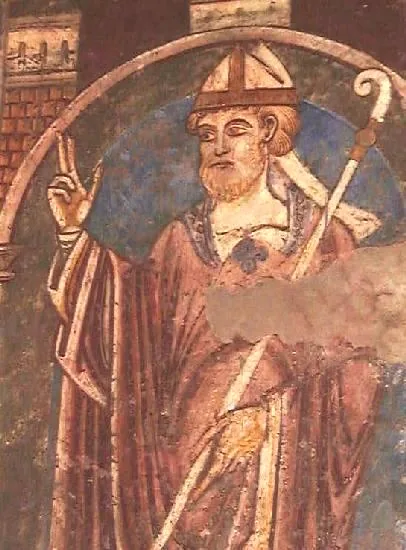
Saint Cuthbert was an Anglo-Saxon monk and bishop of the 7th century, born in Northumbria around 635 and died on March 20, 687, in his hermitage on the Farne Islands, off the north-east coast of England. Prior of Melrose and then of Lindisfarne, a hermit, and finally Bishop of Lindisfarne, he became the best-loved saint of northern England. His relics rest in Durham Cathedral. His feast day is March 20.
Who was Saint Cuthbert?
Cuthbert is better known than many saints of his time. Three Latin Lives were written soon after his death: the first by an anonymous monk of Lindisfarne, between 698 and 705, at the request of Bishop Eadfrith; then two more by Bede the Venerable, one in verse and one in prose, before 721. These texts, written by men who could question his companions, mix precise memories with miracle stories meant to edify. They draw the portrait of a tireless pastor, a man of prayer drawn to solitude, and a builder of the Church's unity in the England of his day.

The shepherd who became a monk
According to his biographers, Cuthbert was tending flocks in the hills when, one night in 651, he saw a light come down from heaven and angels carry a soul away. He then learned that Saint Aidan, Bishop of Lindisfarne, had just died. This sign led him to become a monk. His first Life suggests, however, that he was no simple shepherd: he arrives at Melrose on horseback, carrying a spear, with a servant, and the text alludes to a time spent under arms. He probably came from a noble family.
At Melrose he was trained by the prior Boisil, whom he succeeded in 664. He then travelled through the hill villages, often on foot, to preach and baptize people still barely touched by the Gospel. Bede stresses his gentleness and the power of his words: those who came to confess to him went away, he says, at peace.
Prior of Lindisfarne and builder of unity
Also in 664, the Synod of Whitby had decided that the Church of Northumbria would follow the customs of Rome, notably for the date of Easter, rather than those inherited from the Irish monks. This change was painful for the community of Lindisfarne, founded by Aidan in the tradition of Iona. Called as prior by Abbot Eata, Cuthbert guided this transition with patience. His biographers report that he bore the objections of the brothers without anger, closing the meeting when tempers rose and taking up the discussion again the next day.
The hermit of the Farne Islands
In 676, Cuthbert was allowed to live alone on Inner Farne, a rocky islet beaten by the North Sea, a few miles from Lindisfarne. He built himself a cell and a small oratory, grew a field of barley and received visitors who came for advice. Tradition says that he prayed at night in the icy water and that, when he came out, otters came to warm his feet. He protected the seabirds that nested on the island: the eider ducks of the Northumbrian coast are still locally called "Cuddy's ducks", after him. The rules he set for them are sometimes presented as one of the oldest known measures to protect birds.
A bishop in spite of himself
In 684, a synod held in the presence of King Ecgfrith elected him bishop. He refused at first, and the king himself had to come to the island to persuade him. Elected to the see of Hexham, he exchanged it with Eata to become Bishop of Lindisfarne, and he was consecrated at York on March 26, 685. For two years he visited his vast diocese, preaching, confirming and caring for the sick, while keeping the austere life of a monk. He was close to the royal family, especially to Abbess Ælfflæd of Whitby. Sensing his end was near, he laid down his office at the end of 686 and returned to his hermitage, where he died on March 20, 687, surrounded by a few brothers.

Devotion and art
Cuthbert had asked to be buried on his island, but the monks brought his body back to Lindisfarne. When they opened his tomb in 698, they found it incorrupt and placed it in a new carved wooden coffin, with a small book of the Gospel of Saint John. It was also at Lindisfarne, around that time, that the famous Lindisfarne Gospels were made, in honor of God and Saint Cuthbert. In 875, fleeing the Vikings, the monks left their island, carrying his relics. After long wanderings, they settled at Durham in 995. The body was moved into the new Norman cathedral in 1104, an event once celebrated on September 4.
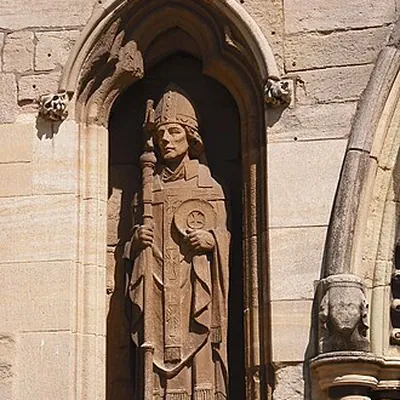
Durham became one of the great pilgrimages of medieval England. In the 12th century, Reginald of Durham counted him among the three most popular saints of the country, with Edmund the Martyr and Etheldreda of Ely. More than one hundred and thirty English churches are dedicated to him. He is shown as a bishop or a monk, often holding the crowned head of the holy king Oswald, which was placed with him in his coffin, or accompanied by seabirds and otters. He is listed in the Roman Martyrology on March 20.
What can we learn from Saint Cuthbert?
Cuthbert united two callings that are often thought to be opposed: the solitude of prayer and the service of others. He loved the silence of his island, but he left it every time the Church asked him to. He knew how to guide a difficult change without breaking a community. You can pray to him for Christian unity, for overburdened pastors, for those who seek God in creation, and for all who hesitate between rest and service.
Where to pray to Saint Cuthbert
- Durham (England): the cathedral, where his tomb lies behind the high altar.
- Lindisfarne or Holy Island (Northumberland): the island of the monastery where he was prior and bishop.
- Inner Farne (Northumberland): the islet of his hermitage, where a chapel keeps his memory.
- Melrose (Scotland): the area of the abbey where he became a monk.
Discover also
- Saint Aidan of Lindisfarne, whose death decided his vocation.
- Saint Bede the Venerable, who wrote his Life and also rests at Durham.
- Saint Hilda of Whitby, abbess of Whitby in the same period.
- Saint Wilfrid, another great bishop of Northumbria and defender of Roman customs.