Saint Conogan (Konogan, Quénégan, also called Guénoc or Albinus) was a 6th-century Breton saint, who came from Wales according to tradition. A companion of Saint Paul Aurelian, a hermit on the banks of the Élorn, he is said to have become bishop of Quimper after Saint Corentin. His story is poorly known and mixed with legend, but his cult has remained alive in many chapels of Lower Brittany. His feast day is October 16.
Who was Saint Conogan?
Conogan belongs to the group of saints from the island of Britain who evangelized Armorica in the 5th and 6th centuries. No ancient Life has come down to us: what we know of him comes from local traditions, the episcopal lists of Quimper, place names and the breviaries of the diocese. These sources are late and sometimes contradictory, to the point that some authors have doubted his existence. His story must therefore be read with caution. His cult, on the other hand, is well attested: the diocese of Quimper and Léon still counts him among its saints.
The companion of Saint Paul Aurelian
According to hagiographical tradition, Conogan left Wales to accompany Saint Paul Aurelian, the future bishop of Léon, to Armorica. He then settled on the banks of the Élorn, downstream from Landerneau, in a place called Beuzit, "the boxwood" in Breton. He lived there as a hermit, and his house gradually became a small community, like many early monasteries of that time. Tradition adds that he wished to be formed by Saint Winwaloe, and that the abbey of Landévennec helped spread his cult.
Bishop of Cornouaille
The lists of the bishops of Quimper place Conogan among the first successors of Saint Corentin. Some have tried to identify him with a "Venecandus" present at the council of Tours in 461 and with an "Albinus" present at the council of Vannes in the 460s. These identifications raise a problem of chronology, since tradition has him arriving in Armorica in the time of King Childebert, in the 6th century. They therefore remain very uncertain.
Popular memory made him a healer, to whom crowds came for help, especially against fevers. The chapel and cemetery of Saint-Conogan, on the edge of Quimper, are said to preserve the memory of the place where he practiced this charity.
Devotion and traditions
Conogan is celebrated on October 16. His cult is attested in many places in Lower Brittany. At Beuzit-Conogan, the church, of which only the bell tower and some walls remain, still kept his head and an arm in reliquaries in the 17th century; every third Sunday of May a troménie, a much-frequented procession, was held there until the parish was suppressed in 1791. At Beuzec-Cap-Sizun, tradition points to the "boat of Saint Conogan," in fact a fallen menhir, on which he is said to have crossed the sea.
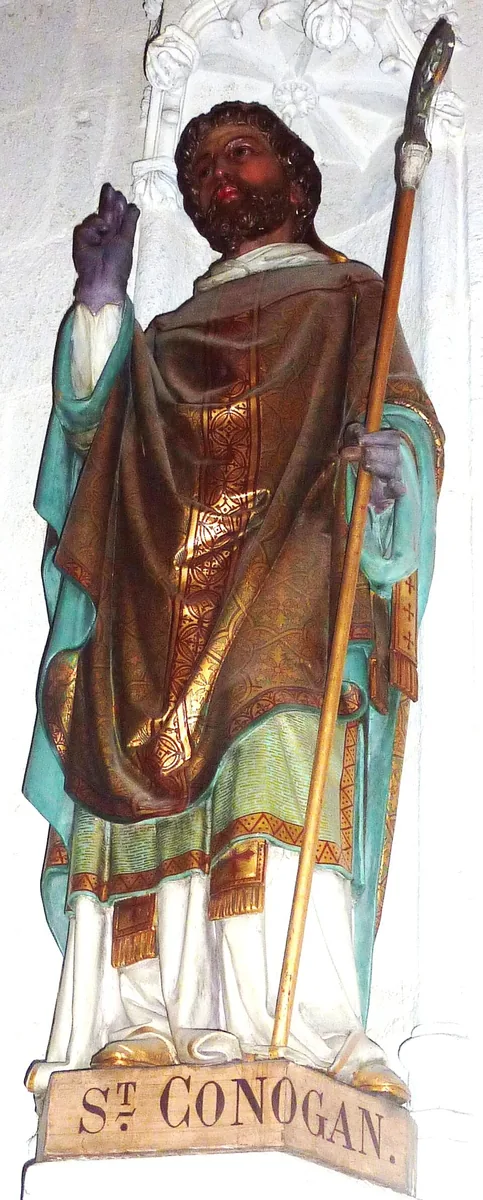
He is shown as a bishop, with miter and crozier, as in the statue in the cathedral of Saint-Corentin in Quimper. His name may survive in that of Tréogan, the "trève (chapel district) of Conogan."

What can we learn from Saint Conogan?
Even if his story is uncertain, Conogan bears witness to the faith of the first monks who came from across the sea and made Brittany a Christian land. A hermit and then a pastor, he united prayer and service of the people. Bretons long invoked him for health, and his memory remains attached to chapels where people still pray. You can pray to him for the sick, for bishops and for Brittany.
To pray with him, see the prayer to Saint Conogan and the novena to Saint Conogan.
Where to pray to Saint Conogan
- Quimper (Finistère): the cathedral of Saint-Corentin, where his statue stands, and the chapel of Saint-Conogan, at Moulin Vert.
- Beuzec-Cap-Sizun (Finistère): the chapel of Saint-Conogan and the stone "boat."
- Beuzit-Conogan, near Landerneau (Finistère): the remains of the church of the former parish that bore his name.
- Lanvénégen (Morbihan): the church of Saint-Conogan, of which he is the patron.
Discover also
- Saint Paul Aurelian, whom he is said to have accompanied from Wales to Armorica.
- Saint Corentin, first bishop of Quimper, whose successor he is said to have been.
- Saint Winwaloe, founder of Landévennec, whose disciple he is said to have been.