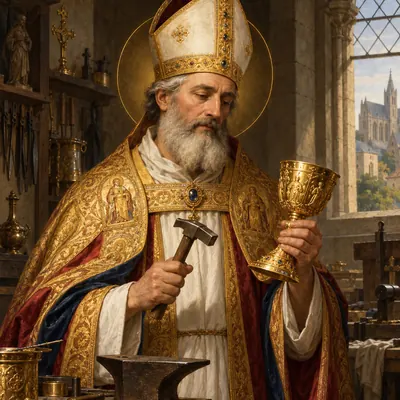
Saint Botolph, in Old English Botwulf, was an Anglo-Saxon abbot of the seventh century who founded a monastery at Icanho, in the kingdom of East Anglia, now identified with Iken, in Suffolk. He died around 680 and became one of the most popular saints of medieval England, the patron saint of travelers. The town of Boston, in Lincolnshire, takes its name from his, and through it so does Boston, Massachusetts. Part of his relics was moved to Thorney Abbey, which is why he is sometimes called Botwulf of Thorney. His feast day is June 17.
Who was Saint Botolph?
Botolph is a witness to the first generation of Anglo-Saxon monasticism, when East Anglia, only recently converted, was filling with monasteries. Reliable sources are very thin: a mention in the Anglo-Saxon Chronicle and a reference in an early life of Abbot Ceolfrith.
The only detailed account of his life, the Vita sancti Botulphi, was written in the eleventh century by Folcard, a Flemish monk who became abbot of Thorney. Folcard himself seems to have had little information and relied heavily on the commonplaces of hagiography. It is therefore important to distinguish what is documented from what belongs to tradition.

The founder of Icanho
The Anglo-Saxon Chronicle records that in 654 "Botwulf began to build the minster at Icanho." This was the time when King Anna of East Anglia, father of Saint Etheldreda, was encouraging religious life in his kingdom.
According to Folcard, Botolph was trained in a monastery in Gaul, perhaps one linked to Anglo-Saxon princesses who had taken the veil there. He then returned to England and obtained from the king a deserted, marshy piece of land, said to be haunted by demons, to found his community.
Icanho is generally identified with Iken, a small village on a headland overlooking the estuary of the River Alde, in Suffolk. Excavations in St Botolph's Church at Iken uncovered a fragment of an Anglo-Saxon stone cross, a witness to the age of the site.
A master of monastic life
An anonymous life of Ceolfrith, written in the early eighth century, reports that this young monk, later abbot of Wearmouth-Jarrow, the monastery where Saint Bede the Venerable lived, traveled to East Anglia to observe the customs of Abbot Botolph, whose reputation for learning and holiness was great. This almost contemporary witness is the most precious one we have: it shows that Botolph was regarded as a master of the monastic life.

Relics and devotion
The monastery of Icanho probably suffered during the Danish invasions of the ninth century. In the tenth century, during the great English monastic revival, Saint Æthelwold of Winchester had Botolph's relics sought out. According to Folcard, part of them was taken to Thorney Abbey, in the Fens, the head to Ely Abbey, and the rest joined the relic collection of the kings of England. The translation of his relics was celebrated on December 1.
His cult then spread widely. More than sixty ancient churches in England are dedicated to him. His cult also reached Scandinavia, where his name appears in medieval calendars. For a man about whom so little is recorded, this wide devotion is striking: it shows how deeply ordinary people trusted his protection.
Why is Saint Botolph the patron saint of travelers?
Many churches dedicated to Saint Botolph stand near town gates or along roads, because he was invoked as the patron of travelers. In London, several St Botolph's churches stood by the gates of the City: Aldgate, Bishopsgate and Aldersgate. Travelers leaving or entering the city could stop there to pray for a safe journey.
Boston, England, and Boston, Massachusetts
The town of Boston, in Lincolnshire, owes its name to "Botolph's town" or "Botolph's stone." Its great St Botolph's Church, whose tower rises over the Fens, is one of the largest parish churches in England. Through the port of Boston, his name traveled to America with the city of Boston, Massachusetts. Many Bostonians today live in a city named, without knowing it, after a seventh-century English abbot.
Botolph is a quiet builder of the Church in England. He chose an unpromising place and made it a center of prayer and formation, and his influence passed through his disciples to the great monasteries of the north. He can be invoked for travelers and pilgrims, for founders and educators, and for England.
Symbols and how to recognize Saint Botolph in art
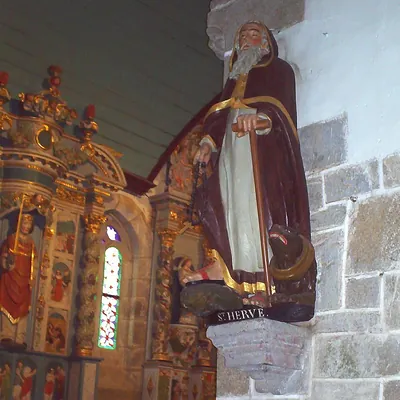
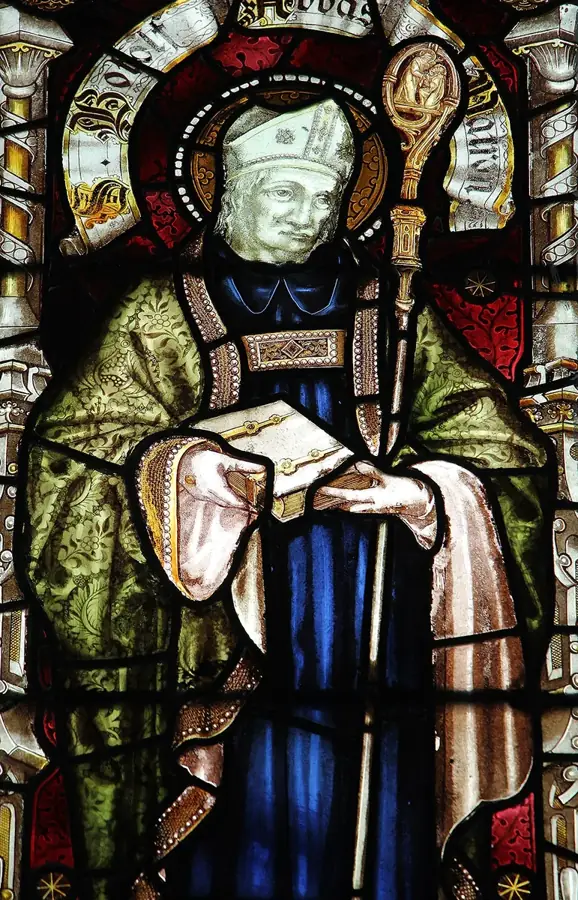
Saint Botolph is shown as an abbot, holding a crozier, sometimes holding a model of a church. He appears in this way in English stained glass windows, often in the churches that bear his name.
Where to pray to Saint Botolph
- Iken (Suffolk, England): St Botolph's Church, on the probable site of his monastery of Icanho.
- Boston (Lincolnshire, England): the great St Botolph's Church, nicknamed the Stump.
- London: the churches of St Botolph's Aldgate, St Botolph-without-Bishopsgate and St Botolph's Aldersgate.
- Ely (Cambridgeshire, England): the cathedral, the former abbey that received his head.
To pray with him, use the prayer to Saint Botolph for travelers or the novena to Saint Botolph, prayed from June 9 to June 17.
Discover also
- Saint Etheldreda of Ely, princess of East Anglia and founder of Ely, his contemporary.
- Saint Cedd, another founder of monasteries, in Essex.
- Saint Edmund the Martyr, king of East Anglia killed by the Danes.
- Saint Hilda of Whitby, great abbess of the seventh century, linked to the royal family of East Anglia.