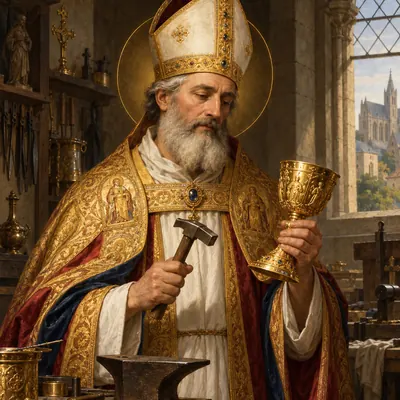
Saint Birinus, called Birin in French, was a missionary bishop from the continent who brought the Gospel to the West Saxons, in the Anglo-Saxon kingdom of Wessex, in the seventh century. Sent by Pope Honorius I, he baptized King Cynegils in 635 and founded the episcopal see of Dorchester, on the Thames, becoming its first bishop. He died around 650 and is remembered as the "Apostle of Wessex." His feast day is December 3.
Who was Saint Birinus?
Almost everything we know about Birinus comes from Saint Bede the Venerable, who devotes a chapter to him in his Ecclesiastical History of the English People, completed in 731. Bede presents him as a bishop sent to Britain by Pope Honorius, with the mission of preaching in the inland regions of the island, where no teacher of the faith had yet come.
Birinus is said to have been of Frankish origin, perhaps from northern Gaul or from Lombardy, but his birthplace is unknown. Nothing certain is known about his youth or his training before his mission. What Bede records is the essential: a man ready to leave everything to carry the Gospel to a people who had never heard it.
Before setting out, Birinus promised the pope that he would sow the seeds of the faith in these distant lands. He received episcopal ordination from Asterius, bishop of Genoa, around 634. He belonged to the second wave of missionaries sent from Rome to the English, after the mission of Saint Augustine of Canterbury, which had reached Kent in 597.
The Apostle of Wessex
A mission that changed course
When he landed in Britain, Birinus came to the land of the Gewisse, the West Saxons, and found, according to Bede, that they were still entirely pagan. His original instructions pointed him further inland, but rather than travel on, he decided it was better to begin his work right there. It is a striking choice: he let the real needs of the people in front of him shape his mission.
The baptism of King Cynegils
Birinus won the trust of King Cynegils and taught him the Christian faith. In 635 the king was baptized. King Oswald of Northumbria was present at the event. Oswald, a Christian formed by the Irish monks of Iona, had come to marry Cynegils's daughter, and he became the godfather of his future father-in-law. The scene brought together two strands of the conversion of England: the Roman mission represented by Birinus and the Irish tradition that had shaped Oswald.
Bishop of Dorchester
The two kings gave Birinus the town of Dorchester, on the Thames, as the seat of his diocese. From there he founded and dedicated churches, and, as Bede reports, many people were converted to the faith through his labors. After the death of Cynegils, his son Cenwalh at first remained pagan, but he too was eventually baptized. Tradition links Birinus to the founding of several churches in the Thames Valley.
Birinus worked patiently with the rulers of his time to root the faith in an entire kingdom. Baptizing a king was not an end in itself: it opened the way for priests to preach, churches to be built and families to receive the sacraments in peace.
His death and his relics
Birinus died around 650, on December 3, and was buried at Dorchester. Toward the end of the seventh century, Bishop Hedda moved his relics to Winchester, which had become the new center of the diocese of the West Saxons. They were venerated there in the cathedral.
In the thirteenth century, however, the canons of Dorchester claimed to possess the true body of the saint, which led to a long dispute with Winchester. A shrine was built at Dorchester at that time, and parts of it survive in the abbey church today.
Why is Saint Birinus the patron saint of Wessex?
Birinus is honored as the Apostle of Wessex because he was the first to preach the Gospel to the West Saxons and the first bishop of their kingdom. Wessex covered a large part of southern England, and the see he founded at Dorchester was the starting point of the diocese of the West Saxons, later centered at Winchester.
His feast is kept on December 3, and the translation of his relics was traditionally commemorated on September 4. His name remains attached to several churches in southern England.
Symbols and how to recognize Saint Birinus in art
Birinus is usually shown as a bishop, with a miter and crosier. The best-known images of him are in the medieval stained glass of Dorchester Abbey, including a roundel showing his consecration by Bishop Asterius of Genoa. In scenes of his mission, look for a bishop preaching to the West Saxons or baptizing a crowned king, Cynegils.
What can we learn from Saint Birinus?
Birinus was a missionary who knew how to stop where the need was greatest. Sent toward a distant destination, he chose to begin with the first pagan people he met. He also worked with the Christian kings of his day, such as Oswald, to plant the faith in a whole kingdom.
His example speaks to anyone who has a plan for God and discovers that God's work is waiting right where they are. He can be invoked for missionaries, for the spreading of the Gospel in places where Christ is little known, and for the Church in England.
Where to pray to Saint Birinus
- Dorchester-on-Thames (Oxfordshire): the abbey church, on the site of his first episcopal see, with the remains of his medieval shrine.
- Winchester: the cathedral, where his relics were moved at the end of the seventh century.
- Dorchester-on-Thames: the Catholic church of Saint Birinus, which bears his name.
You can also pray to him anywhere with the prayer to Saint Birinus or the novena to Saint Birinus, which ends on his feast day.
Discover also
- Saint Augustine of Canterbury, the first missionary sent from Rome to the English.
- Saint Aidan of Lindisfarne, apostle of Northumbria at the same time.
- Saint Bede the Venerable, the historian who told the story of his mission.
- Saint Paulinus of York, another Roman missionary in England.
- Saint Swithun, bishop of Winchester in the ninth century.