Saint Swithun, also spelled Swithin, was an Anglo-Saxon bishop of Winchester, the capital of the kingdom of Wessex, who died in 861, 862 or 863. Little known in his lifetime, he became one of the most popular saints of medieval England after the solemn transfer of his relics in 971 and the many miracles reported at his tomb. A famous English weather saying links his name to the rain of July 15. His feast day is July 2, and July 15 in England.
Who was Saint Swithun?
The documents of his own time say very little about Swithun. We know that he was ordained a priest by Bishop Helmstan of Winchester, whom he succeeded around 852 or 853, and that he signs royal charters as bishop from 854 onward. He lived under the kings Æthelwulf and Æthelbald of Wessex, at a time when Viking raids on England were multiplying. Winchester, the royal capital, was then a growing town.
Most of what is told about his life comes from hagiographers of the tenth and eleventh centuries, especially the monk Lantfred and the homilist Ælfric, who wrote more than a century after his death. They describe him as a humble bishop, a builder of churches and a friend of the poor. According to tradition, he asked to be buried humbly outside his cathedral, where passersby would walk over his grave and the rain would fall on it.
The miracle on the bridge
The hagiographers credit Swithun with building or restoring many churches, as well as a stone bridge on the east side of Winchester, over the River Itchen. A charming story is attached to it. A poor woman on her way to market was jostled on the bridge by workmen, and all her eggs were broken. Moved by her loss, Swithun made the sign of the cross over the eggs, and they became whole again.
The story is probably legendary, but it shows how he was remembered: a bishop close to ordinary people, attentive even to their smallest losses. For a poor market woman, a basket of eggs could mean a week's income, and the bishop did not treat it as a trifle.
The translation of 971
In the middle of the tenth century, England went through a great monastic reform led by Saint Dunstan, Saint Oswald and Saint Æthelwold, bishop of Winchester. Æthelwold decided to honor his distant predecessor. On July 15, 971, Swithun's remains were taken from their outdoor grave and carried solemnly into the cathedral, the Old Minster. The monk Lantfred describes the ceremony, which took place in pouring rain, and records a great number of healings. King Edgar then gave a rich reliquary.
Winchester became one of the great pilgrimage centers of England. In 1006, Saint Alphege, who had become archbishop of Canterbury, took Swithun's head with him. In 1093 the relics were installed in the new Norman cathedral. More than fifty churches were dedicated to him in England, and his cult spread to Scandinavia and France.
Saint Swithun's Day and the rain
An English saying, recorded as early as the fourteenth century, holds that if it rains on July 15, Saint Swithun's Day, it will rain for forty days more, and if the day is fair, fine weather will last just as long. Many people in Britain still know the rhyme:
St Swithin's day if thou dost rain,
for forty days it will remain;
St Swithin's day if thou be fair,
for forty days 'twill rain nae mair.
The proverb has been connected with the rain that fell during the translation of 971, or with the legend that the saint protested with downpours against the moving of his grave. It is a piece of folklore, much like the French sayings about Saint Medard, and not a teaching of the Church.
In 1538, under Henry VIII, Swithun's shrine was destroyed and his relics were scattered. A modern memorial was set up in Winchester Cathedral in 1962, on the site of the old shrine.
Why is Saint Swithun the patron saint of Winchester and of drought?
Swithun is the patron of Winchester because he was its bishop and because his tomb made the city a place of pilgrimage for centuries. His link with the weather comes from the rain of July 15 and the popular saying that grew from it. For this reason he is invoked against drought and by those whose work depends on the weather, especially farmers.
Symbols and how to recognize Saint Swithun in art
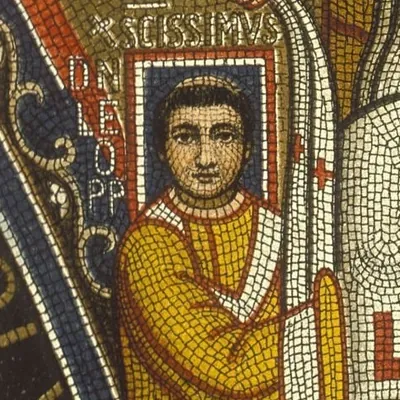
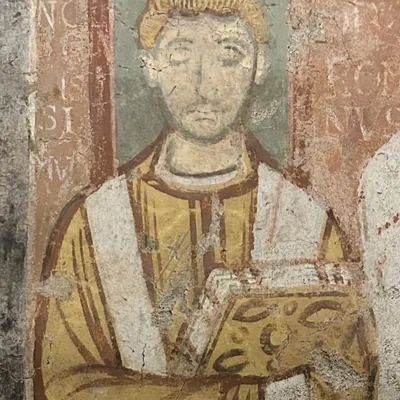
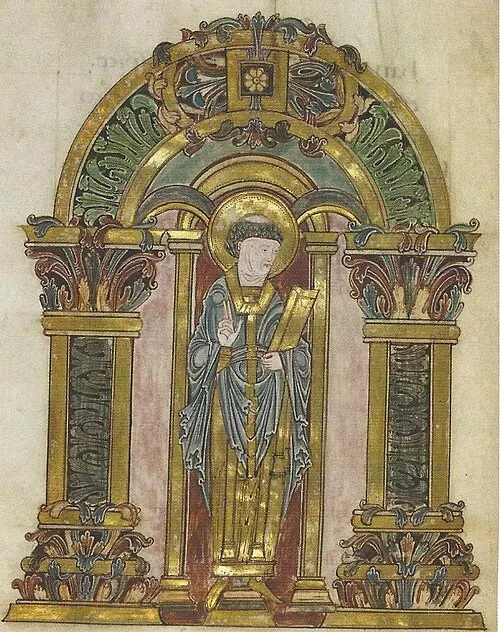
Swithun is shown as a bishop, with miter and crosier, sometimes holding a book, as in the famous tenth-century Benedictional of Æthelwold. He also appears in English stained-glass windows, vested as a bishop. Nothing in his appearance is unique to him, so the inscription of his name, or a setting linked to Winchester, is usually what identifies him.
What can we learn from Saint Swithun?
Swithun is a saint of humility. Bishop of a royal capital, he wished to lie where people would pass by without noticing him. God made him known after his death, and the people adopted him. We can pray to him for bishops and pastors, for farmers who depend on the weather, and for all who have lost something precious, however small.
To pray with him, see the prayer to Saint Swithun and the novena to Saint Swithun.
Where to pray to Saint Swithun
- Winchester Cathedral (Hampshire, England): the memorial on the site of his former shrine.
- Winchester: the Catholic church of Saint Peter and the parishes dedicated to him in the area.
- Stavanger Cathedral (Norway): the medieval cathedral, formerly placed under his patronage.
Discover also
- Saint Æthelwold of Winchester, who moved his relics into the cathedral in 971.
- Saint Dunstan, leader of the English monastic reform.
- Saint Alphege, bishop of Winchester and then archbishop of Canterbury.
- Saint Medard, another saint linked to rain sayings.
- Saint Edmund the Martyr, an Anglo-Saxon king of the same period.