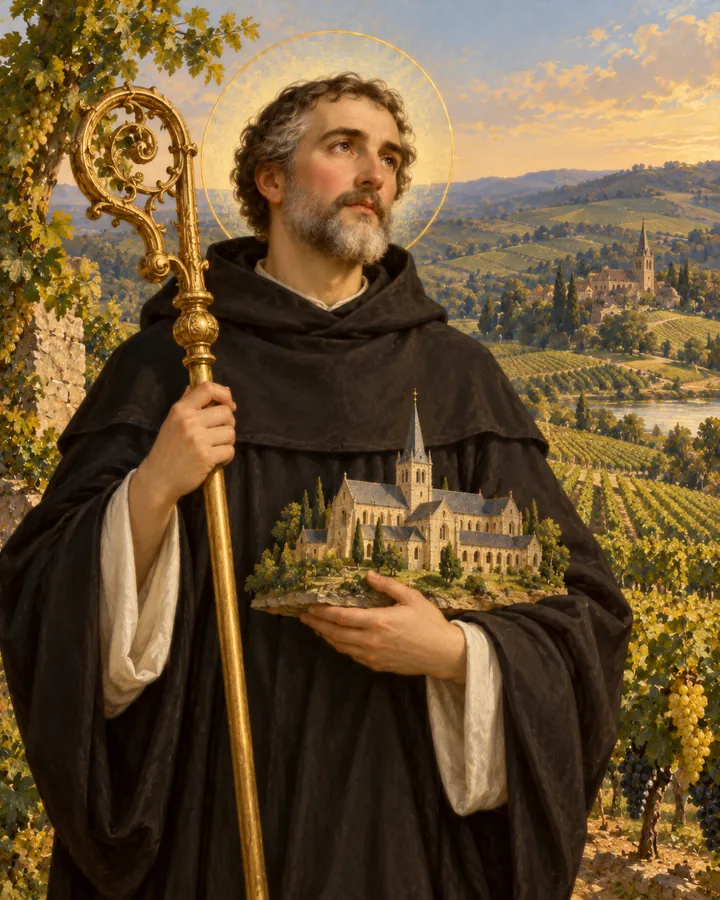
Saint Bercharius (Berchaire or Bercaire in French) was a 7th-century monk and abbot. Born around 620 in Aquitaine into a noble family, trained at Reims and Luxeuil, he founded the abbey of Hautvillers, near Épernay, and then that of Montier-en-Der, in Champagne, of which he was the first abbot. He died in 696, stabbed by a monk he had punished, after forgiving him. Listed in the Roman Martyrology on March 26, he is celebrated on October 16.
Who was Saint Bercharius?
Bercharius belongs to the great generation of monastic founders who, in the 7th century, covered Frankish Gaul with abbeys, under the influence of Saint Columban and the Rule of Saint Benedict. His life is known to us through a Life written around 980 by Adso, abbot of Montier-en-Der, based on documents kept in the abbey and on local traditions. This text was written nearly three centuries after his death, but it rests on a living monastic memory. The dates it allows us to establish vary somewhat among historians, especially for the founding of Montier-en-Der. The essentials are certain: Bercharius was a builder of communities, a man of prayer, and an abbot who died forgiving.

A formation between Aquitaine, Reims and Luxeuil
According to Adso, Bercharius was born into the nobility of Aquitaine. He was baptized by Nivard, who would become archbishop of Reims in 649, and entrusted to the monks of Saint-Hilaire de la Celle, where he received his first education. Around 657, Nivard, now his protector, brought him to Reims, completed his training and ordained him a priest. He then sent him to Luxeuil, the great abbey founded by Saint Columban, to follow the teaching of its monastic school. There he was given the office of cellarer, that is, the material management of the monastery: a school of concrete service that would serve him all his life.
Founder of Hautvillers and Montier-en-Der
Back in Reims around 658, Bercharius received from Nivard the mission of establishing a monastery on an estate of the Church of Reims: this became the abbey of Saint-Pierre at Hautvillers, on the slopes of the Marne, which followed both the Rule of Saint Benedict and that of Saint Columban. He then founded, at the meeting point of Neustria, Austrasia and Burgundy, a monastery for women at Puellemontier, and then a monastery for men on the banks of the Laines, in the forest of Der. On the recommendation of Saint Leger, bishop of Autun, he received for this purpose a former Merovingian royal estate. He gave his foundation the property he had inherited from his parents and became its first abbot in 673.
Tradition reports that the first inhabitants of the place were eight men and eight women prisoners whom Bercharius had ransomed. Montier-en-Der and Puellemontier, a few kilometers apart, formed a double abbey during his lifetime. Bercharius entrusted the women’s monastery to abbesses, and the Life tells that he announced his own death to the nuns. He also fulfilled an old vow: a pilgrimage to Jerusalem, from which he brought back many relics for his foundations. The treasury of Montier-en-Der long kept, among the precious objects he had given it, a famous ancient ivory diptych, the diptych of the Nicomachi and the Symmachi.
A death in forgiveness
In 696, a monk named Daguin, who was also his godson, felt that he had been unjustly punished or humiliated by his abbot. To take revenge, he came and stabbed him with a knife while he slept. Bercharius lay dying for two days. Before he died, on March 26, he forgave his attacker. It is this trait, even more than his foundations, that marked the memory of the monks: like Christ, the abbot wounded by one of his own answered violence with forgiveness.
Cult and memory
The body of Bercharius was kept at Montier-en-Der until the suppression of religious orders in the 1790s. In 1023, his relics were carried to the council of Héry, in Burgundy, to add solemnity to the assembly. The Roman Martyrology commemorates him on March 26, the day of his death. Since 1969, the Church has celebrated him on October 16: this date recalls the return of the monks to Der on October 16, 925, after they had taken refuge in Burgundy from the Norman invasions. The abbey church of Montier-en-Der, consecrated in 998, is today the parish church of the town.

What can we learn from Saint Bercharius?
Bercharius spent his life founding places where people pray. He knew how to receive, from Nivard, from Luxeuil, from Saint Leger, and then how to give: his property, his time, his relics, and even his forgiveness. His tragic death reminds us that Christian communities are not sheltered from wounds, but that the last word can belong to mercy. We can pray to him for superiors and leaders of communities, for those who have been hurt by someone close to them, and for the grace to forgive.
Where to pray to Saint Bercharius
- Montier-en-Der (Haute-Marne): the abbey church of Saint-Pierre-et-Saint-Paul, church of the monastery he founded, where his body rested until the Revolution.
- Hautvillers (Marne): the church of the former abbey of Saint-Pierre, his first foundation.
- Puellemontier (Haute-Marne): the site of the women’s monastery he established near Der.
Discover also
- Saint Columban, founder of Luxeuil, where Bercharius was trained.
- Saint Benedict of Nursia, whose Rule was followed in his monasteries.
- Saint Leger of Autun, the bishop who supported the founding of Montier-en-Der.
- Saint Remigius of Reims, great bishop of the Church of Reims, where Bercharius was ordained a priest.